By DCist Contributor Johanna Mendelson Forman
The Columbia Heights Metro station is a veritable culinary gateway to the foods of the Central American diaspora. In a stretch of just over a mile on 14th Street, starting at W Street NW and going north to Quincy Street NW, there are no fewer than fifteen restaurants and comedores, small dining spots whose menus reflect the street foods of El Salvador and Guatemala.
In addition to the brick-and-mortar pupuserias and bakeries that line the blocks, cooks dish out homemade meals in a parking lot that doubles as an outdoor cafeteria. For most of the year, you can find stands brimming with bagged mango and papaya, vendors selling hot corn on a stick (elote), or any number of other street foods. Residents know summer has arrived when the mobile cart with raspados (snow cones) comes out. To walk along this section of 14th Street with a goal of sampling pupusas, baked goods, and other specialties from these family-run businesses is to understand how enduring the foodways of Central America are in our city.
More than a million Salvadorans fled the country, mainly to the United States, from a brutal civil war that began in 1979; the exodus represented more than one-fifth of the country’s prewar population of 4.8 million. Guatemala was also in the throes of an even longer conflict, which started in 1960 and saw 200,000 civilians killed or “disappeared.” From 1967 to 1980, nearly 109,000 Guatemalans immigrated to the U.S., due largely to the conflict and a devastating earthquake in 1976. When the wars ended, in 1992 for El Salvador and 1996 for Guatemala, the Washington area already had a thriving community from both countries.
Today’s eateries on 14th Street boast older places like Judy’s (2212 14th Street NW), a more established sit-down restaurant with great pupusas, tacos de lengua (tongue), a wide selection of rums and tequilas, horchata (a drink made with rice milk), and Salvadoran seafood soup, a creamy concoction that rivals the best bouillabaisse. Closer to the Metro is El Rinconcito II (1326 Park Road NW, just off 14th Street), where you can enjoy bowls of soup filled with beef, chicken, and corn; great pupusas; and sweet corn tamales.
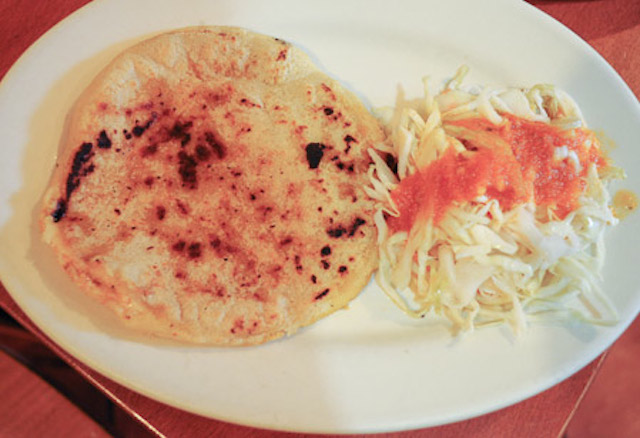
A smaller, but equally tasty, pupuseria is Gloria’s, (3411 14th Street NW), where the pupusas and the accompanying cabbage salad make a wonderful lunch whether you choose these stuffed tortillas with cheese, beans, or a combination of pork and cheese. The charming red and white café has quick service and great prices. Over the course of my tastings, no pupusa order cost more than $3.00, and was always accompanied by the requisite pickled cabbage. Panaderia Lourdes is another great find if you want to sample baked goods and breads, a staple of breakfast and evening meals.
The food is certainly delicious, but it is often the human element that makes these eateries so special. They are often managed by second generation immigrants or staffed by multigenerational family members, mainly women, who remain the guardians of culinary traditions and recipes. Even 23 years after the war ended in El Salvador (and 19 in the case of Guatemala), the vibrancy of these immigrant communities underscores how enduring food and memory remain. To travel on this part of 14th Street is to be in the center of a lively Central American culture.
Restaurant Judy, 2214 14th Street NW
El Rinconcito II, Park Road NW
Susana’s, 3801 14th Street NW
Gloria’s, 3411 14th Street NW
Taqueria Distrito Federal 3463 14th Street NW
El Atardecer, 3475 14th Street, NW
La Placita, 3503 14th Street NW
La Cabana, 3614 14th Street, NW
El Amigo, 3612 14th Street, NW
Juanita’s Restaurant, 3521 14th Street NW
Pan Lourdes Bakery and Coffee Shop, 3407 14th Street NW
Mi Casita Bakery, 3429 14th Street NW
Zometas Bakery, 3703 14th Street NW (replaces Pollomio)
Taqueria Habanero, 3710 14th Street NW
La Molienda Restaurant, 3568 14th Street NW
Johanna Mendelson Forman is a Scholar-in-Residence at American University, School of International Service, Washington, D.C. where she teaches about conflict cuisines. Conflict Cuisine is a registered trademark.