 Growing up in Rockville, Courtney Tisch heard an oral history of the Holocaust firsthand from her grandparents. Now a third-grade teacher in the Montgomery County Public Schools system, she realized that such opportunities are slipping away.
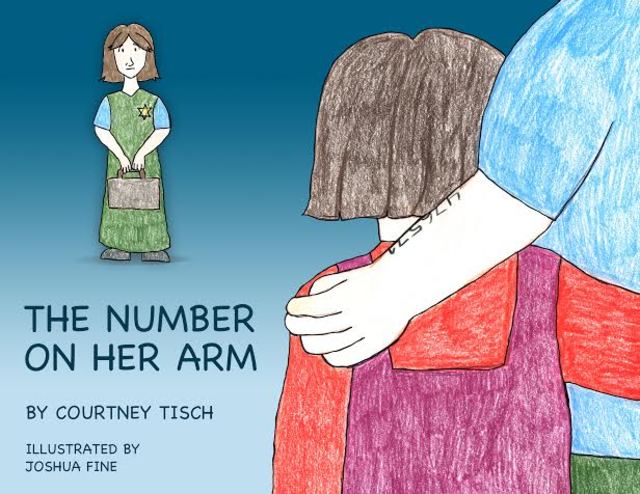
Tisch decided to take her childhood conversations with her grandmother about living in the Auschwitz concentration camp and adapt them for a children’s book. Innocent curiosity about a tattoo is the premise in The Number On Her Arm (self-published, $19), out this week. Tisch will be reading and discussing the book on Sunday, September 20th at 4 p.m. at Upshur Street Books.
DCist spoke with Tisch about how the The Number on Her Arm came to be.
This interview has been slightly edited for length.
DCist: What prompted you to write The Number on Her Arm?
Courtney Tisch: It was initially written back in 2013. I was in my final semester of graduate school for education at George Washington University and I was taking a children’s literature course […] I came up with the idea to write about my grandparents who were both Holocaust survivors, and my biggest inspirations in life. They not only survived the most horrific nightmares imaginable, but they lived without bitterness or regret and always put everybody else’s needs first.
I started to think about the first real conversations I had with them about the Holocaust when I was in elementary school, which had a profound effect on my life. I was in awe of their ability to talk about what they endured without resentment. I wanted to relate those conversations to children as a way for them to learn about the Holocaust while honoring my grandparents at the same time.
DCist: How did you figure out how to communicate something like the Holocaust to kids?
CT: Being an elementary school teacher definitely helped me in writing more simplistic language suitable for younger aged children. I knew I didn’t want the book to be a graphic portrayal of the Holocaust, I wanted it to be more of an introduction and conversation-starter. I also focused on my grandmother’s positive attitude about her survival. I wanted to portray the message that people can overcome the most horrifying struggles in life and come out the other side, stronger than before.
DCist: How were you able to do that, and tell the story without blame or anger? Did you change anything from what your grandparents told you?
CT: It was surprisingly easy [because] when my grandparents talked to me about their experiences during the Holocaust, they did not necessarily sugarcoat the facts, but they explained them without bitterness. […] Since I wanted The Number on Her Arm to be appropriate for younger age groups, I left out harsh or graphic details. In the book, I chose to have my grandmother recount her experiences factually, leaving room for her to patiently answer her granddaughter’s questions.
DCist: When do you think kids should read a book like this, or learn about this subject? What age group would you recommend the book to?
CT: I think the Holocaust can be introduced to children by the time they are in fourth grade as long as it’s presented in a delicate manner. The Number on Her Arm would be a great book to use as an introduction to the Holocaust and I think it would be most appropriate for students in fourth through sixth grades.
DCist: What was the hardest part about the writing process for the book?
CT: The editing process. The story flowed out of me very quickly, but after I completed my first draft I knew that certain chunks needed to be taken out or certain details needed to be included to make the characters and story richer.
DCist: What was the best part of writing it?
CT: Being able to channel my grandparents, and to portray my grandmother [one of the lead characters in the book] as the positive person that she was. It was fulfilling to know that I was doing something to honor them and everything they went through.
DCist: What has been the reaction from kids so far? Have you been surprised by it?
CT: I think that I have been most surprised by the mix of kids who know about the Holocaust and those that do not. It seems that schools and synagogues all introduce students to the Holocaust at different times, so I have to be very careful not to assume that every child has already learned about it. In readings, I always ask some quick questions to gauge who in the room has learned about the Holocaust before I start.
I’ve also been surprised by the wonderful attention to details children have had in terms of the book’s illustrations. I was lucky to have my talented friend Joshua Fine draw the illustrations, and there are some small details, which I won’t spoil, that kids always seem to point out during readings.
DCist: Are there any more children’s books on your horizon?
CT: Right now I’m mainly focused on marketing and programming for The Number on Her Arm, but I’m extremely connected to the idea of writing more children’s books that discuss issues with intolerance. There are so many terrifying acts of intolerance still happening in the world today, so I’m committed to the idea of delicately broaching difficult topics in a way that children can read and learn about.
The Number on Her Arm is now available to order. Find out more about the free event at Upshur Street Books here.