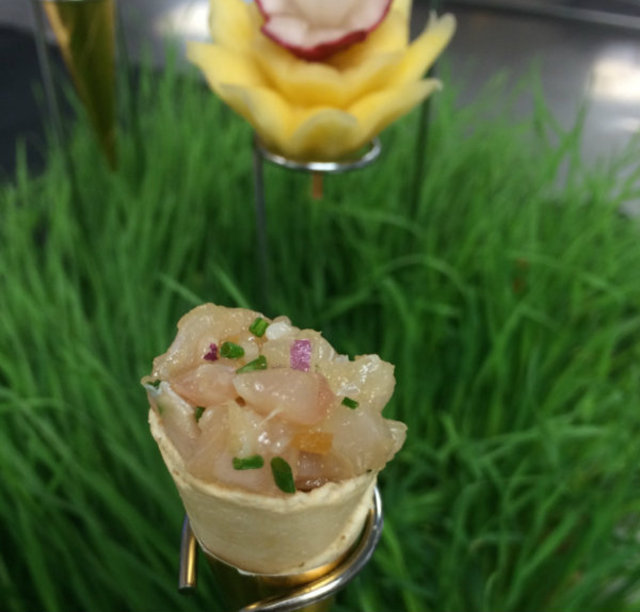
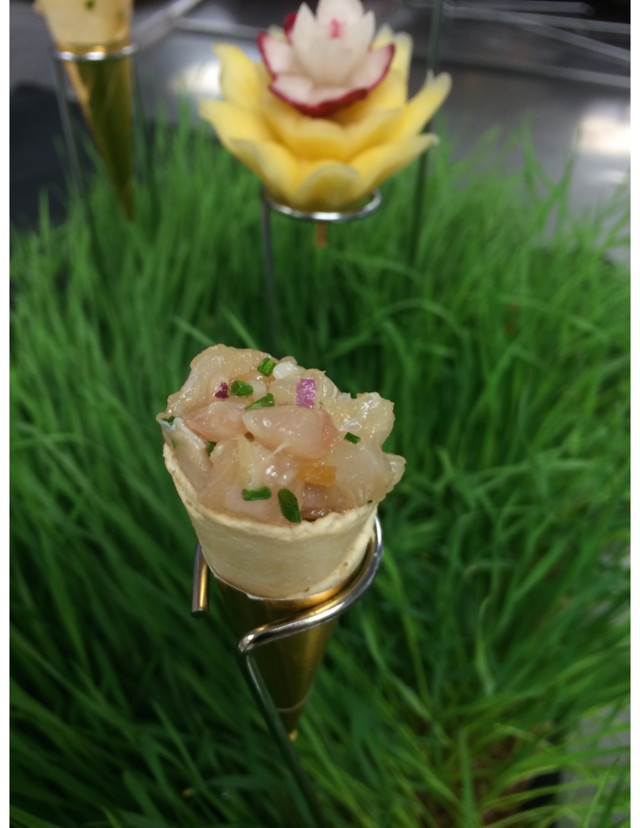
 Xavier Deshayes, executive chef for the Ronald Reagan Building, uses invasive lionhead fish in appetizers like the Buddha’s Hand Scented Lionfish Tartare Cone. (Photo courtesy of the Ronald Reagan Building.)
Each month The Federal Forager explores some of the perks, puzzles, and pitfalls of eating and living more organically, locally, sustainably, and creatively in the D.C. region.
By DCist Contributor Bridget Dicosmo
Keep your friends close and your enemies…delicious? As ancient military strategies go, that might sound a little off, but it is an approach that a number of D.C. chefs are using to help curb invasive species. Designing tasty meals around specimens like the blue catfish and northern snakehead are one way local chefs are developing a market for the pesky critters.
The term “invasive species,” defined in a 1999 executive order, refers to a non-native species whose introduction is likely to cause economic, environmental, or human health harms to a specific ecosystem, according to the National Invasive Species Information Center. Sometimes they threaten an ecosystem’s inhabitants by eating them; other times they pursue subtle tactics, including competition for food and habitat and spreading disease.
Educating the American public on invasive species is one of the best things chefs can do to help out local ecosystems, says Steve Vilnit, former director of fisheries marketing at Maryland Department of Natural Resources, now with the seafood company, JJ McDonnell & Co. Inc. “We need to get these invasive species in front of them and help them to understand that these are delicious options that need to be removed from the environment,” Vilnit says.
By evening the odds a little, such a strategy helps safeguard embattled Cheseapeake Bay aquatic species currently getting crowded out by invaders. Boosting demand for the intruders creates more incentive for fishermen to pursue these types of fish. And while “invasive” may not be the most appetizing culinary qualifier to describe an entrée, some of these interlopers can be quite delicious.
“Using an overpopulated, invasive species, like the Chesapeake Wild Blue Catfish, protects the Chesapeake Bay ecosystem and the native fish species,” says Xavier Deshayes, executive chef for the Ronald Reagan Building. Using blue catfish not only helps out the Bay and its tributaries by thinning the catfish herd, but the fish is locally-sourced, “relatively inexpensive and has great flavor,” making it a good choice for the building’s large-scale catering service.
In the case of the blue catfish, these guys make up to 75 percent of total “fish biomass” in the tidal James and Rappahannock Rivers, according to recent data collection from the National Oceanic and Atmospheric Administration’s Chesapeake Bay Office.
The blue catfish hails from the Mississippi, Missouri, and Ohio River Basins, and the adult fish have few natural predators in the Chesapeake Bay. They thrive there, and it functions “like a fancy restaurant” for them, says Dean Gold, who owns Dino’s Grotto (1914 9th St NW) in Shaw. The Bay provides the catfish, with all the blue crabs, shad, and river herring they can eat.
“The good thing about blue cat is they’re delicious,” Gold says. Gold’s favorite way to serve up blue catfish is what he refers to as Italian-style cod: lightly battered and served with anchovy sauce.
And MJ Gimbar, fishmonger for Black Restaurant Group, calls blue catfish “one of the best eating catfish available,” given that they don’t have the “muddy” flavor associated with some catfish species. The group carries blue catfish full-time at Pearl Dive, Black’s Bar and Kitchen, Republic, Black Market Bistro, and BlackSalt Fish Market. “Replacing heavily used species with blue catfish on menus can help protect other species while introducing a possibly ‘new’ dining experience to guests, utilizing a healthy resource and untapped flavor profiles,” Gimbar says.
The group has also offered snakehead at some locations and BlackSalt has carried sea squirt and lionfish, another invasive species that has been making a menace of itself in the southeastern United States and the Caribbean. “As we look to the future we are always searching for ways we can utilize invasive plant and animal species as long as they make sense on the plate,” Gimbar says.
Deshayes has also made good use of the lionfish. In 2011, he traveled to Bermuda to catch and bring lionfish back to D.C. for a sustainable dinner series hosted with the National Aquarium, and still incorporates the fish into appetizers when its available, such as the Buddha’s Hand Scented Lionfish Tartare Cone.
If you’re looking for suggestions on ways to use invasive species, both flora and fauna, in your home cooking, some great suggestions live here. And Union Market fishmonger The District Fishwife (1309 5th St NE) is a good source for home cooks wanting to purchase local invasive fish.
But chefs looking to offer invasive entrees on their menu and diners interested in voting with their forks face some challenges. Lionfish and snakehead are both non-schooling fish that have to be caught one-by-one, which limits volume. And for the blue catfish, “which has tens of thousands per week being landed, the supply cannot keep up with the demand,” given that many of the fisheries are still working out where and how to catch, Vilnit says.
Some states bar commercial sales of sportfish, like blue catfish, for example. “The regulatory world is still getting used to invasive species,” Gold says.
In the meantime, D.C. chefs are working hard to familiarize their patrons with invasive species. Thip Khao (3462 14th St NW) is now offering an invasive species menu featuring blue catfish and snakeheads, which are both prevalent in Southeast Asian cuisine. I tried the Paa Kaw Tod last week: a delicately fried filet with a fresh salad of mango, avocado, ginger leaves, spicy fish sauce, and cashews. Thip Khao actually ran out of snakehead that night, but made the dish for me with blue catfish instead.
“We always describe it as tasty, yet invasive,” Gold says of the blue catfish. “Let’s eat this fish right out of the bay—that’s right there on the menu.”