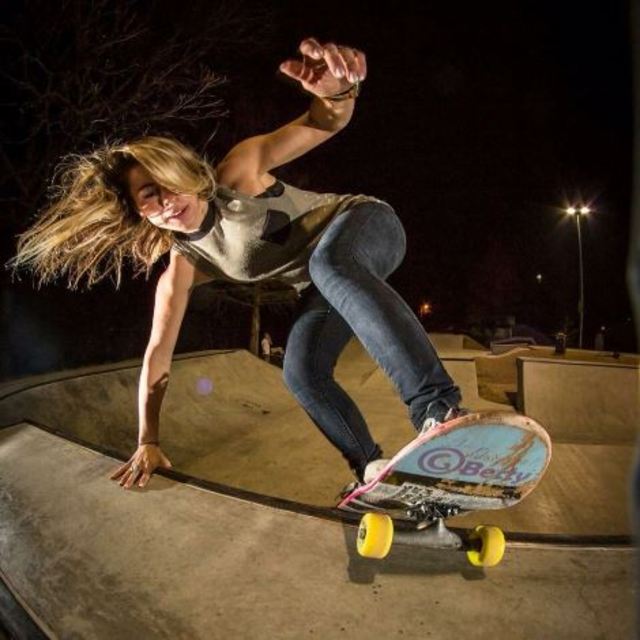
 Natalie Krishna Das, one of the skaters participating in Finding A Line, a festival running from September 4-13 at the Kennedy Center. Photo by Tate Nations.
Three years have passed since Jason Moran was named the Kennedy Center‘s Artistic Director for Jazz. DCist interviewed him shortly before the start to his first season in his post, and even at that time he stated that he wanted to use the venue itself as a player in future events.
“I want to continue to tease out the areas of space that can become much more intimate or much more grand,” Moran said back in 2012.
While many festivals at the Kennedy Center use its cavernous expanses for art installations and the like, the spaciousness and layout have never become an active participant in the goings-on.
That changes with Finding A Line: Skateboarding, Music, and Media, an event running from tomorrow through September 13. The program features live music, open skate sessions—the Center’s scenic plaza is turning into a skate park—visual art installations, and panel discussions.
“We’re very conscious of what communities are allowed inside the space,” said Moran during a recent interview with DCist, speaking about the Kennedy Center bringing skate culture into a venue that is usually associated with “high art.”
“It’s our job to pay attention to how communities are involved in the arts and what kind of communities we can involve in the arts,” Moran went on to say. “We want to build an open door for how arts are received in America.”
Prior to becoming a celebrated jazz pianist, Moran himself was a skater while growing up in Houston. His path took him down the music route, separating him somewhat from the skating community. To re-establish the connection for Finding A Line, Moran and the Kennedy Center tapped Ben Ashworth to co-curate the festival.
Ashworth lives his life at the intersection of skater culture and the visual arts scene. He was among the designers of the Kennedy Center’s skate park, which organizers are trying to eventually donate to an indoor creative recreation space where the bowl will be free and accessible to D.C.’s skate and art communities. He was a founder of the defunct Fight Club DC and was a driving force behind the design and construction of the skate park at the Langdon Park Community Center. As an artist, Ashworth is a core member of the Workingman Collective, serves as George Mason University’s Sculpture Studio Manager, and is completing an MFA at GMU’s School of Art.
“In skate jargon, we are having skate jams where the process informs the overall morphing project and festival,” Ashworth said in an e-mail interview with DCist. “In art jargon we are exploring the aesthetic parallels of skateboarding and jazz.”
While many of the open skate sessions will have musical accompaniment (15 bands and DJs are on the schedule), the marquis collaboration takes place on September 11 and 12, where twenty world class skaters will perform to music from Moran’s Bandwagon, his telepathic trio that includes drummer Jamire Williams and D.C.’s own bass master, Tarus Mateen.
The connection between jazz and skateboarding may not be to obvious to most of us, but both Ashworth and Moran see things differently.
“Skateboarders have a tactile awareness of the world around them,” Ashworth said. “We exist in time and space differently than the rest of the world.”
The way skaters navigate is similar to the way jazz musicians listen, according to Moran. A skater can use an obstacle or a jazzer can use a tricky harmonic turnaround to create something magnificent. Skating and jazz are also forms that exist out of the mainstream. Most people don’t pay much attention to either, but when they see a skater pull off a nasty trick or a skilled live jazz performance, the result can be uplifting and inspiring.
As Moran put it, “Skateboarders and improvisors are both saying, ‘I’m going try something 15 times and I won’t land it 14 times, but when I land it, people are going to lose their shit.”
Other musical acts include See-I, Darren Harper’s Dynasty Band, Javier Starks and DJs such as Provoke and Baby Alcatraz. There will also be exhibitions of skate decks designed by international artists, a showing of photographer Neftalie Williams‘ work of skaters around the world and a screening and panel discussion of iconic skate videos.
Finding A Line is truly something different for the Kennedy Center and builds on last year’s hip-hop festival in bringing street art into the venue. Programming like this helps bridge “Washington” with “D.C.” in a positive and creative way.
“When it comes to performing arts centers, we think of it as one way: the audience comes, listens, then leaves,” explained Moran. “There’s many other intersections for the arts other than just sitting in the audience. I want to expose that.”
Finding A Line: Skateboarding, Music, and Media runs from September 4-13 at the Kennedy Center. Visit the festival web site for full scheduling and ticket information.