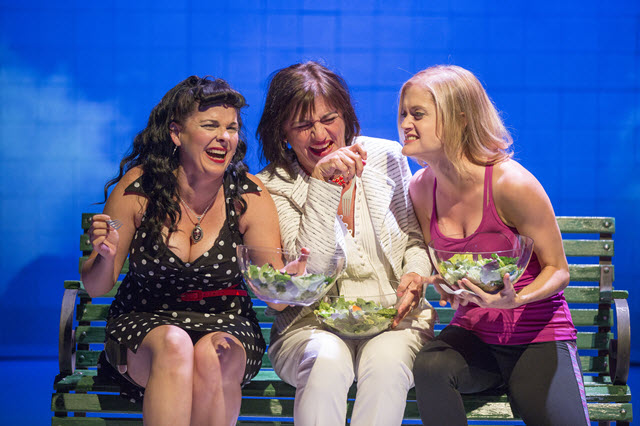
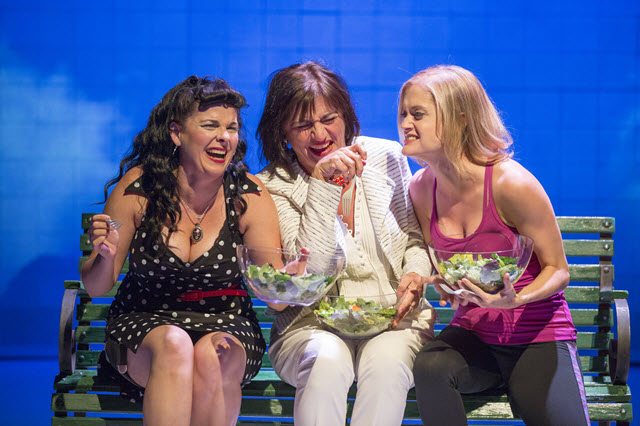
 Kimberly Gilbert, Janet Ulrich Brooks, and Meghan Reardon, laughing together, with salad. Photo: Scott Suchman
By DCist Contributor Abby Evans
Women Laughing Alone with Salad opens tonight in all its leafy glory at Woolly Mammoth as part of the Women’s Voices Theater Festival, a D.C.-based festival with dozens of local theaters producing new plays by women.
Salad tackles two pop culture memes that originated on The Hairpin in 2011 and went viral from there. The titular phenomenon is a collection of stock photos of solo women joyously laughing while eating salad; the other is a trove of stock women appearing to struggle with the task of drinking from water bottles.
The show grew out of three monologues that playwright Sheila Callaghan, the writer/producer of the Showtime dark dramedy Shameless, wrote for female actors in the University of Maryland-Baltimore College’s theater program. She began the project by considering what the inner lives of these stock photo women might be, and how they felt about being objectified. As she developed the plot, she felt the three women (here portrayed by Kimberly Gilbert, Janet Ulrich Brooks, and Meghan Reardon) alone weren’t enough to get to the heart of the subject, and so a fourth character was added, aptly named Guy (Thomas Keegan), who became the protagonist. Guy embarks on a male journey “to figure out his place in a world where women hate themselves and what his responsibility is” Callaghan says, “and whether he wants that responsibility and wants to fight his societal conditioning.”
Callaghan explains that the women of the play act as symbols on a theoretical level. “They’re an impossible ideal and construct. These women can’t exist in reality.” Unlike more conventional plays, none of the characters have a backstory. The play as a whole dangles on the edge of reality, dipping into something more post-modern and hyper-real.
Take, for instance, a meta-moment in which Reardon performs the entirety of Kanye West’s Power. Or a scene in which tons of lettuce—each leaf crafted by hand by the props department—falls from the sky. Or one scene where the three women in the play have slightly overlapping lines, which grow steadily more absurd, into something still recognizable, but more performative, more operatic. It’s not just for theatrics; “there is character work in there” explains Callaghan,“we needed to make sure that wasn’t getting lost.”
Woolly company member Kimberly Gilbert plays Meredith, a woman that armors herself with a larger than life “bombshell/rockabilly/Bettie Page” exterior. Gilbert notes that “Meredith isn’t the ideal body type for our culture—and she knows it. But she’s cultivated this old school sensuality and boldness to protect herself from society.” Preparing for the role, for which she says she gained about fifteen pounds, was a deeply personal process: “It has been a challenge for myself and my body. It is a great learning experience, but also it is emotionally draining at the end of the day, because I’m dealing with everyday human issues in a public way—on stage and in the open…there is no escaping the issues [the play] brings up like you can in everyday life. There are lots of moments where we are really out there. We are like an overexposed picture. Our bodies, our hearts, our minds are overexposed. It’s exhilarating, but by the end of it you are exhausted.”
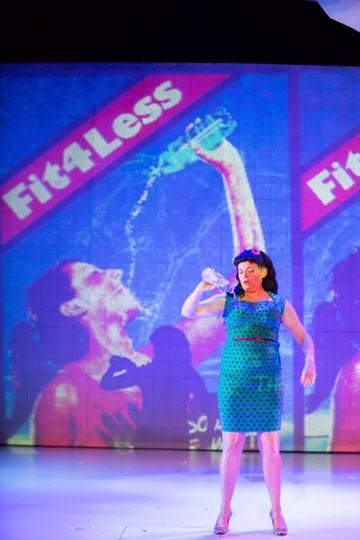 Kimberly Gilbert, with a drinking problem. Photo: Scott Suchman
What Gilbert intuits from the show is the illumination of the fact that we as humans don’t seem to act with free will. She says, “We don’t know what came first: the chicken or the egg. We don’t know if it was misogyny that started the salad trend/memes or advertising (in general), or if it was women’s innate insecurity. We don’t really know the culprit of this trend and of body image issues in culture because it has been going on for so many centuries. Gilbert wrestles with the fact that we might be eating more salad because of these advertising images and that, she says, “is wonderfully disturbing to me.” She continues, “what are our daily choices really? Are they animalistic desires or are they all choices influenced by the thing, by the image … by the man? [For instance,] why did I stop drinking [whole] milk and start drinking skim and then stop drinking almond milk?”
She continues, “I can’t speak for Sheila or anyone else but I don’t believe Sheila is trying to place judgement on any one thing. I think this play speaks to the culpability of a lot of people: and how women treat other women and how we judge women and how we want to be seen by men and how men see us. We are all in our own ways culpable.”
Salad is decidedly feminist and political. It is a play that Callaghan hopes will leave the audience with a good deal of questions to ponder; not feeling as if they just had a night of lighthearted entertainment, nor leaving overwhelmed by hopelessness. Callaghan explains, “I want people to not feel shame for the things we want [after they leave the play]”. She says she struggled with how to end it. “I want the audience to feel empowered by the questions the play raises.”
Gilbert sums up her takeaway from the show: “I know it sounds fucking hippie, but the solution is to find some inner peace, whatever that is whether it is spin class or downing a pint of ice cream. And with that, knowing that what you are doing for yourself is making you a whole, fuller human being that is capable of thought that is not influenced by ‘the man’ or advertising. Hopefully after you see the play, you go out and get a beer and a hotdog and indulge in beautiful-tasting, good things.”
Women Laughing Alone with Salad opens tonight, and runs at the Woolly Mammoth through October 4th. Tickets, $35+, are available online