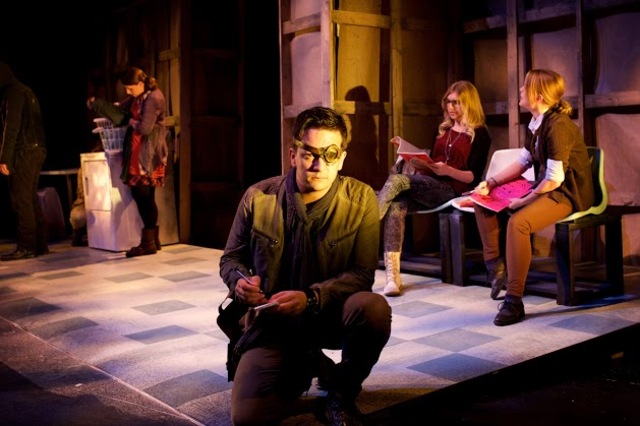
 Daniel Corey as a nearly-blind photographer in the “Objects in the Night Sky” segment of Truth & Beauty Bombs. Photo: Ryan Maxwell Photography
By DCist Contributor Missy Frederick
It takes a deft hand to transform a collection of three-panel aphorisms into something resembling a cohesive story. Rorschach Theatre’s attempt to do so in Truth & Beauty Bombs: A Softer World can be messy and sometimes predictable, but it is affecting and even beautiful.
Consider the unlikely source material. For the uninitiated, “A Softer World” was Joey Comeau and Emily Horne’s long-running webcomic of typewriter text imposed over photos, offering darkly funny, philosophical observations, often with a third panel punchline (after a 12 year run, they ended it in June.) An example, and one that plays a key role in Rorschach’s play: “There are people who believe a photo captures your soul. / For them this is a terrible thing. / For me it’s one last chance.” The impact is like a darker, more melancholy and profound version of Jack Handy’s “Deep Thoughts” from Saturday Night Live. It’s not the most obvious or most forgiving of source materials—imagine, say, if someone had decided to transform a group of particularly funny tweets into a play—but Rorschach pulls it off, with five different authors (Randy Baker, Norman Allen, Heather McDonald, Shawn Northrip and Alexandra Petri) weaving together five different plotlines into one post-apocalyptic world.
Those plotlines, in brief: Two bank robbers form an unlikely love story. A pair of friends find adventure and escape by journeying between…laundry machines? A nearly-blind photographer helps a woman struggling with her past. A young woman braves the end of the world with a man she considered to be her stalker. And three individuals filled with regrets discover how much they have in common (of all the stories, this one comes together a little too neatly). Lines from the comic are peppered throughout these tales, usually successfully, though sometimes the delivery can seem clunky and forced. Those unfamiliar with the comic won’t always recognize when it’s being put to use, though Rorschach is smart to display several of the key panels as artwork in the lobby, prepping the audience for the lines they’re going to hear later.
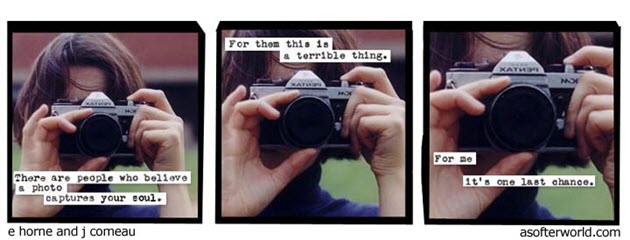 An example of the comic via
Director Jenny McConnell Frederick has assembled an emotive group of performers to inhabit A Softer World’s moody world. Daniel Corey is striking as the suffering photographer, Evgen; Tori Boutin has a sunny and quirky presence as the laundry machine-hopping Hope; Grady Weatherford most naturally brings out the play’s humor as one of the bank robbers. It wouldn’t be a Rorschach production without a gutsy set design—that said, this one is one of the company’s more subtle stagings, though it has a few tricks to it (the audience section is arranged in the last area you’d think, for instance, and in one scene, a bomb goes off with dramatic consequences).
Like many works juggling multiple narratives, Truth & Beauty Bombs takes longer to wrap up than it should. But once it’s finished, the audience will leave feeling like it saw something fresh, aspiring and original—even if it took awhile to get there.
Truth & Beauty Bombs: A Softer World runs through October 4 at the Atlas Performing Arts Center. Tickets ($30 general) are available online.