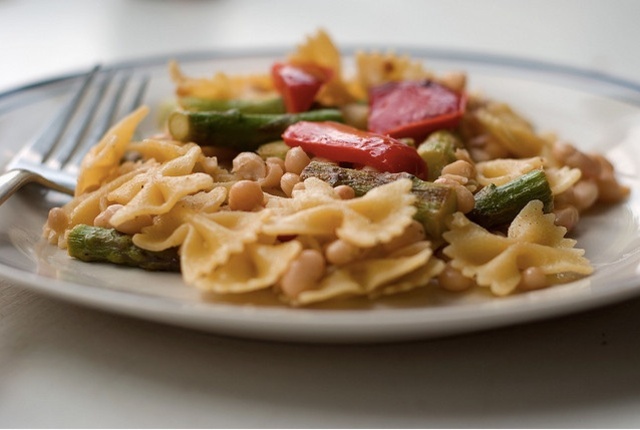
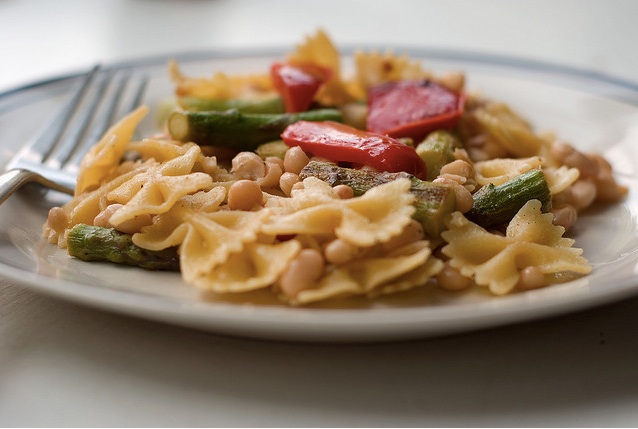
 Photo by Eric Spiegel.
D.C. is an expensive place to live, and feeding yourself is no exception. Follow Capital Cheapskate each month for a look at the cost side of the ledger, and for tips to enjoy the city’s burgeoning dining scene without breaking the bank.
By DCist Contributor Victoria Finkle
It’s no secret that dining out can put a dent in your wallet—but increasingly it seems like a trip to the grocery store can also stretch your savings.
Perhaps that’s why an innovative cookbook, Good and Cheap: Eat Well on $4 a Day, has proven to be an overnight success. The book is filled with simple, tasty recipes designed for those on very tight budgets, including families on food stamps.
Leanne Brown was a food studies major at New York University when she created the book for her masters’ thesis to help poor families eat better. But just a few weeks after she put a free PDF of the cookbook on her website in the spring of 2014, it ended up on Reddit, where the recipes spread faster than a grease fire. From there, the project has spurred a massively popular Kickstarter campaign, a partnership with a publisher, and a nationwide tour.
In the book, Brown lays out recipes and strategies for using your dining dollars wisely. She includes straightforward and easy-to-follow recipes for staples like roasted chicken and vegetable quiche, as well as fun, accessible ideas such as “things on toast.” (Think avocado toast or caramelized onions and cheddar on toast, for example.) She also covers soups, salads, and desserts, as well as tips for shopping smart on things like pantry staples and spices. Each recipe has a cost estimate for the total batch and per serving.
The first edition is still available as a free PDF on her website (it’s been downloaded more than 800,000 times). Print copies of the book follow the buy one, give one model—for every book purchased, Brown donates a copy to a nonprofit that works with low-income families. More than 54,000 books have been given free or at heavily discounted rates to organizations across the country, including half a dozen D.C.-based organizations. (Full disclosure: I received a print copy for this story.)
For more on her project, check out Brown’s talk at Upshur Street Books (827 Upshur St NW) on Tuesday, Oct. 6 at 7 p.m.
In the meantime, I caught up with the author by phone earlier this month to talk cooking and food policy. Below is a taste from our chat, condensed and lightly edited for clarity:
Are you surprised by the huge reaction to your book—both from people who are having or have had a hard time putting food on the table and also folks who just can’t believe their grocery bills are so high every week?
Yes, it seems to appeal to everybody—which is this wonderful, joyful thing to me, but has been sort of astonishing. Part of that is that it tells a simple truth: good food doesn’t have anything to do with price. It has everything to do with what you put into it, the effort you put into it. Good food is just about knowing how to cook it, knowing how to put things together properly. And I think that’s something we’ve gotten away from a bit. There are a lot of myths that are really perpetuated—the idea that healthy food is super expensive or that cooking is hard.
That’s the one that really gets me. Cooking is one of the easiest things on earth to do really quite well. Yes, there are people who elevate it to a level of total art— I’m not talking about that. I’m talking about putting some garlic in a pan with a little bit of oil, let it just toast, add some tomatoes, boil up some spaghetti and toss those things together. That’s something anyone can do and you’re going to absolutely love it. And it’s going to be so much better than if you open up that crappy jar of pasta sauce with a giant list of gross ingredients that’s sugary and doesn’t have any flavor.
And that’s really what I was trying to introduce to people. Simple, delicious food is totally attainable for everybody, and it’s just about cooking.
What do you recommend to people in terms of building a habit of cooking, especially for folks who don’t have a lot of practice in the kitchen or are short on time?
One thing that I really hear a lot of is fear, really being scared about cooking. Being nervous about messing it up and what the results will be. I hope that the book can really take some of that fear out of it and give people some confidence to know that it’s actually all very simple. And even if you mess up quite badly, things are usually still edible.
Basic whole ingredients taste good naturally. What makes things more complicated is we’re usually working with a bunch of junk. Our society has an issue with pleasure, and I think we sometimes forget that food and healthy food should still taste really great or we’re not going to eat it.
Yes, ok, brown rice with no salt or no added garlic or no spices—that’s not going to be that great. But give yourself a chance. Cook it with tomatoes and some garlic and maybe get some hot sauce. There are so many small, simple ways to make your food have more flavoring. Getting into the kitchen and starting to learn a few of those tricks can be transformative.
What items are people better off making at home that they probably buy at the store? And what about vice versa, are there things best bought at the store to save some time and effort?
Honestly, things like pizza dough are good. All you have to do is put the dough together in the evening, slap it into the fridge, it proofs overnight. Come home from work the next day, take it out of the fridge and let it hang out for half an hour while you get everything together and it’s good to go.
A lot of the things that we think of as taking up a lot of time, what they take up more than time is just a little bit of planning. You just have to think through the stuff that you’re doing. I know that puts a lot of people off—“I don’t want to plan”—and I get that, but it’s really just a new habit to form.
And one thing I said before: never buy pasta sauce. I mean, it’s not horribly expensive, but it’s expensive for what it is when you can get a can of tomatoes for nothing and then you’ll already have garlic because you’ll be using it for a bunch of different things. The things that make up a really great pasta sauce are things you should just always have in the house anyway, so you’ll always have a good meal in just a few moments. The time it takes to put a pasta sauce together “from scratch” is the time it takes to boil water for your pasta.
The other thing is salad dressing. That makes me crazy. That bottled salad dressing is ludicrous. The best dressing is just a vinaigrette. So you have olive oil or some type of other oil and you have lemon or lime or some sort of vinegar—things you should always have. There are a million ways to use citrus or vinegar. And then you could either do the classic with Dijon mustard or if you want to make something different, you say, I’m going to make a Caesar dressing, so I’m going to add an egg yolk into this or a little anchovy into this or a squirt of hot sauce.
Most of the time, just to get something on the table quickly, I’ll have dry pasta around. That’s obviously a pretty great product that’s wonderful to make fresh when you can, but you don’t always have the time for it.
And bread. I love baking bread and I strongly suggest that you give it a try, but it’s a great value, actually. The only thing is that it’s better to get the bakery bread that has a nice, hard crust than sandwich bread that stays fluffy forever. And then use it well. I have all kinds of recipes for using up leftover bread. My favorite is panzanella salad, which is where you take beautiful summer vegetables and maybe some fruit if you have it around and toss it with your super hard, awful, stale bread and it becomes a flavor sponge. It’s like the greatest thing on earth. Or making croutons, bread crumbs.
How do you approach eating out, given that it’s so often cheaper to eat at home?
There are certainly meals and foods that are so worth eating out for, if you have the means. I don’t usually order dishes or go to restaurants where I’m like, I can make a better version of this myself. For example, I do not like frying things at home. it’s a total pain in the butt, you have to use so much oil, it’s messy, I don’t like it. So when I go out, I’m like, I’m going to get some fried stuff.
And there are things like that where it’s special, it’s wonderful, and it’s sort of best done in a restaurant – and those are the sorts of things where it’s worth splurging if it’s important to you.
I’m curious since this project came out of the food stamp world, what do you think of the SNAP challenge? Has Gwyneth Paltrow ruined it? What else do you want to see when it comes to raising awareness around food insecurity and the limits a lot of people face on a day-to-day basis?
I’m very torn about the food stamp challenge. I think it comes from a really well meaning place, and I think it can definitely be an extremely good toe in the door for a lot of people. Where it’s troubling is sometimes it can seem like playing at being poor, which can be kind of insulting. It’s only a week. And when people don’t take it particularly seriously, it can come across as insulting. And when people get competitive about it, again, I think that can be insensitive. This is 46 million peoples’ lives. This is not a joke, this is a reality.
At the same time, I think it can be perspective shifting for some folks and certainly I think it can be an important tool. And when politicians use it, often they’re trying to make another point.
And the big point is that $4 isn’t enough I don’t want anyone to ever thing that my book is condoning that people should have to eat on $4 a day. It’s the opposite. I think it’s ridiculous. But it’s a reality and I want people to be empowered to be able to do as much with it as they possibly can.
What I would really to see like is more stories. I hear the most amazing stories from people about what they’ve gone through, about what they’re currently going through. People on food stamps are as diverse as every other part of the American population. No two stories are the same. And no one should have to feel ashamed because they had a tough time because they didn’t have money. We need to share more stories and to be more open about it.