 Joy Behar and her fellow co-hosts of The View got a clear message two weeks ago: Don’t mess with nurses. They got serious backlash after making snarky comments about a Miss America pageant contender who gave a heartfelt monologue about her job as a nurse rather than doing a dance routine with flaming pom-poms.
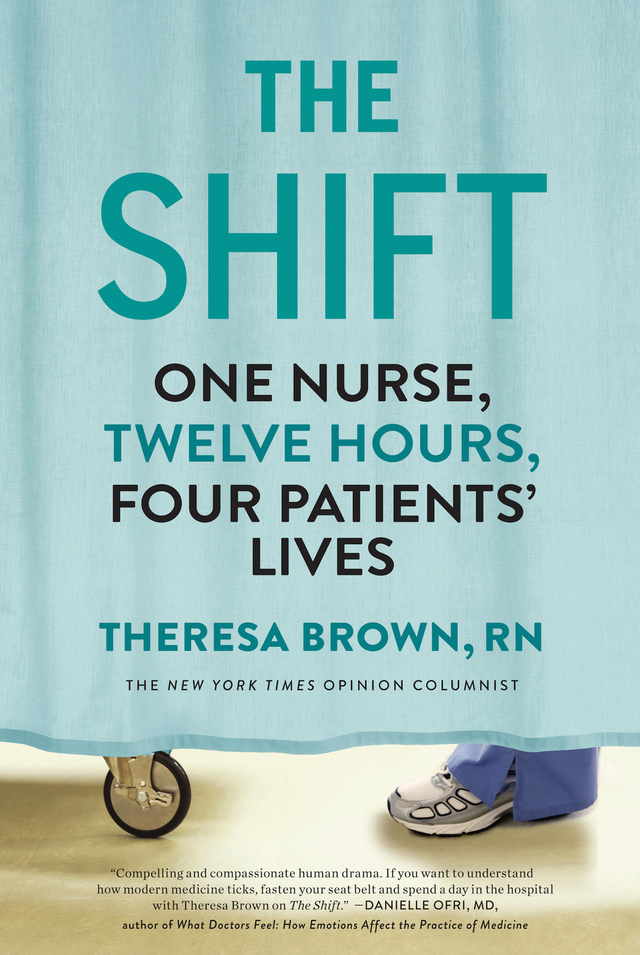
Registered nurse Theresa Brown commented on the incident in Slate, as it happened to coincide with the publication of her book The Shift: One Nurse, Twelve Hours, Four Patients’ Lives (Algonquin, $25). She’ll be discussing it at Kramerbooks on Wednesday, September 30th at 6:30 p.m.
Brown is familiar with the self-deprecating mantra repeated by Miss Colorado that she is “just a nurse.” Unlike physicians, nurses are not diagnosing illnesses or prescribing treatments. So in the eyes of patients, the public, and even themselves, they appear to be less powerful in a healthcare setting.
But The Shift explains how much truly goes into a patient’s care. It chronicles a day in Brown’s life as a nurse, and is described as a nurse’s counterpart to Atul Gawande’s books about physicians.
We meet Brown’s patients on this particular shift: Richard, who has lymphoma and is about to receive a risky drug; Sheila, who came in for a blood disorder but mysteriously has crippling stomach pain; Dorothy, who has leukemia but a sunny disposition as she hopes to be discharged soon; and a surprise fourth, Candace, who is notorious for demanding much of nurses and being a bit of a germaphobe.
As Brown oscillates between her duties and patients on a long work day, we see the saint-like temperament that is required of nurses. One must be stoic enough to manage drama with poise, but good-humored enough to alleviate spirits and hover above some of the realities of the job. Caring for patients at all hours, attending to their families, prioritizing in life-or-death situations, and getting through mounds of paperwork are all in a day’s work.
While that isn’t necessarily news in itself, nurses have a unique perspective on the functioning, or lack thereof, of our healthcare system. Other medical providers or administrators may find it illuminating to read about the common issues facing nurses and understand their approaches in caring for patients.
Overall, The Shift shows how nurses don’t only carry out a doctor’s orders, but provide their own complementary care. They are the most present and as they get to know patients closely, can end up being their biggest advocates.
In addition to being a clinical nurse, Brown is a regular contributor to the New York Times, and previously wrote 2011’s Critical Care: A New Nurse Faces Death, Life, and Everything in Between. She has a PhD in English from the University of Chicago and taught English at Tufts University before becoming a nurse and focusing on oncology and end-of-life issues. She lives with her husband and three children in Pennsylvania.
The event is free and open to the public.