 Rachel Sadon
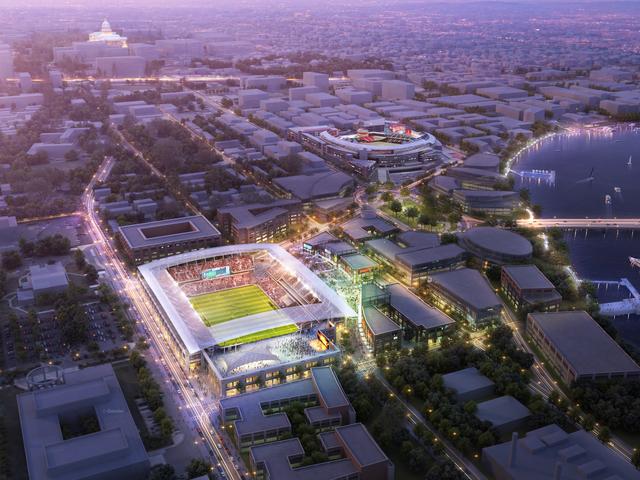 An artist’s rendering of the DC United Stadium Site. (Photo Courtesy DC United)
D.C. filed paperwork to seize land on Buzzard Point from a developer on Wednesday— the last day possible to show the city has full control of the stadium site under the terms of the deal with D.C. United.
In announcing that the District filed for eminent domain for the two acres of land owned by Akridge, Mayor Muriel Bowser said in a press release: “The District of Columbia and D.C. United are moving forward on a soccer stadium that will transform a neighborhood on the banks of the Anacostia and generate hundreds of new jobs for District residents. We have created the best deal for the District, its residents, D.C. United and its fans.”
Under the original deal, D.C. would have relinquished ownership of the Reeves Center, the municipal complex at 14th and U Streets NW, in exchange for the land that Akridge owns at the stadium site. After opposition to the deal in its original form seemed likely, Bowser re-shaped it, eliminating that particular land swap while keeping others. The D.C. Council gave final approval in December.
D.C. and Akridge are about $15 million apart in what they argue is the land’s value, the Washington Business Journal reports. The fight is likely to be much more straightforward than those that occurred over Nationals Park, according to WBJ.
While there is a gulf between them, Akridge is on record supporting a stadium at Buzzard Point. It’s purely about money, and both sides are content to let the dispute play itself out in court. A judge will decide, and D.C. will pay.
For that reason and numerous others, the eminent domain fight to come over D.C. United is nothing like the condemnation fights that played out over the Nationals Park site and Skyland Shopping Center. The latter two were more complicated, more emotional, more angst-ridden, and more costly for the District.
The most obvious difference between the three: At Buzzard Point, there is only one landowner putting up a fight, and it’s a well-financed, well-connected developer. There were roughly 30 court fights over taken land tied to Nationals Park and Skyland, and many of them involved homeowners and small business owners whose livelihood depended on the result.