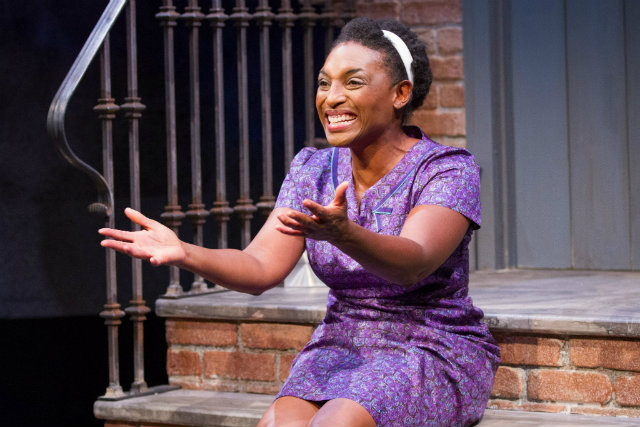
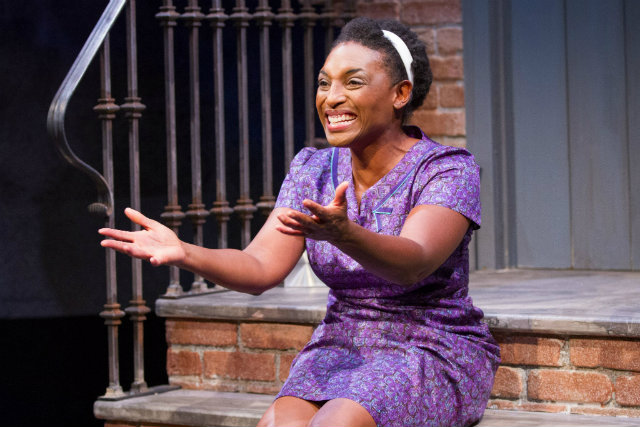
 Dawn Ursula stars in Queens Girl in the World (Photo by Teresa Wood)
By DCist contributor Rachel Kurzius
Jacqueline Marie Butler attracts know-it-all friends. There’s Persephone, the neighbor on her Queens block who teaches her where babies come from and how to dance the Boston Monkey. Brace-faced Karen, who Jacqueline meets at her progressive Greenwich Village school, is an expert in sneaking her parents’ creme de menthe. What is most amazing about Queens Girl in the World is how vividly rendered these young girls are, and how Dawn Ursula, who plays all of them, makes it impossible to confuse any one of them for another.
The play introduces the audience to the different people who populate Jacqueline’s world (and there are many) with tiny distinguishing features—a vocal cadence, a slumped posture. Ursula’s energy and commitment to each character make it easy to follow as she shifts shapes. In one nifty bit, she plays Jacqueline impersonating Persephone and it’s distinct from her portrayal of either of them.
Theater J’s first show of its new season is a world premiere from D.C. playwright Caleen Sinnette Jennings, a founding member of The Welders, and part of both the Women’s Voices Theater Festival and the 2015 Locally Grown Festival. Semi-autobiographical, Jennings’ writing takes Jacqueline’s interior seriously in a way that few works do with teenage girls. Sure, many of the travails of puberty are played for laughs (deservedly so), but Jennings honors her character. The result is an empathetic, probing, and hilarious piece of theater.
It begins in 1962, as a pre-teen Jacqueline hangs out on her stoop under the watchful eye of her mother. Her excitement as she recounts her block’s dynamics is contagious. When her parents take her out of her neighborhood junior high to become one of four black students in a Manhattan private school, she has to navigate a disjointed existence, neither black enough for her neighborhood or white enough for her classmates. She describes her subway commute as “an hour on the E train to change my walk and talk.”
“I try and explain to my friends that I’m not angry about racial injustice because I just learned about it,” Jacqueline says. But she learns fast. Jacqueline’s maturation happens alongside terrifying historic events, like the Birmingham church bombing and the assassinations of John F. Kennedy and Malcolm X. “Does it take a church blowing up for them to see me?” she wonders of her Greenwich Village classmates. Yet the political never becomes dogmatic because it’s always anchored in Jacqueline’s teen experience. At one point, she joins the Student Nonviolent Coordinating Committee, but she’s motivated more by a crush than ideology.
The set is simple—Jacqueline’s stoop and door. Ursula darts in and out of the doorway and explores the small stage. Occasionally, projections along with sound evoke settings, like her subway commute. The projections sometimes feel on-the-nose. One powerful exception: large photographs of the four young girls killed in the Birmingham Church Bombing that force the audience to look Addie Mae Collins, Cynthia Wesley, Carole Robertson, and Carol Denise McNair in the eyes.
Jennings’ writing includes something you rarely find in theater—a keen sense of smell. Jacqueline is always describing the perfume a person wears with specificity, like “Jade East Cologne.” As someone who wasn’t around in the 60’s, those references flew over my head (though they demonstrate Jacqueline’s attention to detail). For the audience member next to me though, who hummed each time a reference triggered her nostalgia, those descriptions served as a time machine.
While Queens Girl in the World is a detailed accounting of one girl’s adolescence, through its particularities it reaches something more universal: the agony of growing up and learning that you live in a world that doesn’t care about you. What makes the show so wondrous is that it leaves you in love nonetheless.
Queens Girl in the World has been extended through October 18. Tickets are available here.