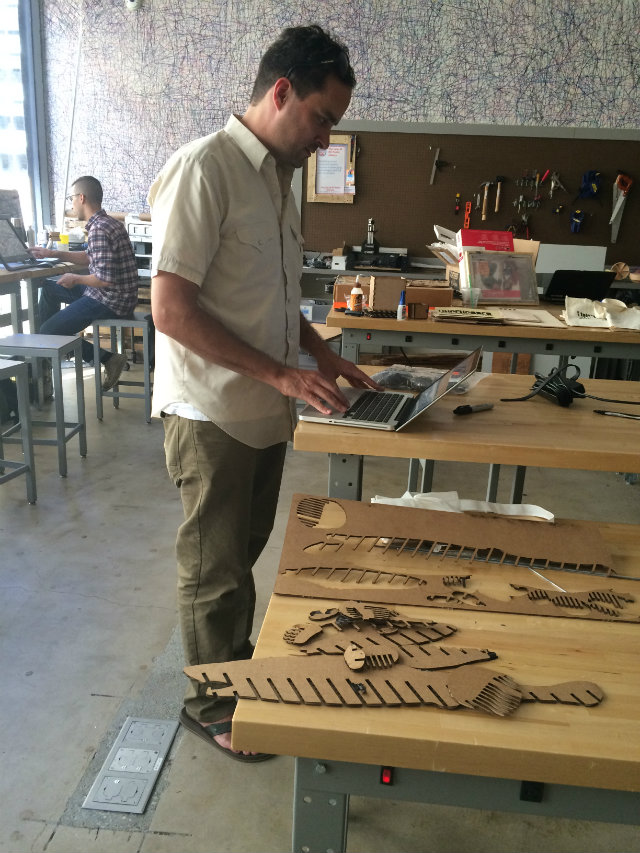
 Mike Iacovone works in the Fab Lab. (Photo by Elena Goukassian)
By DCist contributor Elena Goukassian
Once only found at academic institutions or highly specific retreats, creative residency programs are now taking place aboard Amtrak trains, in Antarctica, inside laundromats, and at the Large Hadron Collider. So it should come as no surprise that many public libraries now also offer artist-in-residence programs. The DC Public Library is taking that idea a step further, adding a maker-in-residence to its growing repertoire of non-traditional programming.
The DC Public Library Foundation, the non-profit wing of DCPL, helped launch the program in August as an effort to promote the Martin Luther King, Jr. Memorial Library’s Fabrication Lab. Complete with 3D printers, a laser cutter, soldering equipment, a wire bender, and a number of other machines that can be programmed to drill and cut almost any material—from wood to aluminum to plastic—the Fab Lab is part of a new movement of public libraries embracing the “maker movement.”
The library’s inaugural makers-in-residence—there are two of them this year, since they work as a team—were chosen from an open call for applications and now have full access to all the Fab Lab equipment for one year (plus a $15,000 stipend), free to make anything they like with it. At the end of the residency, makers show their new works at a local art gallery. This year, they’ll have a show in August 2016 at Flashpoint Gallery, located across the street. In the meantime, the residents are also leading several public workshops at local branches and traveling around to maker faires as DCPL representatives.
While DCPL’s maker-in-residence program is the largest of its kind in a public library, it’s not the only one. Perhaps the most similar is at Connecticut’s Westport Library. Westport’s program launched in 2012 and is meant to bolster its own Fab Lab counterpart, MakerSpace. Libraries in Colorado Springs and Charleston also have maker residencies, but they tend to focus on handmade crafts, which leads to the question: What defines a “maker” anyway?
On a basic level, a “maker” is essentially a tech-savvy craftsperson. Whereas woodworkers have long carved and manipulated tools with their hands, now they can input a final design into a special software program, flip a switch, and watch as a Computer Numerical Control (CNC) machine carves it for them. “Makers” also tinker with robotics and electronics, or create new approaches to traditional crafts, like knitting, origami, and puppet making. Just as “creatives” are people who think about things differently, “makers” are those who make things differently—and both are often influenced by new technologies.
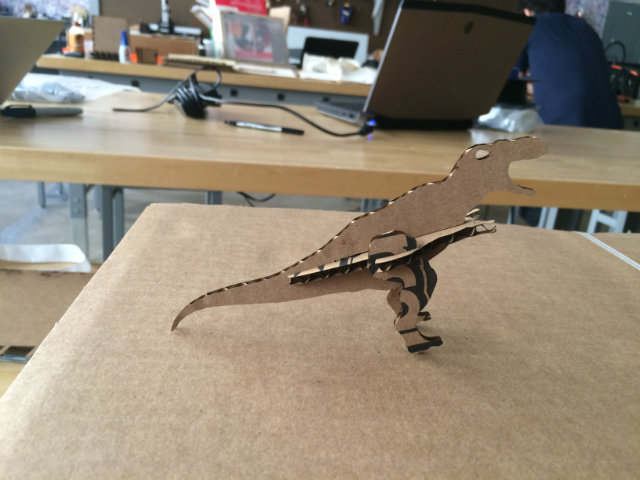
At MLK’s Fab Lab, maker-in-residence Mike Iacovone is working with the laser cutter, trying to figure out how to make his corrugated cardboard not catch fire. He’s working on a foot-long shark, putting it together using 180 3D puzzle pieces he designed to cut out using the laser cutter. If the pieces are too close together, he explains, the material tends to combust.
Iacovone and his art school friend Billy Friebele (collectively known as FreeSpace Collective) are sharing the maker residency this year. At the moment, Iacovone is experimenting with the laser cutter, while Friebele is working on robotics. One of Friebele’s robots plays variations on a little drumbeat when you move toward it from different angles and is currently on display in MLK’s Great Hall, part of the library’s “UNCENSORED: Information Antics” art exhibition, running through October 22nd.
So far, Iacovone is excited about the endless possibilities of what he can make at the Fab Lab. “Essentially, you’re given these tools where you can create pretty much anything,” Iacovone says, “It’s like at a diner, where there are too many things on the menu.” He also points out MLK’s strengths as the residency’s home base, especially for FreeSpace Collective projects, which often involve public engagement. “This library is the most public space in the city that’s indoors,” he says.
DC Library Foundation Executive Director Linnea Hegarty agrees that the library’s reputation as a public space is key to the success of these kinds of programs. “Libraries have become much more like community centers, especially here in D.C., where communities are often divided along different lines,” she says. She also sees the library as a “silo-breaker” and the residency program as a force to bring together makers, artists, and creative people of all types and from all fields and backgrounds, encouraging cross-disciplinary cooperation.
Increasingly, Hegarty starts to sound less like a library foundation director and more like she works at an art museum. She mentions that DCPL even has a curatorial new fellow, who will work with librarians to create novel programming. “Librarians are now curators of information,” Hegarty says. “One of the goals of these programs at large is to break down the barriers of what you think art actually is.” It is a lofty goal for any art museum, but given the public library’s unique position as the non-threatening public space where literally everyone is welcome, it may just be possible.