Rachel Kurzius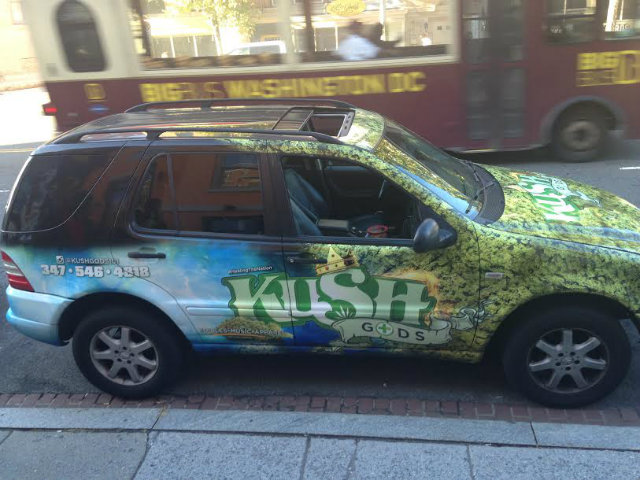
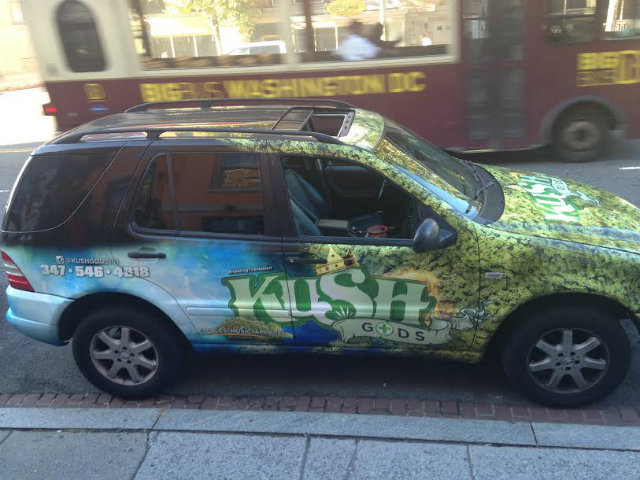 Photo by Rachel Kurzius.
Ten dollars sounds expensive for a pastry, even on U Street, but the Kush God’s brownie has a special ingredient that justifies its price—a healthy helping of weed.
Plus, it’s not a set price because the Kush God operates only on donations.
“I don’t really have a suggested donation price because I don’t want to turn anyone down,” says Mr. Kush God (he asked that we not use his real name), the owner-operator of Kush God, which sells edibles out of its three vehicles. “But people understand the reality of the situation. Brownies are ten dollars.”
The situation he’s referring to is the odd purgatory in which D.C.’s marijuana laws currently reside: voters approved an initiative last November to make it legal to possess and grow weed by a two-to-one margin, but Congress won’t let the city use its funds to create a regulatory system. It’s this limbo that brought Mr. Kush God from Los Angeles, where he started his business this February, to the District three months ago.
“I wanted to be the first,” he says. “This is decriminalization in a major way.”
During the interview in one of the cars, Mr. Kush God rolls a blunt. One of his employees is on the street. “Edibles, edibles,” she says to passers-by.
So far, law enforcement hasn’t been a problem. “They act how you would hope police would be,” he says. “They stick to real crimes. We’ve had people make calls from businesses if we’re parked out front. That’s happened maybe twice.”
He gets marijuana from a local grower. A local chef cooks up the brownies and gummies that comprise the current offerings. According to Mr. Kush God, it takes about ten gummies for a person with a high tolerance to really feel stoned.
Unlike smoke shops in places like Seattle, consumers don’t get to choose between different kinds of bud, like indica and sativa. “There’s not enough demand for special strains. The education of it isn’t there yet” in D.C., he says. “When people want to specify, I’ll get into it.”
He declined to say how much money he receives in donations. “People like it, let’s just say that.”
You can find the marijuana bud-decorated fleet parked throughout U Street and the 14th Street Corridor, as well as Adams Morgan and Shaw from about 2 p.m. to 10 p.m. daily. The cars have his phone number and Instagram account emblazoned on the side, along with the hashtag “#HealingTheNation.”
“We want (Kush God cars) like U.S. Post Office vehicles—everywhere,” he says.
And Mr. Kush God says that he’ll be launching an app to help connect customers with their edibles, which launches next week.
“You’ll be able to hook it up with a card so you can give donations right over the app,” he says. “The future of this business is here.”
Employees of Kush God are paid $13 per hour (“more than minimum wage,” Mr. Kush God notes).
When asked how he finds them, he says, “We put blasts out like any other business to announce we’re hiring. This is not just a hustle. We’re going to expand and be able to provide more jobs for people. When (the D.C. government) regulates and put taxes on it, like Denver, it’s going to be great for the area.”