 Rachel Sadon
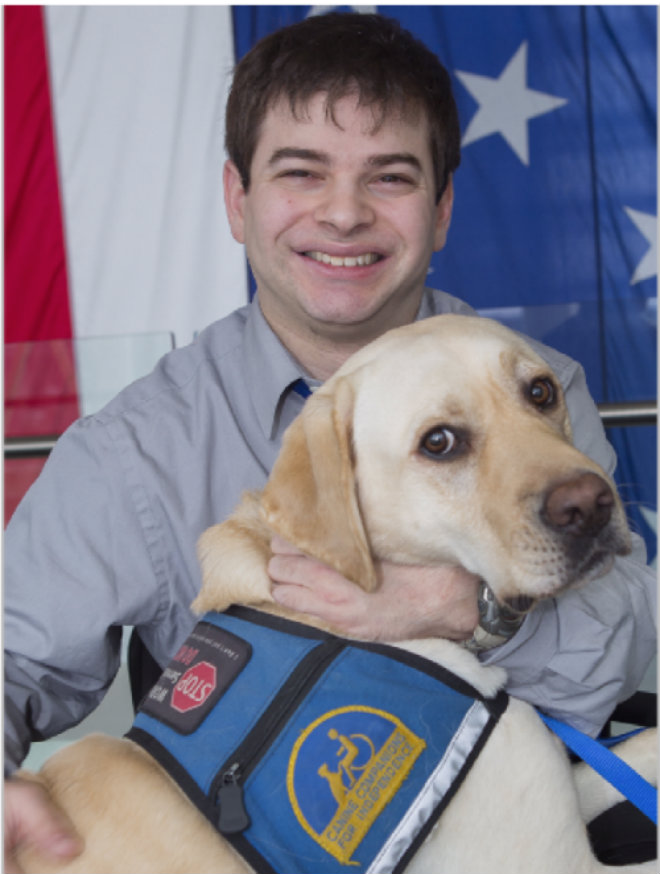 Ryan Honick and his service dog, Pico. (Courtesy of Ryan Honick)
For more than twenty minutes on Monday night, Ryan Honick stared at the emergency exit to the Eisenhower Avenue Metro station, alternately arguing with a Metro employee and fuming that he couldn’t simply get through the gate and get on his way home.
In his telling, Honick had requested that he and his service dog Pico be allowed to go through the emergency gate—as he always does when the pair rides Metro. The wide, ADA-compliant faregates shut too quickly after he wheels through, Honick says, and he fears they will hit Pico. But the woman manning the station refused the request, telling Honick that she didn’t feel comfortable swinging open the manually operated exit and letting him through. She told him that she was simply following agency policy.
So Honick cajoled, reasoned, asked to speak to a supervisor, tweeted, and pulled out his phone to record the encounter (he said the employee stopped speaking to him at that point). So he waited, and waited, for the supervisor to show up.
“The gate assumes it can shut once I’ve passed through, and my pup who is behind me gets scared. If that gate clips him—like it has—it can lead to phobias,” Honick says. “And if he ends up being scared of the Metro, I can’t get to work.”
Usually Honick’s main problem on Metro—besides the ones common to all riders—is pushy passengers cutting him and Pico off as he tries to board the train. But while most Metro station employees allow him to use the emergency exit rather than the ADA gate, this wasn’t the first time they’ve given him a hard time about it. Last month, Honick filed two reports about similar instances.
“I have routinely told Metro, it is great you have that gate, but because it is based on a sensor, it’s not safe'” for dogs like Pico, he says.
Eventually the supervisor showed up and let Honick through the emergency gate. But, according to Honick, she defended the first employee’s decision. And he had waited nearly half an hour to get out of the station.
“I’m just flabbergasted by their antiquated policy,” says Honick, who has also organized a petition against a Petco policy that separate handlers and service dogs for grooming (nearly 60,000 people have signed on.) “Service dogs are extremely highly trained. Anything that is a potential harm to their training, their handler will know about it.”
Honick says Metro reached out to him yesterday to gather information about the incident. The transit agency confirmed that they are reviewing the matter, and indicated that the ADA-gates are designed to be accessible for service dogs.
“Without prejudging the outcome of our review, I can say that the ADA gates are designed specifically to accommodate passengers with disabilities, including those who use service animals, and thousands of riders use the gates every day without any issue,” spokeswoman Morgan Dye said via email. “The emergency gates, on the other hand, are for that stated purpose—i.e. for emergencies—and not intended for routine entry and exit to the system.”
That is what Honick is concerned about. “I know this dog like the back of my hand—we’re never more than a few feet apart,” he says. “I take offense to people who claim to know better than me what is safe for him.”