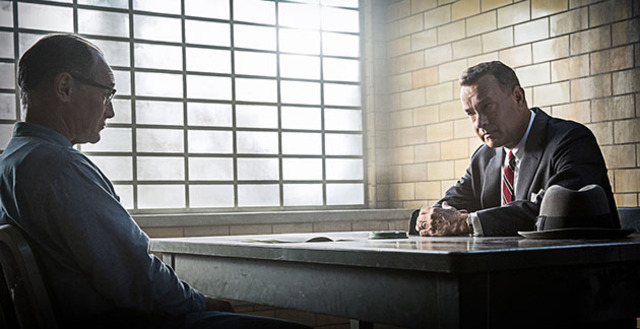
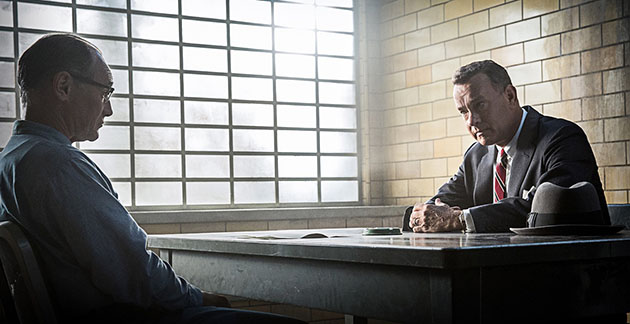
 Mark Rylance and Tom Hanks (DreamWorks)
As Bridge of Spies opens, Rudolf Abel (Mark Rylance) paints a self-portrait in his dingy Brooklyn apartment. Looking at himself in a clear mirror, he makes an unsentimental picture of a dryly stoic man with a long face out of “American Gothic.” But Abel is not a surly farmer; he’s the enemy, a Russian émigré encoding stolen documents for the motherland. Feds close in on Abel and take him in. But this enemy, and the way our country treats him, teaches us something about ourselves.
Steven Spielberg’s dry Cold War thriller is based on the true story of a U.S.-Soviet spy exchange in 1960. Co-written by the Coen brothers with Matt Charman (I can guess which scenes he wrote), the movie is for the most part a watchable old-fashioned procedural with occasional flashes of Spielbergian hokum.
The hero is of course Tom Hanks, as attorney James B. Donovan. We meet him in the middle of an unglamorous case where he tries to work out details of an insurance claim in a way that benefits the insurers. Donovan is assigned the unenviable task of defending the unflappable Abel, who makes no excuses for doing what his country asked of him.
Though the media and even Donovan’s own peers understandably villainize Abel, Donovan wants Abel to get a fair trial even if he is the enemy—that would be the American way. But the game is rigged; Donovan becomes vilified in the press for thinking to defend the enemy, and even the judge presiding over the case makes no attempt to hide his bias. Spielberg doesn’t let you forget who’s right here: while Abel looked into a clear mirror, Judge Byers (Dakin Matthews), as he primps before a night on the town, looks into a mirror as clouded as his judgement.
Abel is convicted of course. When it comes time for sentencing, the spy poses the question: if he is put to death, what precedent would it set if an American in the same position gets caught behind enemy lines? Naturally, American soldier Francis Gary Powers (Austin Stowell) is caught when his U-2 spy plane goes down over the Soviet Union.
Like Lincoln, Bridge of Spies is a drama of negotiations, but that movie’s hushed reverent tones are replaced by a dryer eye that may be largely thanks to the Coens’s script. The production design and photography do effectively convey the bleak colorless winter of Cold War Germany.
Donovan goes to Berlin to navigate the newly walled-in sectors and try to negotiate not only for Powers’ release, but also an American student held in East Berlin. This sub-plot does not start well; up to this point, Thomas Newman’s score is fairly restrained, but it swells as East Berlin officials seize the student and temporarily turn the movie into a Berlin Wall melodrama.
Spielberg is Spielberg, and you get your Normal Rockwell shot of Hanks family, his wife and kids huddling together on a couch as if getting ready to descend into their Fallout Shelter and wait out the end of the world together. But Hanks and an array of German and Russian officials (I kept hoping Werner Herzog would show up in a cameo as an unflinching East German officer, but he never did) keep things from getting too sentimental.
Reading between the lines, the movie doesn’t take itself too seriously. One snowy evening, Donovan walks past a German movie marquee listing Eins, Zwei, Drei; this is One Two Three, Billy Wilder’s 1961 comedy starring James Cagney as a Coca-Cola rep pitching the drink that refreshes to West Berlin. Wilder would have made a more acerbic, cynical film out of this material, but Spielberg is no Wilder, and draws predictable if steadfast lines. Still, this nearly two and a half-hour movie about Cold War intrigue moves along thanks to its script and Rylance’s understated performance as Abel. A rhyming companion piece to the Nazi-hunting film Labyrinth of Lies, Bridge of Spies is an old-fashioned tale of justice, served cold.
—
Bridge of Spies
Directed by Steven Spielberg
Written by Matt Carman, Ethan Coen and Joel Coen
With Tom Hanks, Mark Rylance, Alan Alda
Rated PG-13 for some violence and brief strong language
Running time 141 minutes
Opens today at an American multiplex near you.