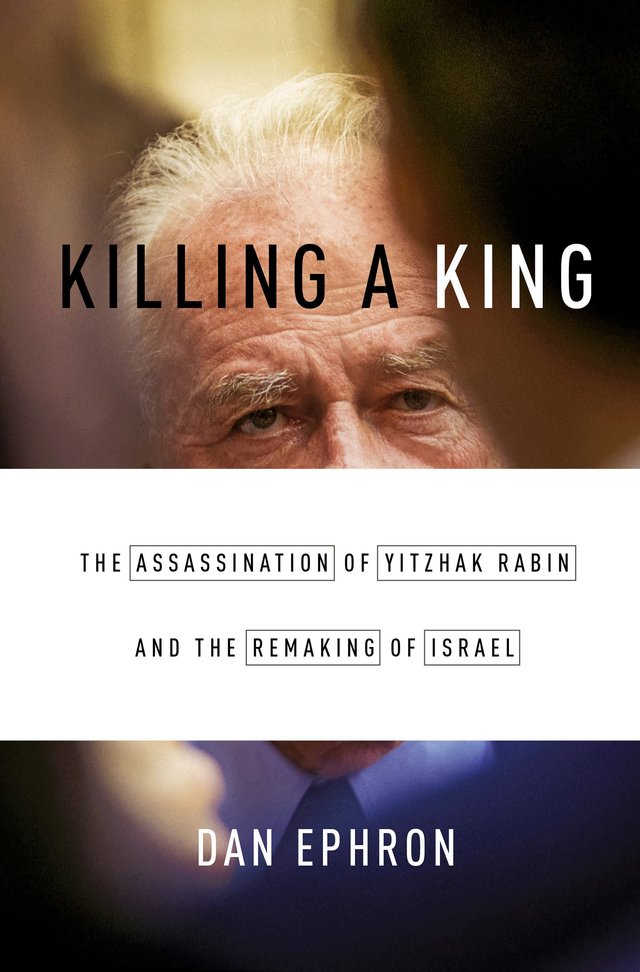
 November 4th marks the 20th anniversary of the assassination of Israeli Prime Minister Yitzhak Rabin. It is considered to be to Israelis what the assassination of President Kennedy is to Americans, and has had a lasting effect on the country culturally and politically.
Dan Ephron tells the whole story in his new book Killing a King: The Assassination of Yitzhak Rabin and the Remaking of Israel (W.W. Norton, $28). He will be in conversation about it with NPR’s This American Life producer Nancy Updike at Politics and Prose on Monday, October 26th at 7 p.m. The event will feature video footage and audio clips from the show’s recent radio documentary on the topic.
Ephron is uniquely positioned to put Rabin’s killing into context. The author has been a reporter in the Middle East since the 1990s, and covered the rally that Rabin spoke at right before his murder, as well as his murder trial.
The rally, and the assassination, were in reaction to the Oslo Accords that Rabin had signed with the head of the Palestine Liberation Organization, Yasser Arafat. The book describes the agreement as a difficult one for Rabin, who had fought as a soldier in some of the earliest battles over Israel’s independence in 1948. But the Accords were hoped to be a step toward peace by giving Palestinians land and the eventual opportunity for statehood.
Many religious and conservative Jews in Israel balked. One of them was Yigal Amir, a 25-year old law student who stalked Rabin and plotted and executed his murder. Amir still says today that he was religiously obligated to kill Rabin before a crazy person did, which would have had the wrong impact.
Using police reports and interviews with many of the people who were there, Killing a King chronicles Rabin and Amir’s parallel lives leading up to November 4th, 1995, and the clues that Israel’s Secret Service missed that may have prevented the assassination. Ephron also discusses the political aftermath in Israel.
At first, Rabin’s quieter supporters riled up in favor of the Oslo Accords, and there was a common feeling of “peace’s inevitability.” But extremists soon made it clear they weren’t going anywhere, and after conspiracy theories emerged and subsequent elections took place, Rabin’s death is largely believed to have started the country’s turn toward conservatism and seemingly further distance from peace with Palestinians.
Why does the book title refer to Rabin as a “king”? Ephron is quoting Amir’s brother and his convicted accomplice in the murder, who said, “according to Judaism, killing a king is profoundly significant. It affects the entire nation and alters its destiny.”
Ephron has served as the Jerusalem bureau chief for Newsweek and the Daily Beast, and has written for The Boston Globe, The New Republic, and Esquire. He currently lives in New York City.
The event will be free and open to the public.