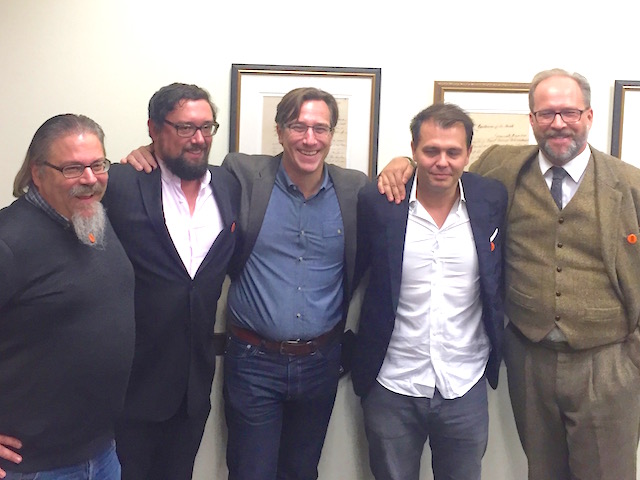
 Spirited Republic panelists and hosts from left to right: David Wondrich, Fritz Hahn, Derek Brown, Simon Ford and Robert Simonson. (Nathan Wilkinson)
Eighty-two years after the repeal of Prohibition, The National Archives has enshrined alcohol for its integral role in shaping American culture. The Spirited Republic: Alcohol In American History exhibit, which opened in March and will run through January 10, 2016, also features speaking seminars in which key figures comment upon the major moments in the history of alcohol production and consumption. The most recent seminar, titled Out Of The Dark Ages: 1970’s-1990’s, explored the drinking trends from the disco era to grunge rock’s heyday. Cocktails of this period are often maligned for the poorness of ingredients and flashier presentation, but the panel, hosted by D.C. restaurateur and spirits educator Derek Brown, also touched upon a few points of light in an otherwise dull era of mixology.
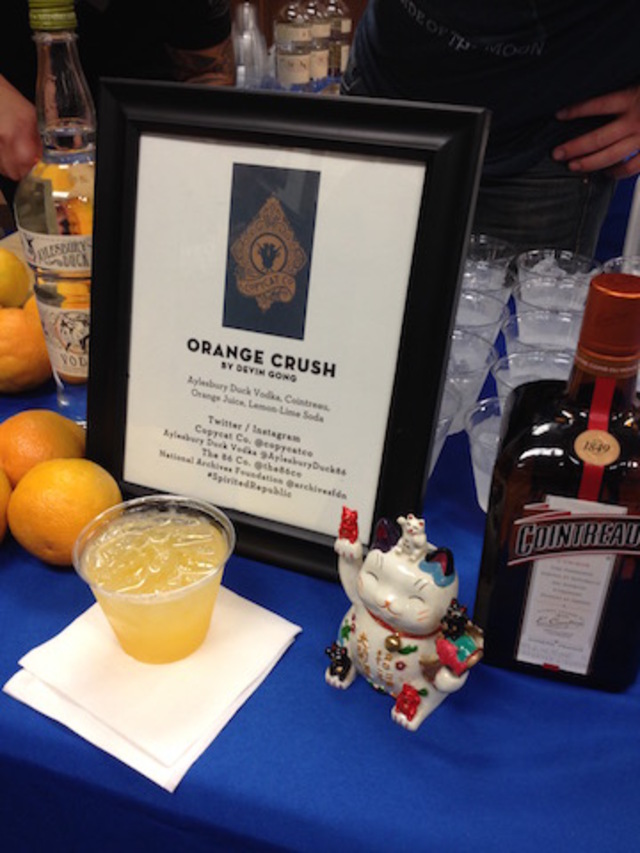
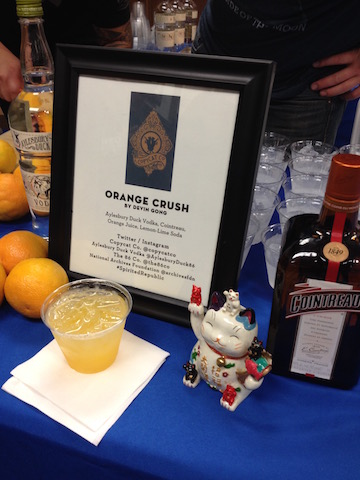 The Orange Crush was a 1990’s-era example of how quality spirits can be combined to taste like Tang. (Nathan Wilkinson)
The panel was composed of heavy hitters of the cocktail world: David Wondrich, Esquire’s longtime cocktails correspondent and author of Imbibe!; Simon Ford of Ford’s Gin, a bartender, distiller and co-founder of The 86 Company of spirit brands; and Robert Simonson, a spirits writer for The New York Times and author of The Old Fashioned: The World’s First Classic Cocktail. Washington Post writer Fritz Hahn introduced the panel and suggested an alternative title for the seminar, “Sex On The Beach to Sex In The City,” to highlight the burst of creativity that characterized this era.
The discussion got underway with the shift away from classic cocktails following the sixties. “People got rid of the Martini—which was for old people—and the Manhattan—which was for dead people,” Wondrich said. Bartenders were meeting the consumer’s demand for highly visible and easily consumable cocktails in the disco scene and drug culture of the 1970’s. “It was the brushfire that burnt down everything for good or bad,” Wondrich added. He began to list infamous drinks like the Apple Martini, the Kamakazi, and Harvey Wallbanger to various cheers and groans from the enthusiastic audience.
Ford contended that alcohol was in competition with harder drugs at this time, and it took its toll on bartenders. “Bartending was a dead-end job then,” Ford said, noting that well-trained bartenders at places like T.G.I. Fridays were more the attraction than the drinks. He cited the Tom Cruise film Cocktail as a bad movie that elevated the position of bartender. “Flair—bartenders were putting on a giant show—and learning to pour (accurately) with two bottles in each hand, helped people to learn that this is a skill set. The problem was they were making crappy drinks,” he said. And of course there were no fresh ingredients; the vibrant colors and fruit flavors came from peach schnapps, apple pucker, and blue curacao.
Yet classic cocktails didn’t entirely disappear. “There were a few old school guys who never stopped doing it,” Ford said. Wondrich agreed: “At the time nobody cared about the drink, nobody was talking about the drink, it was about how to make the party better. Dick Bradsell [a London bartender and creator of the Bramble and Espresso Martini] was one of the first to realize, ‘we could be somebody.’”
Wondrich points to New York’s restaurant bartenders rather than the club scene in the 80’s and 90’s for bringing back craft cocktails, “making Sidecars and Manhattans for friends after close.”
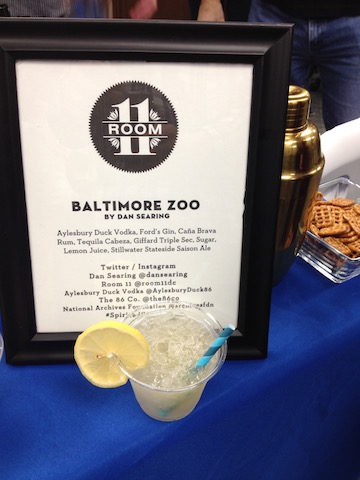 The 86 Company’s Baltimore Zoo cocktail is a Long Island Iced Tea-like drink with a Saison Ale top. (Nathan Wilkinson)
Which brings us to the explosion of flavored vodkas in the 1990’s and the ubiquity of every flavor of Martini. Up drinks became synonymous with light-tasting drinks for women, an image that Ford says he still challenges as a bartender. The cocktails served by The 86 Company bartenders during the tasting portion of the seminar were reminiscent of this later half of these so-called Dark Ages. There was a thoroughly 90’s Orange Crush made with Cointreau and Aylesbury Duck vodka. This turned out to be an appropriately bland drink to demonstrate a 90’s ability to make quality spirits taste like cheap soda. The Baltimore Zoo was a refreshingly updated Long Island Iced Tea with the addition of Stillwater Stateside Saison Ale. It was spicy and a little out of the ordinary, which made it a crowd favorite.
There are two seminars remaining in the Spirited Republic series: “The Rebirth of the Cocktail,” on November 21, and “The Platinum Age,” on December 12. Tickets are $45 dollars and can be purchased online at National Archives website. Attendees must be 21 years of age or older, of course.