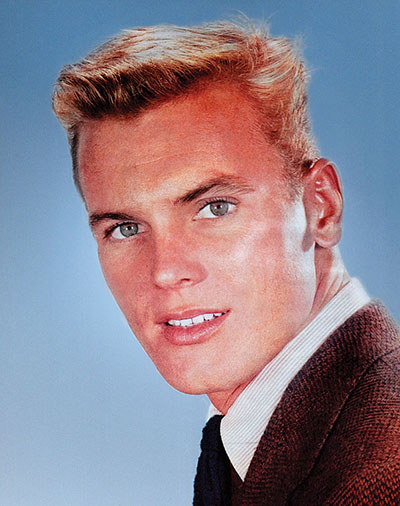
 Tab Hunter, then (Collection of Tab Hunter)
Actor Tab Hunter is the subject of the new documentary Tab Hunter Confidential, which details his storied career and life. Most DCist readers are probably of the generation that know him for cult films like John Waters Polyester and his long-rumored homosexuality, which he only fairly recently came to terms with publicly. But there’s a lot more to the now 84-year old entertainer. Hunter was gracious enough to chat with DCist yesterday.
DCist: How are you?
Tab Hunter: Very well thank you. You know I love being back in Virginia because I used to have a farm here years ago.
DCist: I’m glad you brought it up. You kept horses on your farm then?
Hunter: Well I’ve had horses all my life, I just love them. I started out just mucking out stalls as a stable boy when I was just a kid. In fact that’s how I was discovered for films! Mucking out the real stuff as opposed to the Hollywood stuff!
DCist: Now that you mention your time in Virginia, I wanted to ask about when did dinner theater in the Northern Virginia suburbs [a 1978 production of Here Lies Jeremy Troy at the Hayloft Dinner Theatre in Manassas].
Hunter: I was one of the pioneers of dinner theater all over America, back when they were all in vogue.
DCist: You did a show here called Here Lies Jeremy Troy. What do you remember about that production?
Hunter: I do remember that we had a wonderful cast. We just traveled all over the country and we did that show for well over a year. I do remember working in Manassas. In fact, the first thing I did was bring a horse of mine down to Manassas.
DCist: What was the horse’s name?
Hunter: I think that was a horse I called Nick the Greek. Because he was a gamble, and Nick the Greek was a very well-known gambler. He was a gamble when I bought him to see if he would work out as a show jumper.
DCist: Did you race horses as well?
Hunter: No, mainly I had show jumpers. I’ve done that all my life, and then I was a judge with the horse association years ago.
DCist: Backtracking a little bit, I wanted to ask about your recording career. I wasn’t aware before I saw the film of how many records you made. Is there anything you’re particularly proud of as a singer?
Hunter: Actually you know I did my [first] recording for [the record label] Dot. The main recording was “Young Love,” which knocked Elvis out of the number one slot. We used his backup group the Jordanaires. I cut an album there and after that, Jack Warner called me into his office and said “Waaait a minute we own you for everything,” And I said but “Mr. Warner you don’t have a recording company” and he said “Well we do now” and he started Warner Brothers Records. So I remember that very well!
DCist: The label has had a long great history of recordings, and it’s partly thanks to you!
Hunter: Oh my God when I look at them today compared to what it was at the time, I can’t believe it.
DCist: I was looking up what records you made and noticed the soundtrack for a television musical of Hans Brinker.
Hunter: I did Hans Brinker for [director] Sidney Lumet. It was a live show for Hallmark Hall of Fame. In the old days they did a lot of live TV. I was at the end of the studio era when it was falling apart, and they would loan you out a lot for TV. In those days we had wonderful live TV shows, not only shows like Playhouse 90 and Studio One and all of that but they had a lot of those variety shows and big shows like Hallmark Hall of Fame.
DCist: Was that the only time you worked with Sidney Lumet?
Hunter: No ,I worked for Sidney a few times. I also did a film with Sophia Loren called That Kind of Woman. I could never forget that—Sophia! Whoah! The best!
DCist: Would you like to talk about the end of the studio system? [From the ‘20s to the early ‘60s, the major studios had a lock on production and kept actors under exclusive contract and even had their own chains of theaters.]
Hunter: Things were kind of falling apart. Those were some great moguls. You had Jack Warner at Warner Brothers, Harry Cohn at Columbia, you had Darryl Zanuck at Fox and Louis B. Mayer at MGM. The days of the studio contracts were coming to an end. Television was coming in a big way. People were becoming interested in European films, real people in real situations— it was an entirely different ball game. Of course they had to get rid of all the theatres that the studio owned around the country. That made a major impact also. Audiences were changing quite a bit.
DCist: So the kind of work you did after you left Warner Brothers was different.
Hunter: Well, I did a television series but nobody ever saw it. It was on against the last half hour of Ed Sullivan on Sunday night. Sullivan was an institution, he was great. Things were kind of bad so I ran over to Europe and did some work over there—I call them spaghetti westerns that were a little bit light on the meat sauce.
 Tab Hunter today (Collection of Tab Hunter)
DCist: I was looking over your filmography in the ’70s and there were some interesting films I’ve never heard of. One of them was Timber Tramps, with Joseph Cotten.
Hunter: Joseph Cotten, Cesar Romero. Well I’ve got to tell you that it was without a doubt one of The Worst Films Ever. The nice thing about doing that film was working with Cesar Romero, who was an incredible human being, and being in Alaska at that time, going fishing, which was great. I’ve done a lot of films, some I like to remember, and some I’d reaaally like to forget.
DCist: What’s your most memorable moviemaking experience?
Hunter: I like different movies for different reasons. That Kind of Woman for working with Sidney again and of course Sophia. I loved Damn Yankees because it was my first musical, and it was the complete Broadway cast—I was the only outsider. And I thoroughly enjoyed playing a heavy in a western called Gunman’s Walk with Van Heflin. I had worked with Van a couple of times, and an excellent director named Phil Karlson. Those three films stand out, as well as the days of Playhouse 90 and live television. Those were great days.
DCist: In the 80s, after your career was revived in Polyester, you became a producer for Lust in the Dust.
Hunter: We did produce a few films, Allan [Glaser, Hunter’s long-time partner] and I produced a few films. But mainly I stayed out of the limelight. You know I’m an old man for god’s sake. I feel closest to God with a pitchfork full of the real stuff in my hands.
DCist: Speaking of which, you moved away from the Catholic Church and came back. Is there anything you’d like to say about your faith?
Hunter: Well it’s a very major part of my life. My mother was an incredible woman and Allan paid a wonderful tribute to her in our documentary. She always said the three most important growths we have are mental, physical, and number one, spiritual. And I think we have to be very aware of that.
DCist: You attended a premiere of your documentary with Dolores Hart [an actress who became a nun] as your date.
Hunter: Oh I love Mother Dolores! She’s just the best!
DCist: Is there anything that you wish somebody would ask you about?
Hunter: Actually, no! I appreciate that people ask me different things. It’s wonderful being on the road a little longer with the documentary. But you know I can’t wait to get back to my mare and my filly! I’ve been weaning the mare from the baby and I’m now a proud papa! And those are very important times for me.
DCist: Well thank you so much for your time—I really enjoyed the documentary and look forward to rediscovering some of your old films.
Hunter: Please pick the right ones because there are a lot of bad ones too! I’m looking forward to coming to the Washington screening!
—
Tab Hunter Confidential opens today at the Angelika Pop-up, 550 Penn St NE. Hunter will appear in person on October 25 at the 11:45 a.m. and 1:45 p.m screenings.