Rachel Kurzius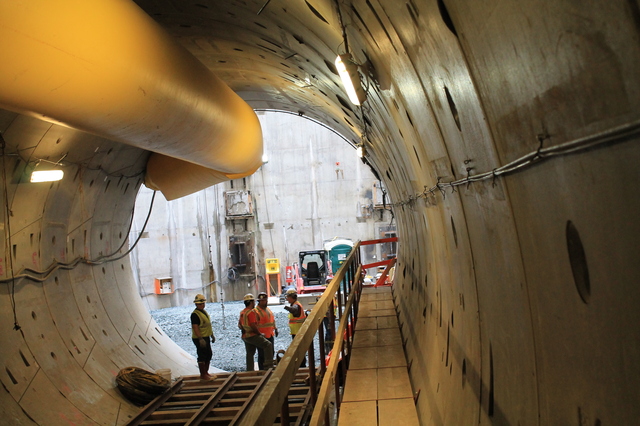
There is a gaping, 160 foot hole in the middle of the District. On purpose.
“This is the remarkable and unseen story of what it takes to solve an issue in the middle of a busy city,” says George Hawkins, the general manager of D.C. Water. “Bloomingdale flooding is a centuries-old problem.”
D.C. Water and contractor Skanska Jay Dee invited media and citizens to descend into the hole this weekend and tour the Clean Rivers Project First Street Tunnel. “We want the neighborhood to see what all this noise and construction is doing to create a permanent benefit,” Hawkins says. The city broke ground on the tunnel in June 2014.
The First Street Tunnel tunnel, which will be 2,700 feet long and 20 feet in diameter when it’s completed, will complement the existing sewer. For stage one of the project, the tunnel will serve as storage for excess storm water. Once stage two is completed by around 2022 or 2023, that storm water will be piped to the Blue Plains Advanced Wastewater Treatment Center, where it will be cleaned to near-drinking water quality before its release into the Anacostia River.
Those on the tour got to meet Lucy Diggs Slowe, a tunnel boring machine named for a local activist who was the first Dean of Women at Howard University. Last used in Dubai, the machine can create about 50 feet of tunnel per day, though the pace began more slowly.
Lucy weighs nearly 1,600 tons. The machine was constructed above ground and then lowered down by crane in 30 foot increments. The machine, which came to D.C. from Dubai, will wrap up its job in December.
“The soil around here is very conducive to tunneling,” says Ron Davis, resident engineer. “It’s just mud, over and over again.” In comparison, a tunnel-boring machine in Seattle was stuck underground for more than a year after breaking down. “There are no showstoppers for us.”
Those who peek into the First Street Tunnel work sites can see what resembles an alien egg hatchery—a number of glistening white knobs growing out of black tubes emerging from the ground.
So, what are these would-be alien eggs?
According to D.C. Water, they’re a surface-level clue that the project is employing a process called ground freezing. They’re using giant refrigerators, known as “freeze plants,” near the main work site on Channing Street and 1st Street NW to cool brine, a saltwater mixture that gets pumped through the ground using pipes. The seeming alien eggs are condensation from the brine when it reaches the surface.
We got to touch some of the “muck” taken from the ground and it felt as cold as a refrigerator shelf.
By creating these ice walls underground, the project avoids some of the noise and vibrations associated with other methods, like using concrete. Hawkins says the inclusion of ground freezing in Skanska Jay Dee’s proposal is what gave them the edge over other contractors.
Residents in the affected neighborhood still point to the ongoing construction as the cause of home damage and disturbance.
To access the claims process or otherwise speak to D.C. Water about the project, call 1-844-FST-INFO
Don’t look down… @dcwater pic.twitter.com/Iu3m2Kxego
— Rachel Kurzius (@Curious_Kurz) October 23, 2015