Rachel Kurzius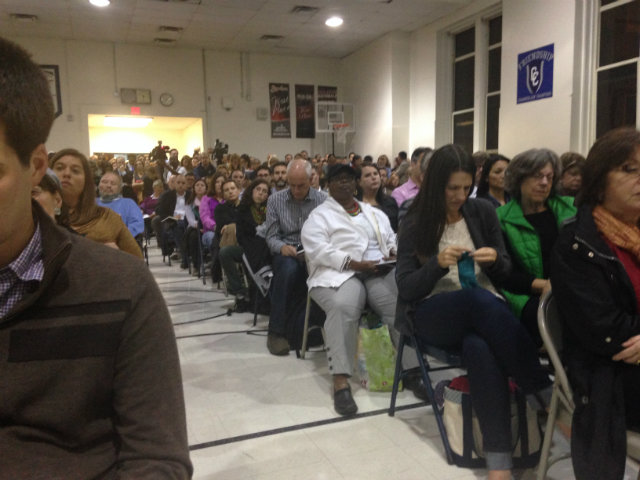
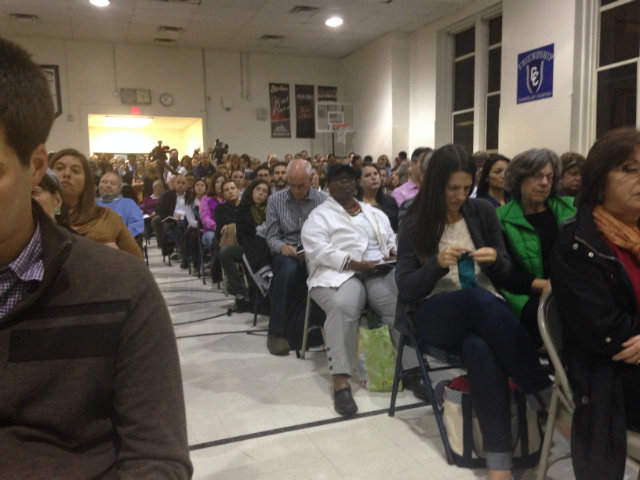 The packed gymnasium at the community meeting on public safety. (Photo by Rachel Kurzius)
“I didn’t bring my wallet or cell phone out tonight,” Hubert Dobson said. He didn’t want to take the chance of their getting stolen, so he went to the Ward 6 Community Meeting on Public Safety with nothing in his pockets. He just moved into D.C. from Arlington in August. “I get that this is a city, but people should not be afraid to walk their dogs.”
Dobson is referring to the rash of armed robberies in the Capitol Hill neighborhood that have made residents fearful. In the First District, the total number of reported violent crime for 2015 so far is 643, compared to 547 during the same time span in 2014, according to police numbers. Total reported crime numbers in the First District in 2015, however, are actually down as compared to year-to-date in 2014.
“We entered mid-May below our numbers for last year in all violent crime, and we ended August with a 50 percent increase in homicides,” Deputy Mayor for Safety and Justice Kevin Donahue told DCist. “Something unacceptable and severe happened this summer. Since the summer, the incidents have diminished but there are still clusters in neighborhoods continuing. That’s what we’ve seen here.”
The million dollar question is why. “We can’t point to a single cause,” says Donahue.
Hundreds of Ward 6 residents packed into Friendship Chamberlain Public Charter School for a conversation organized by Councilmember Charles Allen that included Donohue, Metro Police Department Chief Cathy Lanier, MPD First District Commander Jeff Brown, Assistant U.S. Attorney Doug Klein, and other city officials. Congresswoman Eleanor Holmes Norton also made an appearance, though she did not speak.
“What we saw happen these past few weeks for me was unacceptable,” Allen said. “In the last 48 hours there have been significant arrests, but this is an issue that MPD cannot solve alone.”
Lanier explained that the nature of criminality in the District has changed over time. “We used to say that violence was neighborhood-based, so it was pretty easy to identify. About six years ago, the gangs stop forming around neighborhoods and open-market drug dealing. Now, criminal street gangs are organized around armed robberies. They’re involved in a high number of robberies and they don’t just do it in one neighborhood.”
On one evening of high-volume crime, October 21, five armed robberies were reported in a 40 minute span in Capitol Hill and Navy Yard. MPD arrested five people who they say are linked to these and other robberies.
“Typically, there are three to five people in a group doing the robberies,” said Lanier. “We’ve impacted three groups and seen robberies drop dramatically.”
Residents hungered for information on what happens after an arrest, and took Klein, of the U.S. Attorney’s Office, to task for what they deemed inadequate communication about how his office handles prosecutions.
Klein shared his personal phone number and email address with the crowd. “If you have a question about any case, you can always email me,” he said.
ANC 6B10 Commissioner Denise Krepp doesn’t just want to know about individual cases. “Those answers are insufficient,” she told DCist. “We want to know how many crimes they’re prosecuting. They have that data. We’re going after justice and we’re going to demand that information be shared.”
Mayor Muriel Bowser is pushing for a single database that would provide end-to-end information about a criminal case from arrest through the criminal justice process. “The only way that’s going to happen is if the Department of Justice shares their information,” Krepp says. Klein “is not representing our interests. He’s representing a bureaucracy that sees us as mindless numbers.”
Klein insisted that the “the majority of crimes papered by our office are misdemeanors. I understand that these quality of life crimes are the ones that affect you the most.”
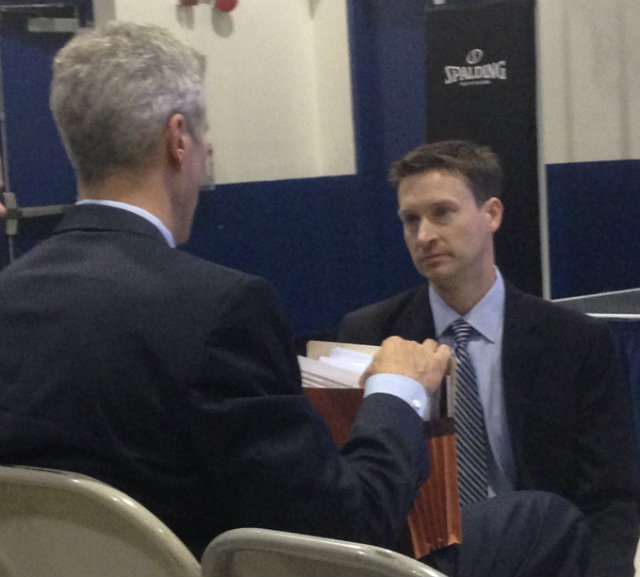 Assistant U.S. Attorney Doug Klein and Ward 6 Councilmember Charles Allen talk before the meeting begins. (Photo by Rachel Kurzius)
One incident that raised the ire of the crowd was the case of Elijah Jeremiah Smith, who punched a man at Eastern Market’s Metro station in a widely-seen video. Smith is currently serving a seven-month sentence for simple assault, a misdemeanor charge, and is facing additional charges for later punching a plainclothes transit officer.
“In my mind, that was a felony assault,” said Councilmember Allen.
Klein explained that the victim’s injuries were bruises, which legally meant that the assault did not amount to a felony. “Stitches, broken bones—that’s a felony,” he said. “Simple assault is not an insult about how the crime affects the victim,” though it certainly affects the way the crime is handled in the courts. For instance, it does not come with a mandatory pre-trial hold.
Allen pledged to look at that and other legislative fixes to deal with crime. The council currently has four separate pieces of legislation aimed at curbing crime—some of which have drawn major objections from Black Lives Matter activists.
“It’s not just about how crimes get prosecuted, but how do we prevent crimes from taking place?” Allen told DCist. He mentioned additional funding for recreational centers and examining pre-trial holds, among other ideas. “That’s the next level.”
Donahue notes that without a “single driving cause, our approach has to be multifaceted.” The District is “still learning about the role of new drugs, specifically synthetic drugs. Drug markets are on social media, not street corners, meaning there’s a broader distribution. We also know there’s a new drug on the market, and we’re trying to figure out if violence is caused by competition over distribution.”
Barbara Bonessa has lived in Ward 6 for 30 years. Despite the anger directed at Klein, she notes that, “I was expecting a little more tension” from the meeting. She says that the strong turnout at the meeting signals “a very strong reaction to a series of violent crime, which we’re not used to. It conveys that we care.”
Krepp says that 10 years ago, people in her neighborhood took the bars off their windows. “It was a symbol. I don’t want the bars to go back on the windows.”