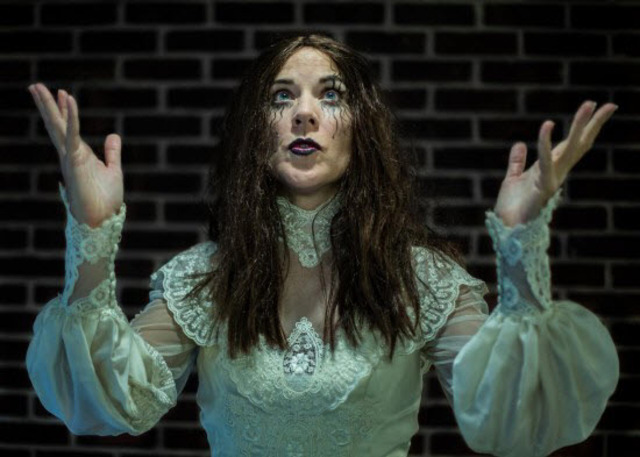
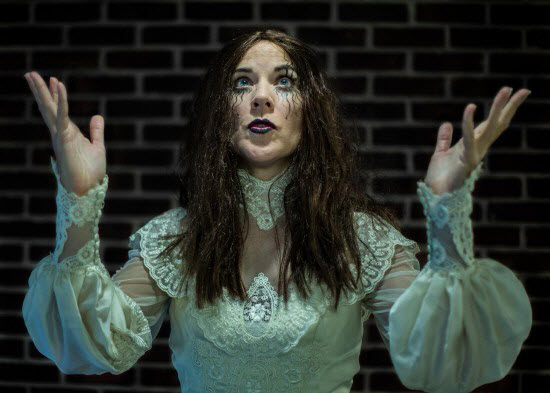
 Jennifer Restak in Molotov Theatre’s Lovecraft: Nightmare Suite. Photo: Tony Hichcock Photography
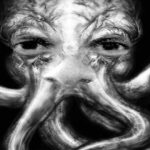
When one thinks of horror writer H.P. Lovecraft, usually slimy tentacles, incomprehensible languages, and spooky Northeastern towns come to mind. Molotov Theatre Group and playwright Dan Spurgeon, however, have looked upon the pallid, gaunt visage of Mr. Lovecraft and seen a stage hit waiting to be discovered. With All Hallow’s Eve quickly approaching, it seems like a match made in … well … hell. Unfortunately, for what it has in charming seasonal treats, Molotov’s Lovecraft: Nightmare Suite at DC Arts Center is seriously lacking in spooky Halloween tricks.
For Lovecraft: Nightmare Suite, Spurgeon has adapted six of Lovecraft’s classic short stories into monologues with occasional dialogue interludes. The stories range from menacing cats to suspicious neighbors to cannibals. Running about 10 minutes each, the variety of stories provides frequent relief, if mysterious foreigners with strange gods are less your thing, for example.
One of the production’s greatest flaws, however, is in how directly Spurgeon has adapted Lovecraft’s work. Which is to say that the play might have you scratching your head wondering what adapting actually happened. From the sound of it, Lovecraft: Nightmare Suite is more or less a recitation of the exact text of its source stories. By two stories in, it becomes pretty clear that each of the evening’s vignettes will consist of a narrator describing an apparently normal situation, which quickly becomes frightening with a “shocking” twist. As you might expect, this leaves the play feeling awfully stagnant, even as Molotov’s company of six actors does their best to liven the text with movement and style.
Putting the troupe in troopers, the small cast has a few standouts despite fighting the drab playtext. Molotov co-founder and artistic director Alex Zavistovich gives a solid performance throughout the show from a menacing monologue at the top to his finale speech. As the Storyteller and Old Man in “The Picture in the House,” Zavistovich’s experience with horror styles is obvious; he does well balancing the melodramatic tones of Lovecraft with realistic character work. Similarly, Jennifer Restak deftly embodies two distinct roles as the titular character in “The Outsider” and the woman at the center of “Cool Air.” Genuinely chilling in both roles, Restak turns in Lovecraft: Nightmare Suite’s most memorable performances, using physicality and her commanding voice to evoke gothic horror classics like Wuthering Heights and Robert W. Chambers’ truly scary The King in Yellow.
Leading the fight against Spurgeon’s dry script is projection and set designer Rachel Marie Wallace. Wallace creates a clever and simple palate for her projections with a series of fabric panels, which director Jay D. Brock takes full advantage of to create curtains, walls, hills, and other essential set pieces. When the panels come together to showcase the projections, the seams between them seem to disappear; a truly impressive effect that highlights Wallace’s design skill. The projections themselves can often look a little cheesy, frequently resembling mid-90s point-and-shoot games like Doom (likely a leftover aesthetic from Molotov’s recent video game laden Neighborhood 3: Requisition of Doom). They dutifully serve their purpose, however, allowing for the sudden appearance of colossal gods in the sky and other such Lovecraftian hi-jinks.
More effective than the projections is shadow play used during “Cool Air,” briefly utilizing a scrim Wallace places on the upstage wall. These shadows are so effective, in fact, that it is a wonder that shadow play is not integrated into every vignette.
Ultimately, the biggest problem with Lovecraft: Nightmare Suite is that Molotov is not playing to its strengths. As a company dedicated to the tradition of ultra-violent Grand Guignol-style horror theater, the audience expects flying body parts and a blood splash zone. While the company should perhaps be commended for turning to the more subtle, atmospheric horror of Lovecraft, the absence of their true expertise is plain.
For example, at the end of “The Picture in the House” there is an act of violent magic that will have audience members squealing with horror and then surprised delight. This moment is a highlight of Nightmare Suite, when the audience crackles with anticipation for even more fiendish tricks. Unfortunately, that quick jab of violence is the one and only of the entire performance.
While Lovecraft: Nightmare Suite is a largely disappointing opener for Molotov Theatre Group, the brief glimmer of their gift for gore is a hopeful endorsement for the rest of their season.
Lovecraft: Nightmare Suite plays at DC Arts Center through November 8. Tickets ($25) are available online.