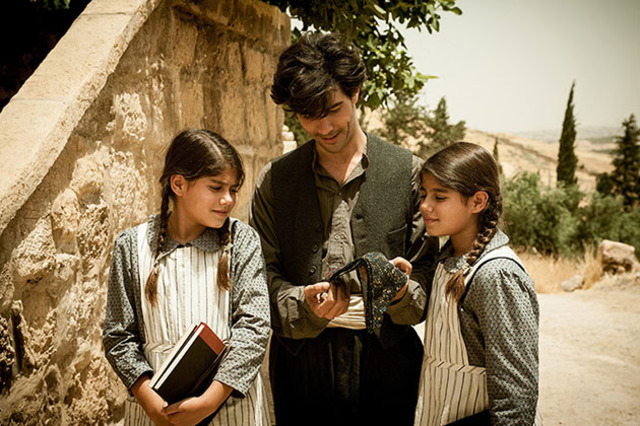
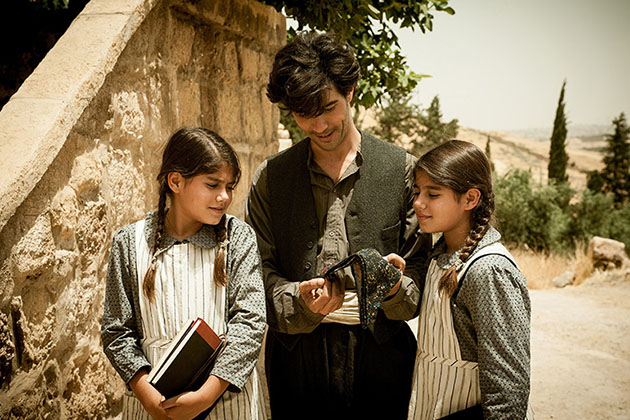
 Tahar Rahim (center) (Strand Releasing)
Early in director Fatih Akin’s moving drama The Cut, Nazaret (A Prophet’s Tahar Rahim) and his twin daughters are walking in their town of Mardin, in the Ottoman Empire. When they see a crane flying above them, Nazaret tells his children this signifies that they will all be undertaking a journey. It turns out to be a perilous, heartbreaking one.
The film begins in 1915, just before the Ottoman government began to round up Armenians for extermination. Nazaret is ripped from his family and taken to a desert work camp where he breaks rocks in the hot sun and is asked to renounce his Christian faith. Most of the men in his camp refuse, but the man with the Christ-like name ends up the only survivor of a massacre by Ottoman soldiers.
The man who spares Nazaret’s life left him with a cut that severed his vocal cords, so Nazaret must use his wits and perseverance to escape the war around him. He is taken in by a kindly Muslim soap maker who ends converting his factory in Aleppo into a refuge for displaced Armenians. It is in this refuge that Nazaret learns that his daughters are still alive, which leads him on a long and frustrating journey around the world.
Akin did a lot of research for the film, which he co-wrote with Mardik Martin, a writer of Armenian descent whose scripts include Raging Bull and Mean Streets. But Akin’s tale is less urban grit than global epic. The Cut is not based on a specific true story, but in Akin’s research he found diaries of Armenians who ended up in Havana, which plays a part in this film. Much as Nazaret’s story is a composite of the Armenian struggle, so his film is fueled by inspiration from Italian arthouse directors like Bernardo Bertolucci to Sergio Leone’s spaghetti westerns. The desert landscape (shot in Jordan) of Nazaret’s journey makes it ripe for a western, and the score by Alexander Hacke encourages this. Despite his symbolic name, and specific quest, Nazaret is like a variation of Clint Eastwood’s Man with no Name, a lone and determined traveler.
Born in Germany to Turkish parents, Akin thought it was time for Turkey to deal with the Armenian genocide. It is still a contentious topic; after speaking to the Turkish-Armenian newspaper Agos about the film, both the director and the newspaper received death threats. But as Akin told the New York Times, “I’ve shown the film to people who deny the fact that 1915 was a genocide and to people who accept it and both groups had the same emotional impact. I hope the film could be seen as a bridge.”
The Cut is the final part of what Akin calls his “Love, Death and the Devil” trilogy, which starts with the excellent Head-On (2004) and continues with the less successful Edge of Heaven (2007). The trilogy’s previous installments have been melodramas, and as Akin turns to address a historical blight in the land of his descendants, he’s taken a powerful tale of genocide and a severed family and made from it a melodramatic western. Cornier and more epic than his previous films, The Cut is an effective and old-fashioned weeper about a volatile time for the Armenian people.
—
The Cut
Directed by Fatih Akin
Written by Fatih Akin and Mardik Martin
With Tahar Rahim, Simon Abkarian, Makram Khoury
Unrated, but contains nudity and the graphic violence
138 minutes
Opens today at E Street Landmark Cinema.