Rachel Kurzius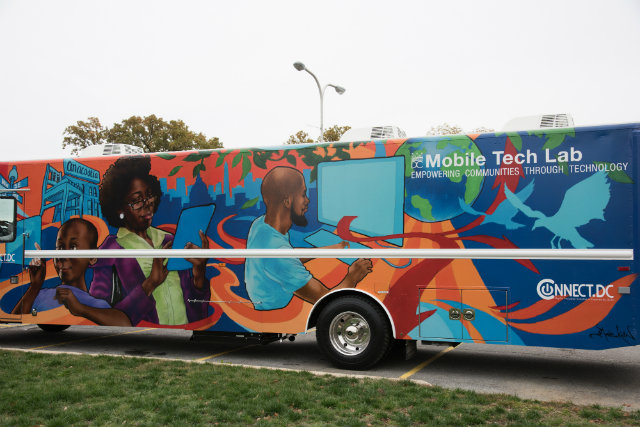
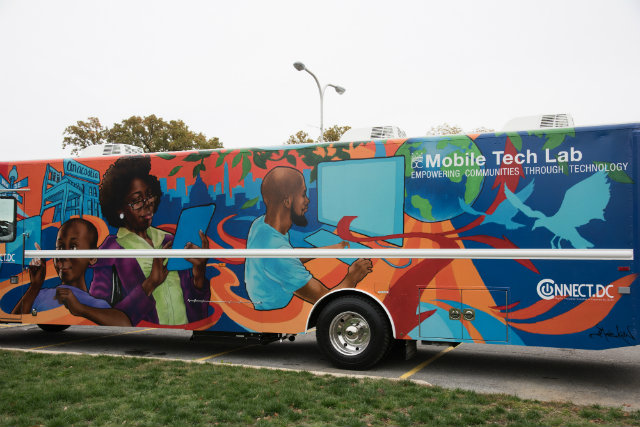 Photo courtesy of Connect.DC
As people conduct more of their professional and personal lives online, a quarter of D.C.’s households still don’t have broadband internet.
“If you’re not using technology to its full capacity, you’re missing out,” says Delano Squires, director of Connect.DC, a digital inclusion initiative created by the Office of the Chief Technology Officer. Squires notes that job applications and city services are moving online, as well as information about health and housing, and opportunities to stay connected to family and friends, and engage civically. “We don’t want the benefits of being online clustered to the people at the top.”
To help bridge this gap, Connect.DC relaunched its Mobile Tech Lab today. The former bookmobile was decommissioned back in July 2014 for renovations that totaled around $150,000.
“The primary goal was to increase capacity,” says Squires. “Before it was more of an ad-hoc event model but we were never really able to do substantial long-term programming. Now we’ll be able to say, ‘Tuesday and Thursday, we’ll be at this location doing trainings.'”
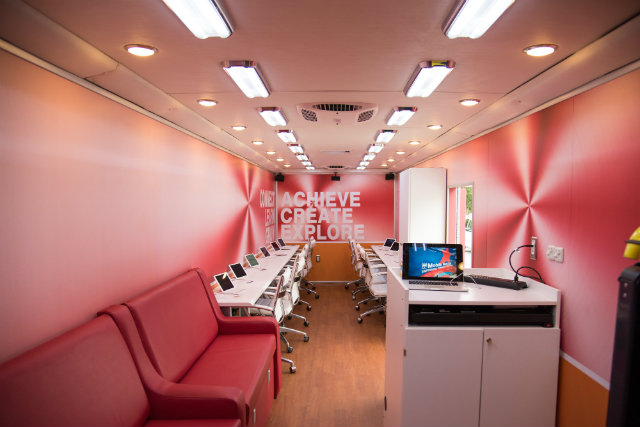 Photo courtesy of Connect.DC
The D.C. Mobile Tech Lab’s focus will be on Wards 5, 7, and 8. “We want to reach residents who are hard to see otherwise,” says Squires. He envisions the classroom on wheels going to schools where a certain percentage of students are enrolled in assisted-lunch programs, so families who don’t have internet access can sign up on the spot.
The former bookmobile will serve as a classroom and a place to help parents sign up for government services like the D.C. school lottery.
The relaunch of the Mobile Tech Lab is one part of the D.C. Connect Home initiative, which is pushing to connect public housing residents to the internet. Connect.DC is working with the D.C. Housing Authority and the mayor’s office, as well as a number of community non-profits.
One challenge is figuring out how to reach the people who don’t have internet, for whom a website update or an email wouldn’t work. Connect.DC has been using a texting platform for the past two years. “We’ve found that to be very effective,” says Squires, because about 90 percent of D.C. residents have cell phones with texting capabilities.
“When we started fiscal year 2015, we had about 530 people on the texting platform,” says Squires. Over the course of the year, the organization began an advertising campaign using transit media, newspapers, and radio (the first time Connect.DC utilized radio ads). The advertisements featured former students who’ve benefitted from their programming. They also partnered with non-profits in Ward 7, who functioned as the street team by going door-to-door. “We ended the year with 4,500 people on the text platform.”
In many cases, though, being on the text platform isn’t enough to connect families to the internet.
For instance, one of Connect.DC’s roles is to help families with school-aged children get free internet through a pre-existing program that Comcast runs—Comcast Internet Essentials. People sign up online and determine whether they’re eligible, and then pick up an “opportunity card” that provides them with sign-on information. Comcast also provides a $150 voucher for a low-cost laptop.
For FY15, Connect.DC budgeted for 500 families to get free internet through the multi-step process. Only five families completed the process, though 1,200 people took the first step.
“My sense is that many residents probably need a more personal touch in applying,” says Squires. He says the D.C. Mobile Tech Lab will be able to help families end-to-end, so they can determine whether they’re eligible on the spot and leave with an opportunity card.
Connect.DC wants to make this one of its core offerings, and will utilize money from this year’s budget, as well as the leftovers from past year, to help residents get online.
“I’m not saying giving everyone a computer will solve all their problems,” says Squires. “But it is an opportunity and if people are ready to meet it, it can be life-changing.”