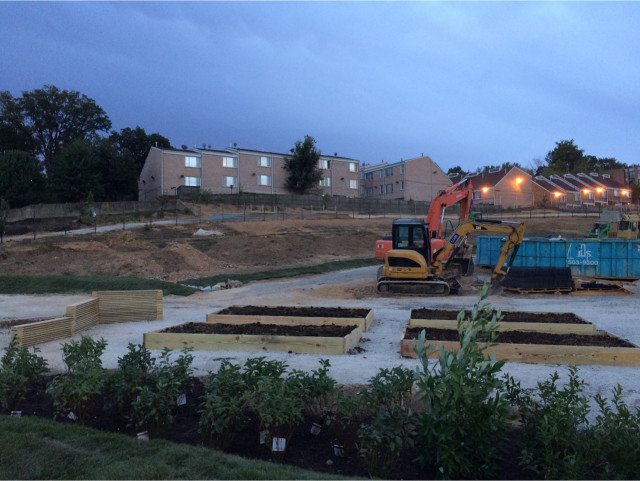
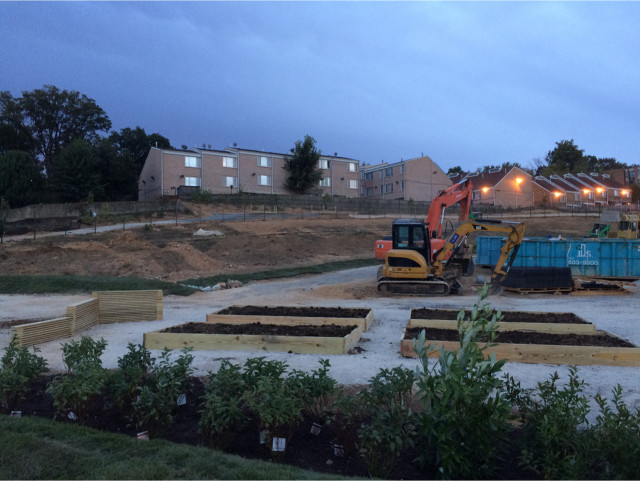
 East Capitol Urban Farm. (Courtesy of the D.C. Building Association.)
Each month The Federal Forager explores some of the perks, puzzles, and pitfalls of eating and living more organically, locally, sustainably, and creatively in the D.C. region.
By DCist Contributor Bridget Dicosmo
Urban farmers in D.C. have gotten pretty good at doing more with less—space, that is. Already a farmers’ market mecca, we’re starting to see everything from pop-up rooftop gardens to hydroponics facilities taking root in the District. And if there’s one common thread between these projects, it’s that finding space for producing food in D.C. breeds creativity.
“It might just be part of a broader trend, but better awareness of how to use space,” is becoming more evident in the types and locations of D.C. urban farming projects, says Thomas Schneider, executive director of Rooftop Roots.
Rooftop Roots specializes in helping folks make better use of underutilized roofs, balconies, patios, and vacant lots, but the idea of making the most out of limited space—wherever it happens to be available—is gaining ground elsewhere in the District. It’s even sparked the cultivation of more dwarf and other varietals of plants that grow well in tight spaces, such as in container gardens. “Produce people imagine only seeing grown at farms we’re now seeing in urban areas,” Schneider says.
Common Good City Farm is in the process of piloting a 720 square-foot “high tunnel”greenhouse that will allow the half-acre farm in LeDroit Park to grow food year round. The first year will help test the tunnel’s production capacity, executive director Rachael Callahan says.
“What a lot of urban farmers have done is piece together front and back yards,” says Mary Ackley, founder of Little Wild Things City Farm in Northeast. Ackley, who grows a variety of microgreens for sale to local restaurants and markets, notes that in some cases, institutional space is available through agreements with landowners. One of her plots, for example, uses land at a local monastery.
And the nascent East Capitol Urban Farm, on which volunteers broke ground for September 26, has one really cool feature aimed at taking advantage of vacant lots that often are only temporarily available: It moves.
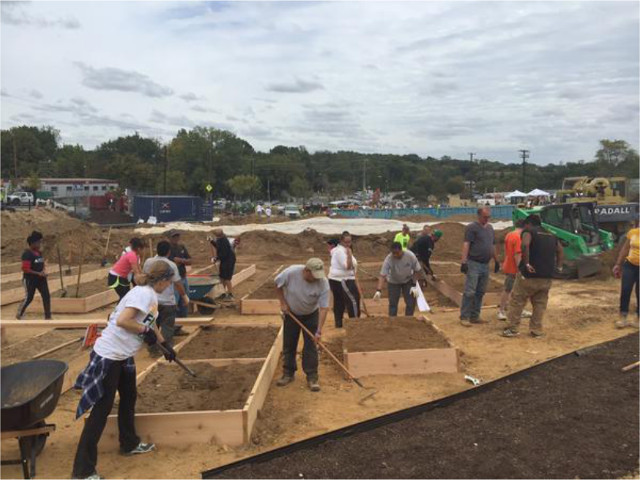 East Capitol Urban Farm. (Courtesy of the D.C. Building Association.)
Vacant lots in the District are “one of the low-hanging fruits” for urban farming, but sometimes they don’t stick around long before being flagged for development, points out Dwane Jones, director of the Center for Sustainable Development College of Agriculture, Urban Sustainability and Environmental Sciences within the University of the District of Columbia.
The Center partnered with the D.C. Housing Authority to lease the lot, located in Ward 7 at 5900 East Capitol Street SE, with the idea of creating a model for a portable urban farm that could be transported as needed to make better temporary use of vacant lots.
D.C. Council member David Grosso (I-At Large) introduced the D.C. Urban Farming and Food Security Act in 2014 with the intent of spurring similar projects. The bill requires the mayor to identify 25 eligible vacant lots that could potentially serve as urban farms and develop an application process and offers tax abatement for those looking to farm locally and donate produce and grains to D.C. food banks or shelters.
Ackley calls the bill a “great start,” but says zoning and other obstacles remain. For example, greens grown indoors are subject to more regulatory barriers because of food processing restrictions.
Additionally, only the tax abatement piece of the bill appears to have been funded in the fiscal year 2016 budget, at $460,000. The remaining parts of the legislation are still awaiting markup. The Office of the Chief Financial Officer is in the process of developing an application process for the tax abatement but had not received any inquiries as of October 22.
“The bill provided a unique and perhaps significant opportunity,” UDC’s Jones says, adding that the East Capitol Urban Farm “is a model for what the bill has the potential to do.” The project, slated for completion later this fall, will be the city’s largest-scale urban farm.
The D.C. housing authority has targeted the lot as an eventual site for affordable housing, but many of the farm’s pieces, such as the raised vegetable beds, can be moved to other lots in other parts of the city, explains Liz DeBarros, a senior advisor for the building association. UDC already has an eye toward identifying other potential sites, she says, adding that the facility is intended to be “more just a farm, it’s a community asset.”
More than just a farm, indeed—the East Capitol Urban Farm will boast a patented aquaponics facility that serves the dual purpose of raising tilapia and collecting fish waste, i.e. fertilizer, while recycling water through the garden beds. The fish will provide a protein source to supplement the estimated minimum of 500 pounds of produce the facility will produce in a year. The fish also offer an alternative to consuming potentially polluted fish from the nearby Anacostia River. With only three grocery stores in Ward 7, and the Anacostia not considered suitable for fishing, it was “important to make sure we had fish,” DeBarros said.
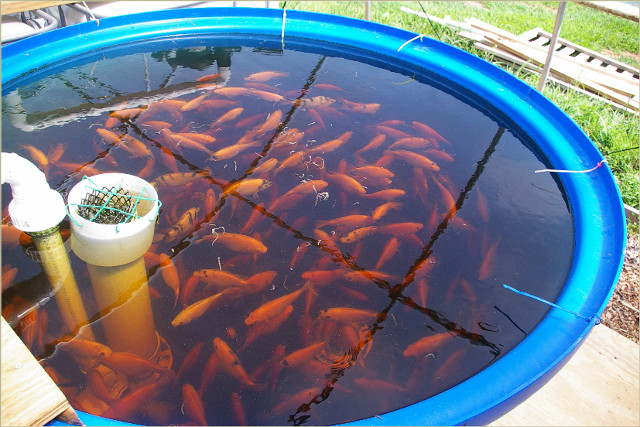 Photo courtesy of UDC.
Once completed, the facility will house garden space, exercise trails, public art, rain and pollinator gardens, a farmers market, and other features.
As for what you’ll find growing there, project coordinators focused on produce with a high nutrient yield, including some specialty crops, such as the green vegetable native to Cameroon known as jamajama.
Cooking classes, demonstrations, and nutrition analyses will also be provided at the new facility—reflecting an outreach trend on food access that Common Good City Farm’s Callahan sees emerging. Several years ago, the dialogue revolved around the quality of food available in schools; now that conversation is shifting to where people live. “A big part is incentivizing programs to actually just grow food in close proximity to people who need it,” Callahan says.