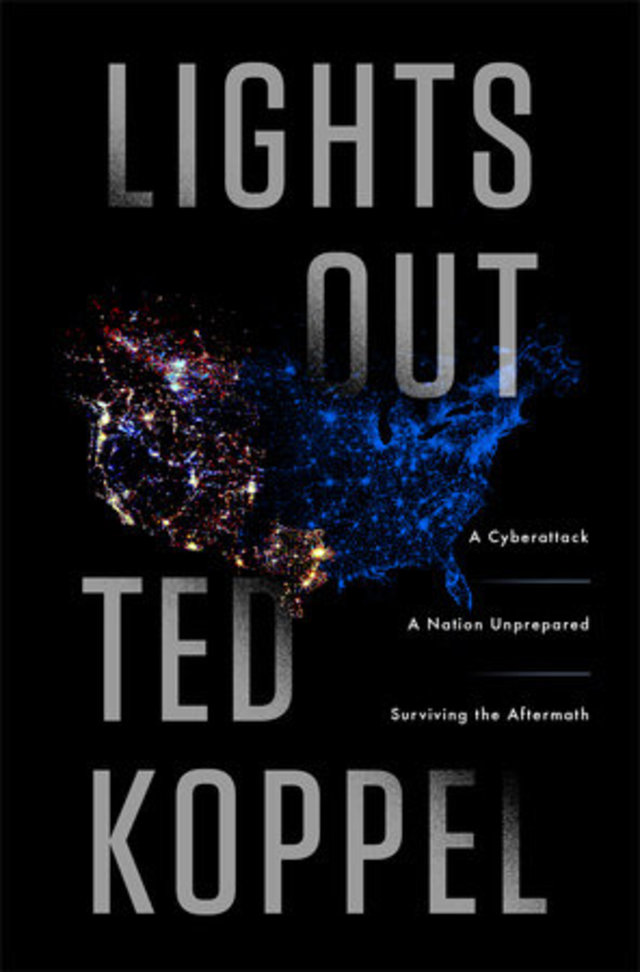
 The challenge is on, D.C.: Ted Koppel says that we, as city dwellers, and the federal government are woefully unprepared for a cyberattack on our power grid. The veteran journalist will be at Sixth and I Historic Synagogue on Thursday, November 12th at 7 p.m. to discuss his new book, Lights Out: A Cyberattack, A Nation Unprepared, Surviving the Aftermath (Crown, $26), with NPR All Things Considered host Robert Siegel.
Cyber hacks of retailers, insurance companies, and affair websites have become a fixture in the news. But we have yet to see (knock on wood) or talk seriously about a widespread attack on our electricity. Enter Koppel, who has extensively researched this possibility.
In Part One of Lights Out, Koppel describes the three electric power grids that the nation’s infrastructure relies upon. An attack on one or more of them, he writes, could cut power to many states for weeks or longer. Even an outage lasting a few days would leave many people without water, sanitation, or food.
“It’s not a question of if” such an attack will happen, “it’s a question of when,” said United States Central Command Commander General Lloyd Austin. According to a former chief scientist at the NSA, China and Russia have already penetrated the grid, though Koppel believes our shared interests make them unlikely to attack. But, some presidential advisors say individual hackers or terrorists are already capable of carrying it out.
It’s one thing for individuals not to have a survivalist kit, but in Part Two, Koppel writes that neither does the government. In an interview with AARP, he said:
The more I looked into it, the more I came to the conclusion that the federal and state governments have done little or nothing to prepare for anything other than the natural disasters we experience every year … Meals ready-to-eat, which are the standard government fallback position, are only good for five years. With tens of millions of people … you’d quickly get into [those meals]. The government is not going to spend billions of dollars for a warehouse full of food that can’t be used after five years. I recommend in the book that we focus more on freeze-dried food, which has a shelf life of 25 to 30 years.
In fact, Koppel told CNN’s Jake Tapper that he was inspired to stock up on freeze-dried food, water, and emergency generators for his family. He continued to AARP, “I don’t see my wife and me sitting behind barred doors with our storehouse of food and water, each of us armed with a shotgun, waiting for starving hordes to descend on the house. ‘We know Koppel’s got food, let’s go get it.’ But I fear that scenes like that could very likely happen.”
Part Three indicates the perfect place to descend upon: Salt Lake City. Koppel spent three days there with the leadership of the Mormon church, and saw their enormous storehouses, dairies, and orchards ready to provide food. “We have a lot to learn from them,” he told Tapper. Members of the church “are encouraged to have at least a three to six months supply of food, water, and extra cash.” He compares their chances of survival as far better than those of Americans living in urban centers.
Koppel hopes Lights Out will spur a government response, but isn’t optimistic. “It might cause a little bit of shouting back and forth,” he said. “In the final analysis, those who say ‘Koppel is wrong’ will probably win because saying that I’m right requires action.”
Koppel was born in England and came to the U.S. in 1953. He was a newscaster for WABC radio before switching to television in 1971 while covering the Vietnam War. He was the anchor of Nightline from 1980 until 2005. Currently, he serves as a senior news analyst for NPR and contributing analyst to BBC World News America.
Tickets may be purchased online. One ticket is $16, one ticket and a book is $30, or two tickets and a book is $40. Seating is general admission and doors open at 6 p.m.