By DCist contributor Elena Goukassian
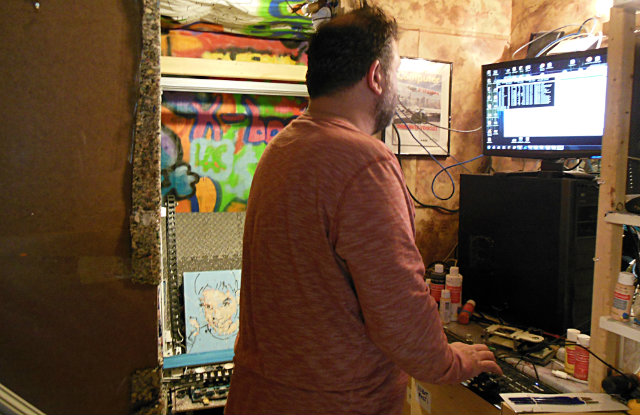
Working out of a closet-sized studio space, an artist in Tysons Corner toils day and night, painting portrait after portrait. But this isn’t your typical starving artist story; our indefatigable painter in question is actually a robot.
Dubbed Crowd Painter by its inventor, software engineer Pindar Van Arman, the robot does more than just paint a pre-programmed image. “Each portrait begins when a user takes a selfie with a tablet,” Van Armen explains. “The selfie then appears on the touchscreen, where lines can be traced over it. Wherever a line is drawn, the robot dips its brush into paint and replicates the stroke on the canvas.” Connected over the internet with its patron, the robot both takes commands from the tablet and uses artificial intelligence to “auto-complete” the rest, or even fix user errors.
“Everyone wants to be able paint a portrait,” Van Arman says, and the robot gives people a chance to do that, regardless of artistic skill. “The robot paints way better than I do,” says Van Arman, who had been painting the traditional way for years and says his dream job had always been to be an artist himself. “I don’t paint on my own at all anymore. Teaching the robot and making it better is my new artistic outlet.”
Crowd Painter is Van Arman’s fourth painting robot, and he’s already working on an updated, fifth version, bitPaintr. (He’s funding it via Kickstarter until mid-November). Van Pindar made his first painting robot 10 years ago. At the time, he was working on a DARPA challenge to build a driverless car. He really enjoyed the project, but found it would be much too expensive to pursue similar projects on his own, without a sponsor of some sort. “I started thinking about stuff I could do myself,” he recalls. “I like painting, so I thought I’d design a robot to paint for me.”
The paintings created by the robot are actually quite interesting, and not just because of how they were made. Like many human artists, the robot has a tendency to splatter paint everywhere and make a mess (Van Arman notes that the robot uses about $10 worth of acrylics every day). “It’s cool when stuff goes wrong,” Van Arman says, pointing out that if it were perfect, it would be nothing more than another robot printer with a paintbrush. The imperfections, in part a result of the collaborative work of a patron drawing on an iPad and AI, add to the compelling nature of the robot’s output.
“It’s kind of scary that robots are starting to do stuff for us,” Van Arman says. “We just started this age where the robots are replacing us.” He notes that human artists are often either fascinated or offended by his invention, and Van Arman compares it to the advent of digital photography and the death of the darkroom. “Robots will soon take the craftsmanship out of art,” he says.
But the robot isn’t completely replacing the human in this case. The fact that it paints through a collaborative process is what makes it different, arguably more successful, and potentially more palatable to the average person. This isn’t a robot replacing people, but a robot working with people to create something new. (Whether that’s more or less scary is a topic for a larger discussion.)
And while Van Arman has programmed his robots to paint quite well (a huge feat in and of itself), they are as yet unable to come up with their own ideas of what to paint or how to frame it, the very reason that digital photography is still considered an art form. Ultimately, Van Arman is the one who decides when one of the robot’s paintings is finished, whether it be a few minutes or 24 hours later. The robot does all of the labor, but most of the creativity—programming the robot, choosing paint colors, choosing and framing the image, deciding when it’s done, etc—still stems from the humans controlling it.
When I visited Van Arman earlier this month in Tysons, Crowd Painter was working on a portrait of a young boy in Toronto, dipping its brush into various shades of blue, brown, and peach and painting the canvas with a mechanical stabbing motion. “Someone in Toronto orders a lot of portraits,” Van Arman says. “The robot’s working on their 14th one.”
Robot painter from DCist on Vimeo.