Rachel Kurzius
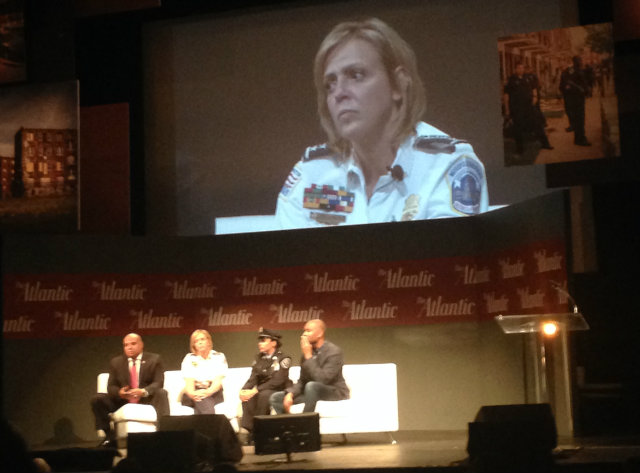 MPD Chief Cathy Lanier in conversation with other law enforcement and Ta-Nehisi Coates. (Photo by Rachel Kurzius)
D.C. Police Chief Cathy Lanier took the stage at Lincoln Theater for a panel discussion with other law enforcement and Atlantic scribe Ta-Nehisi Coates, directly following a conversation about police overreach in Southwest.
The film Think of Calvin captures an incident in 2012, when D.C. resident Calvin Davis was arrested and charged with assault of an officer. The crowd saw clips from the episode, which began when Davis’ 15-year-old stepson, Armonta’e, was biking in the neighborhood. Davis intervened as officers attempted to search Armonta’e. At the time, it was unclear why officers wanted to conduct a search, though they later said it was because he wasn’t riding his bike with headlights.
Davis, his wife Carlet Harris and son Armonta’e Harris, as well as Kelly Amis, Think of Calvin‘s director, talked to NPR Host Michele Norris about the experience as part of The Atlantic’s Race and Justice In America Summit.
Davis asked to speaker with the officers’ supervisor. Instead, they called for back-up.
“All Calvin did was question the police officer,” said Amis. “He spoke. Is that illegal? Is that assault?”
According to D.C. law, it can be. In fact, resisting, opposing, impeding, intimidating, or interfering with officers are all considered fair game for an assault of an officer charge. A project from WAMU found that D.C. employs the assault of an officer charge nearly three times as much as cities of comparable sizes.
Davis spent the night in custody. A court-appointed lawyer recommended he accept a plea of 32 hours of community service in exchange for the expungement of his record.
“I grew up in D.C. The interaction between minorities and police officers is, in my experience, never good,” Davis said. “So I wanted to be done with it.”
While Davis completed his community service by working on a landfill on Michigan Avenue, the charge is now sealed, though not removed from his record.
The experience has impacted how younger members of the family view MPD officers. “Since this has happened, my eight-year-old is terrified of the police,” Carlet Harris said.
As for Armonta’e, now a high school senior, he said that he still rides his bike during the day but, “when it gets dark, I’d rather walk.”
When asked about Davis’ experience with the MPD, Lanier avoided specifics, saying that she just recently saw parts of the footage.
“Anytime I see an interaction between a community member and a police officer that ends badly, it bothers me,” she said.
She went on to say that it “just takes one or two small things to change an encounter with a police officer but once that tension starts, it tends not to stop.” Those small things, according to Lanier, could be coming from either officers or community members.
“Your uniform doesn’t determine authority and respect—your behavior does,” she went on, earning applause from the audience. “Your uniform is going to represent fear and oppression or hope and safety. You decide.”
When asked if police officers were tasked with too much by Ta-Nehisi Coates, Lanier said yes.
“Policing has become a drive-thru 24 hour McDonalds of services,” she said. When pressed for examples by Coates, she said that enforcement of minor regulations might be better served by people without badges and guns.
“The goal should be to put us out of business,” Lanier said. “The goal should be having investments before someone gets in the system. More investments in social services, and less in policing and incarceration.”