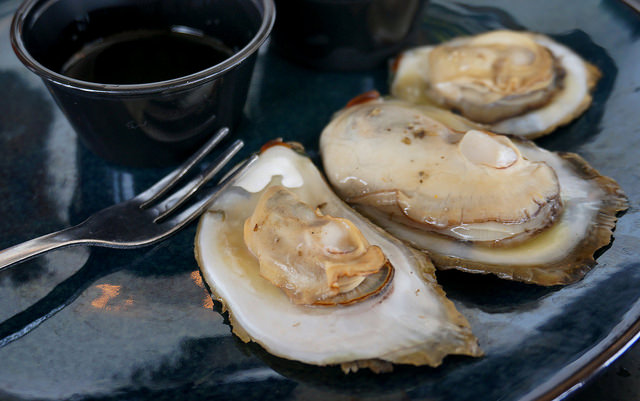
 Photo by LaTur.
By DCist Contributor Bridget Dicosmo
An autumn drive in Virginia now offers something more than just gorgeous foliage—and it lends itself well to vodka shooters and cocktail sauce. Virginia is celebrating its status as the number one producer in the nation of farm-raised and wild caught oysters according to the Virginia Marine Products Board, with oyster roasts and other shindigs that let tourists sample the distinctive flavors each of the state’s seven oyster regions produce.
Gov. Terry McAuliffe designated November as Virginia Oyster Month. And this month marks the kickoff of the new Virginia Oyster Trail—a string of boat tours, local restaurants, wineries, art venues, and cultural points of interest dedicated to showcasing Old Dominion’s favorite bivalve.
“Governor McAuliffe is a huge oyster fan and he challenged those of us in his Cabinet involved with oyster growing, harvesting, selling, marketing, and promoting to come up with unique ideas to make Virginia the rightly recognized home of the oyster,” Virginia Secretary of Agriculture Todd Haymore says. The trail is a tourism development undertaking focused on oysters, yes, but also on restaurants, wineries, breweries, and seafood production sites.
Highlights include oyster chowder made with local pork belly; a church partially constructed from oyster shells; scores of oyster roasts; eco-tours where visitors can join watermen to harvest the oyster beds; and an array of signature wine pairings across the region, says Sherri Smith, executive director of the Artisans Center of Virginia. “It’s all about Virginia oysters, but we know oysters pair really good with wine,” Smith adds.
November and December are prime oyster months, if one takes into account the old adage about oysters being best during months that end in “R.” Of course, thanks to modern refrigeration and Virginia’s burgeoning aquaculture industry, the saying no longer holds much water. “The ‘R’ month adage came about during a time when refrigeration and long-distance transportation was not as easily accomplished as today,” explains Mike Oesterling, executive director of Shellfish Growers of Virginia.
Virginia’s oyster farms, which now account for more than half of the state’s total oyster harvest, Oesterling says, play a role in widening the time frame. Warmer months are when wild oysters are feeling friskier—when they are more focused on reproduction than in putting on body mass. “When an oyster spawns, it becomes ‘watery,’ losing the nice plumpness associated with a tasty oyster,” Oesterling says.
While farm-raised oysters are not genetically modified, according to Oesterling, they are “selectively bred” to produce an extra set of chromosomes that inhibits reproduction, making them “fat, plump, and tasty year-round.”
Travis Croxton, of the Rappahannock Oyster Company, points out that some farms produce both the non-reproducing triploid oysters and the diploid oysters that spawn during the summer months. That process introduces larvae to reefs and boosts the wild oyster harvest. In fact, state and oyster industry officials partly credit the rise in aquaculture in Virginia with bringing the wild oyster populations back from the brink.
The farms take some of the pressure off wild stock, allowing it time to replenish, and the state has sought to strengthen fisheries management of the wild populations. “It’s not coincidence that the rise in the wild population of oysters has increased as the number of aquacultured oysters has increased,” Croxton says.
Virginia’s total oyster harvest, which has steadily been on the rise over the past several years, increased by 31 percent during the 2014 season and yielded more than 658,000 bushels, according to state officials.
On a visit in 2002 to New York City’s Grand Central Oyster Bar, Croxton says, “We were amazed that they listed multiple oysters from a 5 mile radius of the Massachusetts’ shoreline but only one oyster from the Chesapeake Bay.” That observation sparked a “mission” to not only grow oysters by Croxton’s farm by the Rappahannock River, but to establish farms in other parts of the state to “highlight long-forgotten flavors.”
The flavors differ slightly depending on from which of Virginia’s seven coastal habitats your shellfish happens to hail. Pluck and shuck from the tidewater region, and you’ll get mild brine with a sweet aftertaste. “Classic” Bay oysters come from the Eastern Shore’s upper part of the Chesapeake, and they have a balance of salt and sweet with a savory finish, while those from the Western Shore tend to have a sweeter, creamier taste.
Get to know the various regional nuances and they remind you of a “sense of place,” says Croxton, who prefers the Rappahannock River and Chincoteague oysters that remind him of his farms in those waters.
Haymore says he gravitates toward the brinier oysters, preferably paired with a Virginia wine—a steel fermented Chardonnay or a locally brewed, mildly hoppy craft beer.
Looking to develop your own favorite wine and oyster pairings? Here’s a list of Eastern Shore restaurants featuring signature oyster dishes paired with local wines through November.
And if a road trip isn’t in the cards this fall, you can still crack some Virginia oysters at a number of restaurants closer to home. Here are a few suggestions:
- Clyde’s Restaurant Group (multiple locations)
- Eat the Rich (1839 7th Street NW)
- Mussel Bar & Grille (800 North Glebe Road, Arlington, Va., and 7262 Woodmont Avenue, Bethesda, Md.)
- Old Ebbitt Grill (675 15th Street NW)
- Joe’s Seafood, Prime Steak, & Stone Crab (750 15th Street NW)
- Pearl Dive Oyster Palace (1612 14th Street NW)