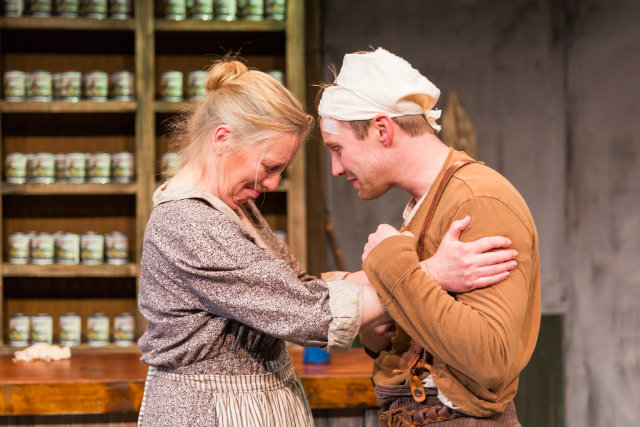
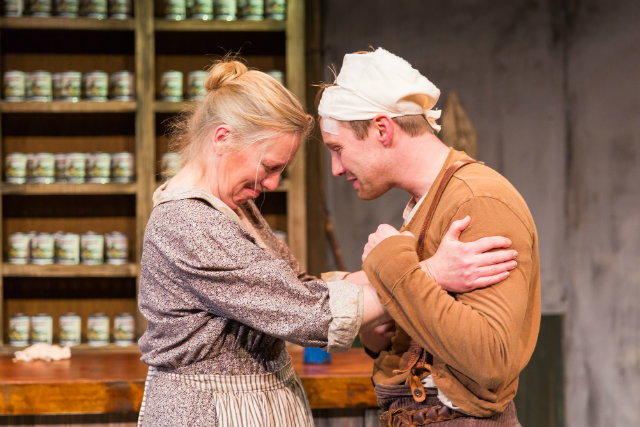
 Nanna Ingvarsson and Josh Adams in The Cripple of Inishmaan. (Photo by Jae Yi Photography)
By DCist Contributor Anya van Wagtendonk
“Ireland mustn’t be such a bad place,” the characters in The Cripple of Inishmaan keep insisting, if exotic foreigners like Americans or Germans continue to visit.
They’re mainly trying to convince themselves, as a way to temper the boredom of their small-town lives, and you can almost buy their logic throughout the play’s first half. Playwright Martin McDonagh has set much of his work in Ireland’s rural provinces, and Cripple, produced by Scena Theatre and playing at the Atlas Performing Arts Center through November 29, begins as a lively character study of the kooks and cretins in one such village. But for all their amusingly rendered color and quirks, Cripple’s characters are, for the most part, profoundly unlikeable. Even Billy (Josh Adams), the titular cripple limping his way towards tubercular doom, is almost so pathetic as to engender no true pathos. Thus, the play begins to drag as the story shifts from portrait to plot-driven narrative; rooting for no one, I was ready to get the heck off the Emerald Isle well before the play’s tragic spiral stopped.
In 1934 Inishmaan, there’s nothing much to do but stare at cows and throw eggs at the neighbors. Everyone knows everyone, and gossip abounds, though it’s mainly harmless. Everyone knows but no one seems to truly care, for example, that Jim Finnegan’s daughter has been around the block town once or twice. The only person who seems to face true cruelty is Cripple Billy (“just Billy,” he begs, in vain), an orphan being raised by two neurotic spinster aunts. The neighbors tell him his parents killed themselves after he was born a freak. Never kissed, he pines after the spunky and unkind Helen (Megan Dominy), who laughs in his face about his condition and affections. So when American film crew arrives in the village, he is among the throngs vying for stardom. Where the rest of the town may crave a change from the mundane, Billy wants true freedom from the pain of his existence.
If that sounds heavy—well, yeah. The play earns its “dark comedy” status purely through dialogue and character choices, not for any actual levity within the story. For this reason, Nanna Infvarsson and Jennifer Mendenhall deserve particular praise as Billy’s eccentric aunts. Together, these two actors feed off one another’s anxious energy, magnifying each tic and every perfectly timed sniff. Aunts Eileen and Kate are totally, earnestly batshit, but so playfully that, under all the crazy, we see two humans who love their nephew.
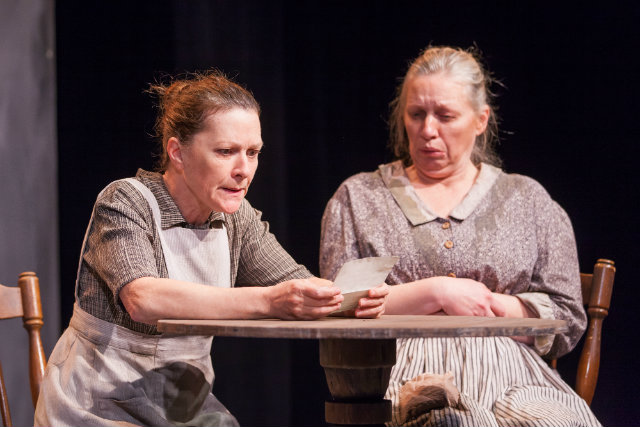 Jennifer Mendenhall and Nanna Ingvarsson in The Cripple of Inishmaan. (Photo by Jae Yi Photography)
The rest of the cast, by and large, doesn’t bring such depth to their performances. Maybe it was the Irish accents tripping up their tongues, but few transcended country caricature long enough to earn an audience’s emotional investment. Take Helen, for example. Billy’s love for this little redhead girl is frankly unfathomable. Helen is awful. She’s pretty and cheeky, which is maybe enough for a small-town boy in the pre-Internet age, but I assume she’s also supposed to be charming or mischievous. Instead, she’s just a bully.
Likewise, Adams’ Billy is flat. His story takes such twist and turns that he often gets lost among the action. Maybe that’s a commentary on what it was like to be disabled at a time when birth defects were scorned. But Cripple is much more about place than about time; Hitler’s rise gets a passing wink, but Ireland is the play’s heart. The strange takeaway, therefore, seems to be a great joke about Ireland itself, which feels inappropriate on an American stage. In the same way that you are the only person who can complain about your mother, it feels funny to laugh at a small, wacky community as an outsider. Because Cripple grants such intimate access to Inishmaan’s townspeople but does not manage to couple mockery with warming familiarity, you end up laughing at a lot of people who aren’t in on the joke.
The Cripple of Inishmaan is playing through November 29 at Atlas Performing Arts Center. Tickets are $25-45 and can be purchased here.