 Rachel Sadon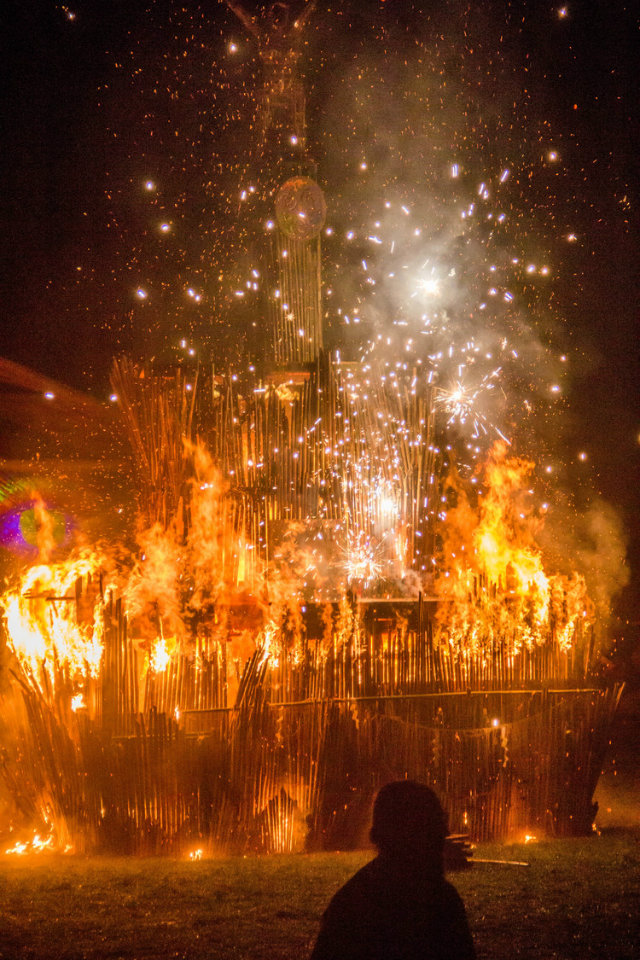
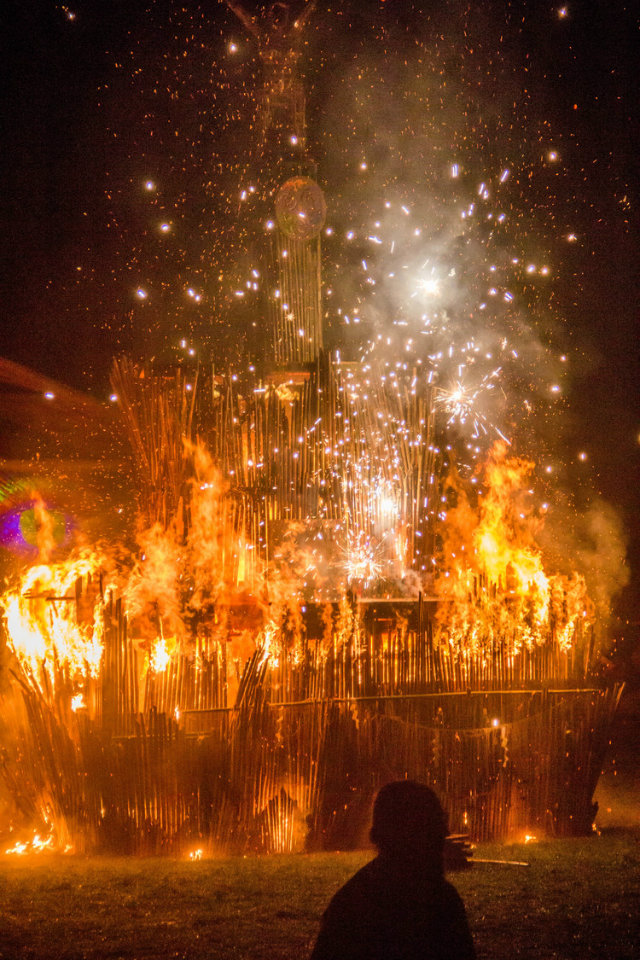 One of Michael Verdon’s previous structures on “burn night.” (Photo by William Tanksley)
For however much D.C. is stereotyped as a city filled with suits and steakhouses, despite all of the new restaurants that open up with the same Edison light bulbs and reclaimed wood and strategically placed succulents, there is still a colorful community of activists who are marching to the beat of their own, well, protest drums.
A mix of lawyers, artists, policy wonks and activists, many of them have come together to plan a seemingly first-of-its-kind event on the Mall. They explain it as visionary art, a peace vigil, an interactive installation; they’re calling it Catharsis.
Starting at sunset, the 48-hour vigil to “heal from the drug war” will commence in the vicinity of the Washington Monument.
“Even though this is about a nightmare—the war on drugs—this event is really positive and inclusive. That’s the root motivation,” says Robert Haferd, a civil rights attorney and one of the event organizers.
The schedule of events includes: yoga, cathartic dancing, speakers (including the lawyer for Freddie Gray’s family), stories from the drug war, and the burning of a specially built structure called the Temple of Essence.
If this all sounds a little like Burning Man, the week-long art festival in the Black Rock Desert, that’s because many of the organizers have been and taken inspiration from the event. But Catharsis isn’t affiliated with the organization.
“Many of us have had the privilege of attending Burning Man or seeing this type of artistic ritual at a festival or somewhere else that’s not really accessible,” Haferd says. “Bringing it to the Mall and making it about a real world issue that affects everybody is the perfect combination of what many of us are passionate about… this is a unique creation of the D.C. creative community.”
They’ve worked hard to get clearances from the National Park Service and D.C. Fire (which will give a final approval once everything is in place on Saturday), including writing up a detailed safety plan. And on the night of the burn, which will begin at 11 p.m. on Saturday night, there will be a perimeter with organizers manning the structure, as well as a fire truck present. Hundreds of people are expected to show up.
“Some people are confused, some are angry, mostly people are curious,” Haferd says about what they’re planning. “There’s no substitute for the actual experience. Once people are there, and feel the authentic engagement that occurs with these structures, the reaction is overwhemingly positive.”
And that is the ethos behind the work of the artist who actually conceived the Temple of Essence, Michael Verdon.
He’s been building, and burning, large-scale structures—perhaps most notably, as a project for his undergraduate degree at George Mason University in the spring—since 2011. The works works deal with themes of empowerment, loss, community, and forgiveness.
“These projects create a space for people to gather and share their stories and realize that they’re not alone in those struggles,” Verdon explains. “When people gather together and share this experience, we take our struggles and our stories and we write them on the object, and we turn our individual stories into collective memory. There is something very powerful about ending in the glow of the fire with a thousand other people that often can act as a catalyst for people to let things go.”
People are encouraged to bring booking documents, probation papers, and other flammable items inside the temple—to be ignited along with the structure.
“We lock away millions of people for essentially nonviolent pseudo-victimless crimes,” Verdon says. “We shame them, we isolate them, we make the problem worse, and it disproportionately affects people that have pigment in their skin.” But with the loosening of marijuana and mandatory sentencing laws around the country, he says “I feel we are at the precipices of the end of the drug war.”
In the meantime, the public can walk into the all-white structure he and a group of volunteers built, which wraps around an inner sanctum, painted black, that represents a jail cell (with a cot and toilet rendered in wood). At the top, thirty six LEDs flash different colors before going all white and blinking off every 19 seconds—the arrest rate for a drug offense in the United States.
Once the conflagration gets going, the jail cell will appear amidst the flames before burning down to the ground.
The whole thing has been painstakingly considered and imbued with symoblism—all for it to turn to ashes. “If we put a stack of wood on the ground and burned it, it wouldn’t have the same meaning,” Verdon says. “When you can tell that everything was considered and touched and not left to chance—you know we put love and effort into it—it allows people to bond it.”
Here, the hope is that it will allow for “healing from the drug war,” says Adam Eidinger, the marijuana activist, co-owner of Capitol Hemp, and one of the organizers. “This is a spiritual thing. This is not a rave. There will be music and dancing—but it is cathartic dancing.”
Says Haferd: “It’s an organic expression on the grandest stage of the community. That’s want I people to associate D.C. with. There’s a beautiful activist creative community.”
For more information and a full schedule of events, see the Facebook page.