Rachel Kurzius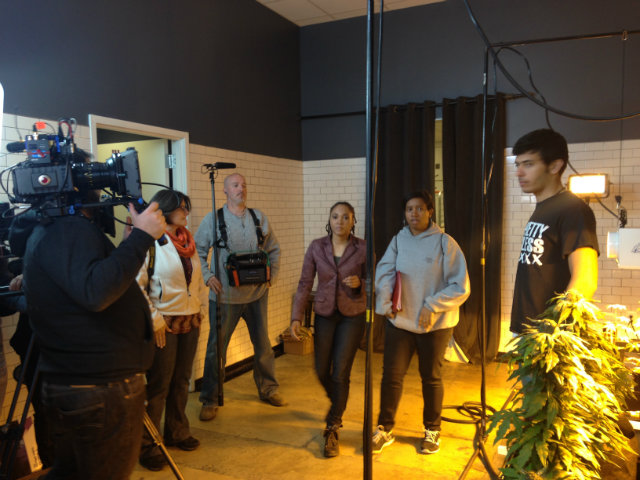
Dozens of differently-sized weed plants grow beneath lights as a plate of cocktail weenies goes by.
Did I die and go to heaven? Nope, I just stumbled on the set of East Coast Grow, currently filming at Brookland’s Mess Hall Culinary Incubator.
The comedic web series from Aboveboard Productions focuses on the D.C. marijuana industry. “It’s a unique setting that has never been approached in narrative,” says Matt Doherty, co-creator and executive producer of East Coast Grow. “It’s an opportunity to highlight the city and a community that you don’t see in other productions. We don’t normally see stuff that gives justice to the culture of this town.”
He has firsthand experience in the ever-evolving world of weed in the District, like managing hydroponic retail stores and consulting for medical marijuana cultivation centers.
Writer/director and co-creator Amy Tasillo came to Doherty with a short script in April, and the two have been working on the show ever since. “It took on a life of its own,” she says.
The pilot takes place before the passage of Initiative 71, which made it legal to smoke and possess marijuana in the city. “It was a lot more restrictive at that time,” Tasillo says.
East Coast Grow focuses on Mike—one man who, even with Initiative 71, cannot be a part of the weed industry because of a previous misdemeanor possession of cannabis charge (that is part of the law.)
“It’s focusing on him trying to navigate a system he knows so much about, but isn’t allowed to be a part of,” says Tasillo.
At-large Councilmember David Grosso, who attended part of the filming on Saturday, says that, “You can explore a lot of complexity through comedy. If all you have is a marijuana offense, I think you should be able to work in the industry.”
Theo Copeland, who plays Mike, travels from Brooklyn for filming. He describes his tactic for acting stoned as: “smile a little more than you thought and it’s all good.”
Doherty is glad to bring a more nuanced characterization of potheads to the fore. He says most stoners in film are “aloof, ignorant, dopey people. In D.C. we have government lawyers smoking up every day, and they’re good at what they do.”
Other than Copeland, the other four actors are from the D.C.-area. The cast beat out more than 400 people for the roles. “We thought we’d get 100 at the most,” says Doherty. “It felt like in Jaws: ‘I think we’re going to need a bigger boat.'”
Actor Greg Crowe, who plays dispensary owner Aldo, says that the production’s ability to pay actors upfront contributed to the huge casting call response. “That’s commitment I want to be a part of,” says Crowe. “If they’re not paying upfront, it often doesn’t get done and it wastes everyone’s time.”
Doherty declined to comment on where the investment for East Coast Grow comes from, saying only that it was “an in-house process.”
D.C. native Devin Nikki Thomas relates to her character Tia, a fixer with a brother incarcerated for a drug offense. “We can literally walk outside and see someone affected by ineffective drug laws,” she says. The show is a “social justice piece wrapped in comedy.”
At Saturday’s filming, Doherty called out the D.C. Office of Motion Picture and Television Development. He acknowledged that the office was helpful with permits, but “we wanted them to be here. We wanted to put a D.C. Film logo at the end of the show. They said the content was too questionable.”
The D.C. Office of Motion Picture and Television Development does not dispute Doherty’s account. “We support all filming in Washington D.C., but we just felt because of the sensitivity of the subject matter, we didn’t want to touch it,” communications director Pharoh Martin told DCist. “This is really the only subject where I’ve seen that happen. It’s not a position. We just decided not to attach our logo to it … to not [have to] field these phone calls.”
But Grosso says that East Coast Grow could be a way to “reduce some of the stigma around marijuana and growing it.”
Hemp Butter CEO Kyla Hill was one of many members of the D.C. marijuana plant business community in attendance. “The stigma is real,” she says. “This show could go a long way towards helping people get a better view of this side of the industry. I mean, no one has even seen a grow house before.”
If all goes to plan, audiences will be able to view East Coast Grow right around 4/20 of next year, after a winter of editing.
“We have had interested parties and we’re interested in going through larger channels of distribution,” Doherty says. “I think we’re going to have the opportunity to gage different options. I’m hoping we get a wonderful deal but if not, we’ll launch it through our own website.”
There’s one burning question, though. Are the cast and crew enjoying the fruits of Initiative 71?
Copeland doesn’t during filming. “If you’re working, which we are, you want to be sharp.”
Neither does Doherty. “I do smoke a lot, but when it’s work time I try to not be too fucked up,” he says. “After the work is done, though, let’s burn one down.”