 Rachel Sadon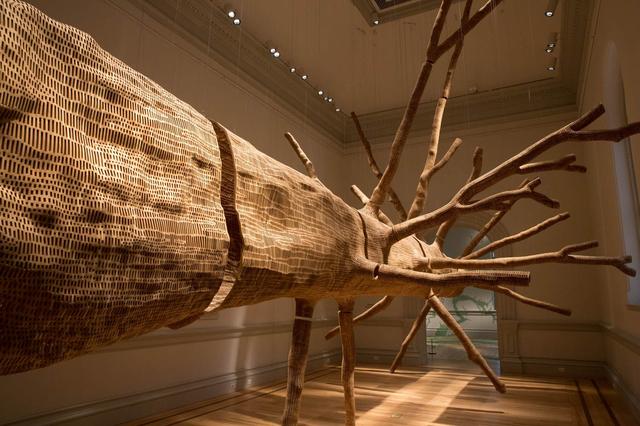
The numbers behind the nine dazzling artworks that make up the Renwick Gallery’s new exhibition are staggering:
A room awash in pink is covered in 5,000 insects. The room-sized tree lying prone on thin air is comprised of 500,000 individual blocks of wood. The towering, sinuous rainbow is actually 6 miles of embroidery thread.
Perhaps even more surprising, though, is the number of people who have come to see WONDER, the museum’s debut after a two-year renovation. At times, the line has stretched up the block, poking into the midst of tourists gawking at the White House, the Renwick’s rather more famous neighbor. On the first three days of the show, one of the Smithsonian’s most under-the-radar museums saw well over 20,000 visitors.
“I’ve never seen a line before at the Renwick,” says Nicholas R. Bell, the Fleur and Charles Bresler Curator in Charge at the Renwick Gallery. “The response has been beyond our wildest dreams.”
Last Saturday, the second day of the show, the staff had to initiate impromptu crowd control in certain galleries; 1,500 people came an hour, and they had no plan in place for the flood of interest.
Some of the curiosity, no doubt, arose as a result of the otherworldly images of the works that have been popping up on social media. Signs beckon to visitors: “Photography Encouraged.” And the results have been stunning (see above).
Still, there is no substitute for the real, awe-striking experience. And that was the whole point of the exhibition.
“We need places where we can go and be swept away,” Bell says. “Even if it doesn’t for every visit, or for everyone, there need to be public places in our society that have the potential to carry us out of the every day.”
There have been several significant moments in the building’s history where commitment to that mission has wavered; Bell points out that this is the third time that the Renwick has re-opened as an art museum in three separate centuries.
“Do we put time and money and effort into considering the contributions of American culture? There have been multiple times in the past 150 years where we have gone back and forth on the issue,” Bell says.
The short version of the building’s history: James Renwick Jr. built the nation’s first museum dedicated to art—and chose a location within a few feet of the president’s home—to showcase the collection of William Corcoran. But just after the “American Louvre” was completed in 1861, the Union Army occupied the building. It was eventually returned to Corcoran, and opened as an art gallery in 1874—only to become the home of the U.S. Court of Claims from 1899 to 1964. In the middle of the 20th century, Congress proposed tearing it down to make way for a hulking office building. But after lobbying from First Lady Jackie Kennedy (“we credit her with being our patron saint,” Bell says), the building was returned to the Smithsonian for its original purpose. It re-opened in 1972 as a facility dedicated to art, crafts, and design.
“The building is our most precious object,” Bell says. “We’re saying we’re reinvesting in Corcoran’s original mission.”
Much of the work isn’t visible to visitors—roof insulation, new LED lighting—but it is ensuring the museum holds up for the next few decades.
In the museum’s future is a less narrowly defined definition of craft than what previous visitors might expect, one where artists may use computer modeling while still being dedicated to handwork. “Attitudes toward craft in the 21st century have changed,” Bell says. “It’s a whole way of considering materials and skill and those values that is different than what it was in the last century. We’re increasingly looking at how craft informs lifestyle not just in the fields of art but science, design, technology, and so forth.”
Which is where WONDER comes in. The curators went out and sought artists who identify strongly with handwork—you can see it in the meticulousness of all the half a million individually tied knots in “1.8.” They’re also artists whose work demands your attention.
“We are really going out and seeking to provoke awe, trying to trigger a physiological response to the museum—let yourself be washed over by it,” Bell says. “We’re reminding people of the value that’s inherent in the personal, physical visit to the museum—showing people quite literally why this building matters, why it has always mattered and why it will continue.”