Rachel Kurzius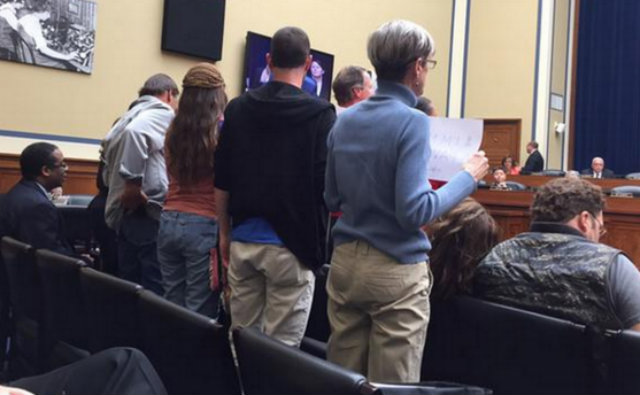
Updated with comment from the U.S. Attorney’s Office
“I’ve sued a lot of people in this town over the years,” says D.C. activist Adam Eidinger. But he has been at the District of Columbia court most recently as a defendant. And next Tuesday, he’s going back to see if the government will retry its case against him after a mistrial.
The unlawful entry charge stems from a House Oversight Committee hearing last April, which Eidinger and a number of other D.C. activists were attending. Members of D.C. Vote created a disturbance that resulted in their removal from the hearing room.
photo shows me & @aeidinger seated as others disrupt yesterday’s deplorable @jasoninthehouse hearing
@OversightDems pic.twitter.com/4oxYKrPXSn
— Kathleen Frydl (@kfrydl) April 22, 2015
Eidinger says that he purposefully did not take part in the protest, despite being asked, because he wanted to witness the full hearing. When he refused to leave after police told him to, he was arrested.
The man who kicked him out was Sean McLaughlin, the outgoing House Oversight Committee staff director. When McLaughlin testified, he said that Eidinger was part of the protest.
“It’s guilt by association,” Eidinger says. Should the government retry its case he says he will enter additional evidence, including a video that he claims shows he was not participating in the protest.
However, he was a known quantity to Committee Chair Jason Chaffetz (R-UT), due to Eidinger’s activism on behalf of Initiative 71 and D.C. statehood. “Chaffetz and I have had a lot of run-ins since the beginning of the year,” says Eidinger, who believes that, “They object to my entire lifestyle. They look at me and say, ‘That fornicator.'”
Congressman Chaffetz and his office declined to comment.
The case hinged on whether McLaughlin had the right to kick Eidinger out of the hearing, and if the activist had the “good faith belief” that he should stay. Ultimately, six jurors thought he was guilty, five thought he was innocent, and one remained undecided.
Mike Rothman, the attorney representing Eidinger pro bono (“I saw this was someone whose rights were being trampled,” he explains), thinks that the mistrial results from a “philosophical split in the jury reflective of any jury in D.C…between those who say that it doesn’t matter whether a person was creating a disturbing event, because if a chief of staff orders you to go, you’ve got to go. On the other side is people who think you can’t be ordered out if you’re not doing anything disturbing.”
Eidinger agrees, though he characterizes the first group as those who took the “sheeple position.”
He says that he thought his chances “looked really good” based on his perception of the jury’s reactions as the government presented its case. “We were worried we were wasting the jury’s time so we decided I wouldn’t testify and Representative Eleanor Holmes Norton wouldn’t testify.”
Now, he regrets that decision. If he could do it over again—and he might have to—he would take the stand and have Congresswoman Norton testify as well. The Congresswoman, who witnessed the arrest, signaled her willingness to do so.
“The notion that congressional staff, even if authorized by a Member of Congress, can determine who can stay or go during a committee meeting is a very dangerous precedent, and may be unconstitutional as applied in this case,” she said in a release. She also expressed doubt that “the government will be able to find a jury of 12 D.C. residents willing to convict a fellow resident for peacefully sitting in a committee meeting about overturning a local D.C. law.”
The U.S. Attorney’s Office, which brought the case against Eidinger, isn’t indicating yet whether or not it will retry him. “”We’re reviewing the case and have no further comment pending the hearing next Tuesday,” Bill Miller, the spokesperson for the U.S. Attorney’s Office, told DCist.
In the interim, Eidinger is not allowed to go into the Rayburn Building. “It keeps me away from hearings and I work in drug policy,” he says. “I can’t even go to my own representative’s office.”
The maximum penalty for the unlawful entry charge is six months in prison and a fine, though Eidinger says he will not take a plea deal that involves community service. “I see it as a form of slavery,” he says. “It’s all cleaning up disgusting toilets and sweeping up toxic crap on Rhode Island Avenue.”