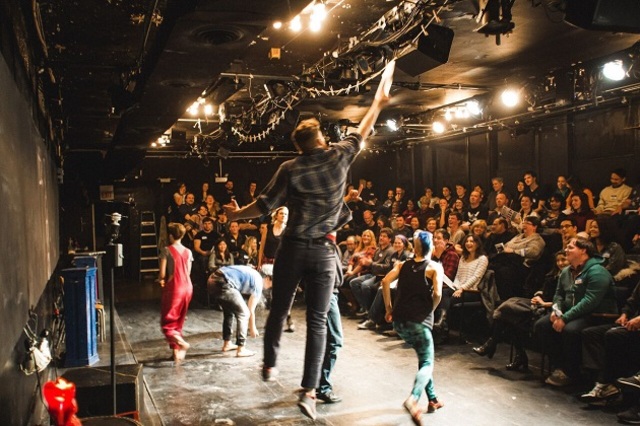
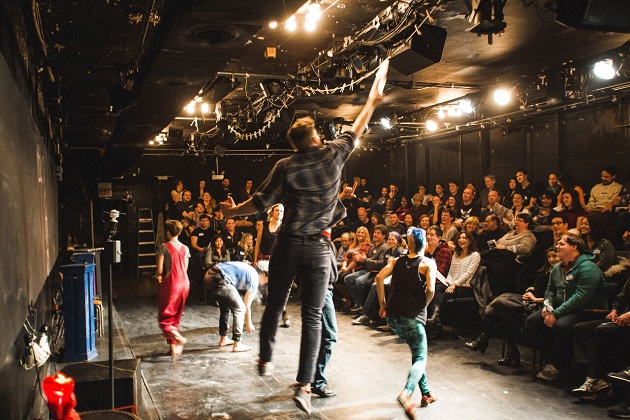
 A Neo-Futurist leaps for the final of 30 plays at a performance of Too Much Light Makes the Baby Go Blind. Photo: Joe Mazza Brave Lux
The Chicago Neo-Futurists are making their fifth return to Woolly Mammoth Theater this month, with their crowd-pleasing 30-plays-in-60-minutes show, Too Much Light Makes the Baby Go Blind. The show is always evolving; not only will it be completely different this year than it was in any previous D.C. run, the mini-plays will also be updated through their run at Woolly. We spoke with Neo-Futurist Artistic Director Kurt Chiang about what to expect this year.
DCist: The Neo-Futurists have been performing this show for years now, with the content always being updated but the structure (as far as I’m aware) remaining unchanged. How has the show evolved over the years?
Kurt Chiang: It’s true: Too Much Light Makes the Baby Go Blind has retained a lot of what it always has been. A dark room timer ticking down [60] minutes, a clothesline holding up 30 pieces of paper indicating the numbers one through 30 on them, with different play titles written on the back. The audience enters and pays a sum of money plus the roll of a six-sided die. They are name-tagged a new name and they sit in the audience, listening to music, until the show starts and a Neo-Futurist tells them the rituals and rules of the show they are about to see. And then a group of Neo-Futurists attempt to perform that evening’s plays in 60 minutes or less, or fail at the attempt.
So, a majority of the change comes from the active ensemble that is in Chicago, which is always a mixture of people that have just been cast, or veterans of three, five, seven, ten, or maybe even 27 years. That’s where the big change is. Ensemble members bring new ways of doing Neo-Futurism every year. Dave Awl introduced a lyrical, symbolists language in his plays. John Pierson pushed on what a metaphor can be in a realm of extreme “truth on stage.” Diana Slickman simply made everyone want to write better. Jay Torrence—image, movement, physicality, and clown. Dean Evans—clown, mime, fucked up comedy. Bilal Dardai—a keen, insightful, fun socio-political voice. Megan Mercier brought modern improvisation and sketch comedy sensibilities. That’s just a smattering. Every single ensemble member is dictated (by the aesthetic, but also the nature of being an independent artist) to bring what tools they have to the table, and the material, content, and structure itself can’t help but be changed. What’s allowed the structure to hold up is a finely tuned, ensemble-built practice of what we like to see, how we like it to be done, and the method in which that work is brought into the show, through our company.
What’s the creation process like for writing and workshopping these short plays? How many ideas ultimately don’t make it to the stage?
We are a company of writers first, but I mean that more like “creators.” It’s mostly like writing because we put it all on a page before we bring it to each other on a Tuesday rehearsal, where we pitch our plays for the week to each other, mostly by reading what is written. But sometimes that play might be in the form of a dance that we try to roughly show to the group. Or it’s a weird concept or joke. However we need to show our peers what the play might look/feel/be like for the audience that coming week, we pitch it to the best of our ability. After everything has been pitched, we discuss every play. This part is much like a writer’s critique, if you have ever been in a writer’s workshop setting. We talk about what works, what doesn’t, and do it in a tactful, respectful manner. After everything has been discussed, we work on picking what should go in the show. It all takes about two hours (we value time in all parts of our process). Once everything is picked, we quickly tech and rehearse plays that night, if needed. Then we go home, and memorize. Then we show up on Friday and rehearse a little before we throw the thing up for an audience.
We write plays all the time that aren’t picked. That speaks to something [else] we value, which is to not be too precious about our creations. It’s prevalent in everything we do. It’s a real danger in our type of theater, which is so attached to our feelings and lives, for it to be completely insufferable. Or [diary] theater. We cut that by being diligent in giving each other feedback, and remaining true to our process of critique and ensemble trust. That’s not to say we don’t take risks: with our content, or emotions, or the audience experience. We do it all the time. But every strong artist choice is backed by our ensemble’s process, so that everything we put before our audience has gone through the group, in a practiced and purposeful way.
What has been your favorite way an audience has reacted to one of these plays?
I don’t have a favorite way that they react as much as I favor that they react at all. When I did other theater before doing this, I was happy if the audience clapped at the end, or laughed at the funny parts. Here, I’ve made someone scream with joy by handing them a flower, I’ve grossed someone out by putting my mouth to raw meat, I pissed off someone for making them go buy me a bus pass in the middle of the show. People email me, asking about a song they liked that I used in a play, or challenging me on a topic I put forth in a play. This is only from my experience. All the Neos have experiences like these with audience members, and they’re all completely different. We never just go for a laugh, or a shock. We simply talk directly to them, and see what they say back.
The Neo-Futurists are famous for crafting plays with a “possibility of failure.” Do you discuss any sort of contingencies for things going wrong, e.g., an audience that doesn’t yell out any numbers?
We embrace and love failure. We try things in plays that we might never do again, just because we want to see how it plays out. We stretch our own parameters as writers and performers. If we intend that an audience find our play funny, but they just don’t, that’s fine, we’ll keep making them for next week, see what lands next week. Neos in Chicago keep doing it for many years, and it’s a practice that we live and work in, as opposed to a product we try and churn out on a weekly basis. I think we’re a rare case where our “process over product” business/artistic mentality pays out, and gets a following and response from an audience.
To answer your question more directly, yes, contingency plans exist, but they’re grounded in common sense, and respond to extreme risk. If the audience doesn’t yell numbers, we’ll just….remind them to yell numbers. Remember, we’re ourselves. We don’t play characters. We’re always where we are. So if something isn’t quite right, for the flavor of the show, we can stop and say, “Hang on. We need to make this clear.” If you have people into your home, and everyone’s standing, you say “Hey. Take a seat. Make yourself comfortable and this is going to be a lot more fun.” I don’t think we have the same paranoia that another type of performance might have. We don’t have the same stakes as a group of high-wire performers. We’re more casual than that.
So, doing up to eight shows a week while you’re at Woolly is a little different than your normal schedule, and I gather you’re using the same 30 plays (though told in a different order each night) during the run (or am I wrong about that?). Was the process any different for putting together or selecting the shows for this run at Woolly?
Good question, because this is important for the audience to know. Actually, we are changing out plays as we go. We’ll usually do this if we go on a tour that’s a little longer than one weekend. In this case, we’ll roll a die onstage every other night, and switch out between 1 and 6 plays from the menu, for a slightly different menu the next show. So people can come back and see some new stuff (and some new Neos, as the cast will change starting Christmas week). When we travel, we use archived material—that is, plays that we have premiered at the home show in Chicago. Generally we don’t write new plays on the road. So seeing a touring Too Much Light is like seeing a medley of our favorites, or the best-of-the-best, or plays we thought would land for that particular crowd. For D.C., obviously it’s a politically charged city, so we’re bringing plays that might have a point-of-view geared towards social justice, current events, political humor, etc. But also the Woolly Mammoth stage is way bigger than our theater, so we’re also thinking of plays that will fill that space. It can be a challenge to bring our show to a new place, but we’ll be there for a while, so we’ll start to make ourselves at home as we get used to it.
TOO MUCH LIGHT MAKES THE BABY GO BLIND runs at Woolly Mammoth Theatre Co. through January 3. Tickets are available online.