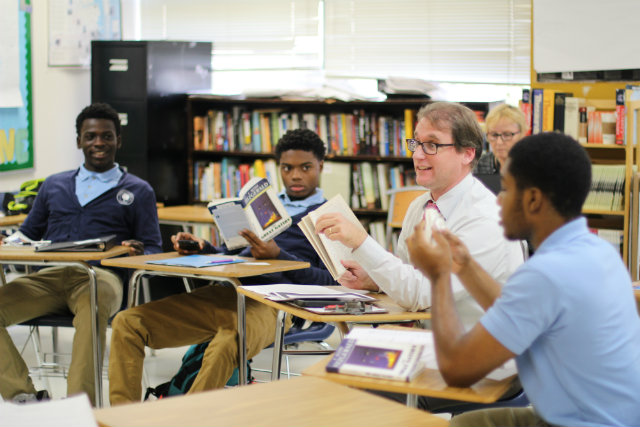
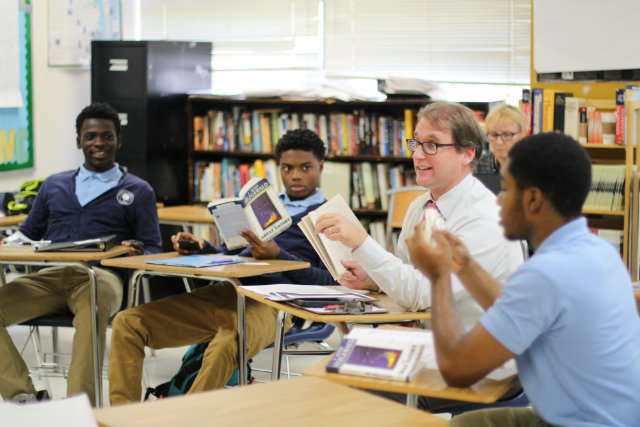
 Photo courtesy of The SEED Foundation
The holiday season is Topher Kandik’s favorite time of the year. “Students start coming back from college and they reminisce about the books that they read in my class—it’s really gratifying to hear them say that they felt prepared talking about Shakespeare in college,” says Kandik, an English teacher at The SEED School of Washington, D.C. in Southeast.
“It’s very refreshing to see students become grown and successful and doing things that make me proud,” he continues. “It’s a long game, but that’s one of the great rewards of being a teacher.”
Yesterday, Kandik was named the 2016 District of Columbia Teacher of the Year, making this holiday season especially significant. State Superintendent of Education Hanseul Kang presented the award in a surprise visit to the Ward 7 charter school.
Kandik is now entered into the National Teacher of the Year competition. He also has an extra $7,500 in his pocket that won’t be used for school supplies. #8220;I’ll probably put some toward a vacation with my family this summer and save the rest for a down payment on a house,” he says.
After receiving a graduate degree in education from George Washington University, Kandik started his teaching career at SEED nine years ago.
As a former fundraiser at the Shakespeare Theater, he’s become known for integrating arts into his curriculum. He’s brought students to the White House for poetry workshops, had students’ original short stories and poems published, and welcomed several MacArthur Geniuses into his classroom to discuss their work.
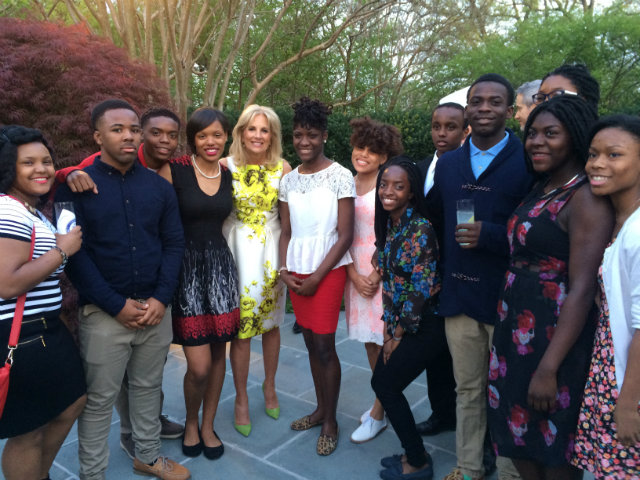 Topher Kandik’s students with Dr. Jill Biden at her home. Photo courtesy of Topher Kandik.
Currently, Kandik teaches four English classes to the sophomores and juniors. But, he says, “A good majority of the reason that I was nominated and got the teacher of the year award is because I also taught some elective classes.”
He conceptualized one of those classes while visiting New Orleans’ lower ninth ward a year after Hurricane Katrina. “I became overwhelmed with emotion by the devastation of the lower ninth ward and the quietness of it… there were no kids around—you would see stragglers here and there, but there were no schools… there was nothing.”
Then he began thinking about his students and their similarities to children who once lived in the abandoned New Orleans neighborhood. “And I thought, what if something like Katrina happened in Washington, D.C.? Who would be the ones swept away and chased out of D.C?” Kandik says. When he posed the question in class, “the resounding answer was that it would be students who looked like the ones that I teach.”
Kandik’s course, called Why New Orleans Matters, allowed students to compare and contrast low-income communities in New Orleans and D.C.
“New Orleans has great culture, amazing amenities, and everyone wants to go to it,” he says, adding that D.C. has similar things. “So the conclusion we came to is New Orleans matters for the same reason that D.C. matters—there’s so much here to protect that could actually be washed away if we let it, so we have to start evaluating ourselves and thinking about ourselves in a serious cultural way.”
Kandik’s also used his creative side during the course.
“I try to disrupt traditional notions of education,” he says, explaining how he took students grocery shopping to cook jambalaya and invited journalists and jazz musicians to the classroom.
But the course took flight—literally—when students suggested a trip to the Crescent City, prompting Kandik to have them create a budget and itinerary.
“This New Orleans class was the epitome of learning real world things, but in a way that inspired students to do it on their own,” he says, “because if I sat them down at the beginning of the year and said ‘now research how much it costs to get to New Orleans,’ they would have said ‘I don’t care’ and I would have lost them immediately.” But since it was the students’ idea “it’s not like work anymore, it’s like I’m going to find this out—and that’s how you get them.”
The students went to New Orleans that year for a week, and different classes did so for three years to follow.
In sum, the New Orleans class illustrates Kandik’s teaching philosophy. “The most important things to learn in school is that you matter, your voice counts and to be engaged in life,” he says. “And I would say my goal for kids is to know that they matter and to teach them that because a lot of them don’t hear that in a positive way all the time.”