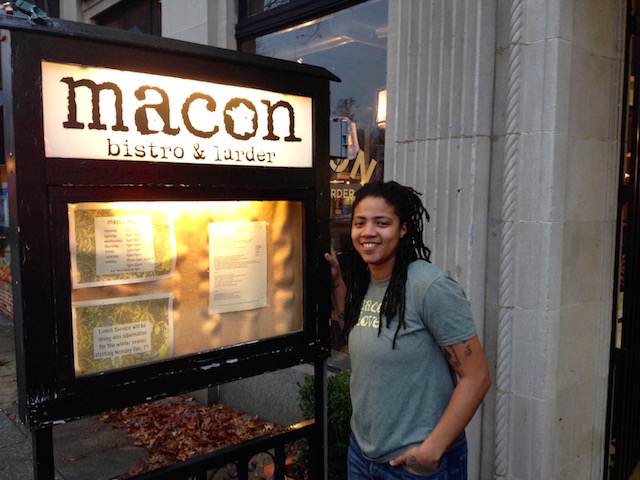
I didn’t know what to expect when I entered Macon Bistro & Larder (5520 Connecticut Ave NW) for a solo blind tasting of spirits. Beverage director Andra “AJ” Johnson waives me over to a half dozen pairs of snifter glasses on the bar with about an ounce of liquor in each. “Is this all for me?” I asked her. “Guess what’s in the glasses. I’ll be surprised if you get them all,” she tells me. On closer examination, I see she’s placed cards at each glass, presumably with the identity of the alcohol and its price obscured on the bottom side.
I set about my task with gusto and a little humility. I correctly identified something red that was unmistakably Campari and an orange cognac that had to be Grand Marnier, but I was unsure about so many others. There were cloyingly sweet dark rums, hot and lightly flavored bourbons, and gins that were undistinguishable from any other London dry style. What surprised me, with nearly every card Johnson flipped over, was that the brand name liquor was so much more expensive than its low-batch production competitor. It was even more surprising that I often preferred the lesser-known spirit.
That, of course, is Johnson’s point. She’s shaking up Macon Bistro’s beverage program by experimenting with small batch production spirits. This is good for keeping costs low and good for the guests, who benefit from lower-priced cocktails. What used to be a $15 dollar Hendricks or Bulleit bourbon cocktail can now be sold for $12 dollars. It also gets drinkers to try new things. “For me it’s about what’s in the bottle,” Johnson says. “If I can save the bar and other people money while educating them, that’s great.”
Saving money by buying limited, low-production products seems counter to the rule of economies of scale, but the liquor market is complicated. Small alcohol manufacturers only produce as many bottles as they can sell, which means that they have more flexible pricing. They don’t have the cost of worldwide advertising campaigns that larger companies do. Meanwhile, liquor distributors that fill bar orders have the buying power to offer a wide selection, but most consumers stick with known brands anyway.
Johnson’s substitutions favor more interesting and bolder flavors that will benefit Macon’s cocktails. She’s swapping a $38 dollar bottle of Hendrick’s at 40 percent ABV for a more citrus and herbal 46 percent ABV and only $20 dollar Green Mountain gin. Blackwell dark rum that will replace Goslings in Macon’s Dark And Stormy is five dollars cheaper per bottle “without that sweetness that makes Goslings taste like Coca-Cola, ” says Johnson. Bulleit bourbon for $32 dollars loses to the higher vanillin and ABV of Traverse City bourbon at $28 dollars. And Beauchant orange liqueur’s light, elegant flavor beats the sugary and $13-dollars-pricier Grand Marnier.
Macon’s cocktail menu further disassociates from branding by not listing any brand names in the drink descriptions. “Why say Cocchi vermouth when ‘aromatized wine’ will do?” Johnson says. And that makes sense. If you think about it, the cocktail program is the only part of a restaurant with such strong brand identity. We don’t see chefs, for instance, beginning new recipes by saying “I want to choose only the most popular brands of ingredients.” But that’s the extent to which brands influence cocktail menus.
Very few restaurants I’ve visited make no mention of brands on their cocktail menus. The menu at Zentan (1155 14th Street NW) features none, except for the description of Vice And Virtue with Deep Eddy’s Ruby Red grapefruit vodka, as opposed to plain vodka. Oyamel and Hill Country Barbecue on 7th Street only include brands of mescal or bourbon that are used in punches or infusions. And Zengo, also on 7th, doesn’t name brands for some cocktails, but names tequilas and rums to differentiate their many Mojitos and Margaritas. These restaurants are a small minority that have shifted focus of their cocktail programs toward greater creativity.
The Oval Room’s (800 Connecticut Avenue NW) head bartender Max Hill has no need for brands. His inspiration comes from flavors he is trying to create from memory. His tropical Hummingbird Charm gets its flavor from whole pineapples cooked—skin and all—down to a syrup that is strained and combined with Angostura rum (not a brand, an origin) and spices. “I had several Afro-Caribbean friends when I was growing up,” says Hill. “Their mum’s made pineapple juice from the skin, boiled it down with butter until it is all caramel and…nothing.” The pineapple flavor in Hummingbird Charm is a culinary experience, not something that can be attained with store-bought juice.
Likewise, Hill’s Mycelium Tremens is a nutty brandy drink with Hill’s real kola nut syrup that reminds me of Crystal Pepsi. It is also the first drink I’ve had that gets its flavor from the fungi kingdom in the form of a porcini mushroom and salt rim. Only a cocktail chef like Hill could come up with these addictively sweet and salty flavors.
The beverage shake up at Macon allows Johnson the freedom to create some stiff drinks, too. “I’m not into syrups,” says Johnson. “I like to work with the flavors of the liquors themselves.” It shows. The Sang et Fume is a smoky and spicy mescal cocktail with bitter orange liqueur, bitters, and a smoked espelette chili rim. The smoke and spice hit first, quenched briefly by lime, but the finish is long with smoky orange bitterness. She also makes the Delgres with a little known Damoiseau VSOP French rum, sherry and cardamom bitters—all spirits—on the rocks. “I make drinks I would go out and look for,” says Johnson. “It’s about knowing what you’re asking for. If you have a nice spirit, why cover it up?”