 Photo by LaTur.
Each month The Federal Forager explores some of the perks, puzzles, and pitfalls of eating and living more organically, locally, sustainably, and creatively in the D.C. region.
By DCist Contributor Bridget Dicosmo
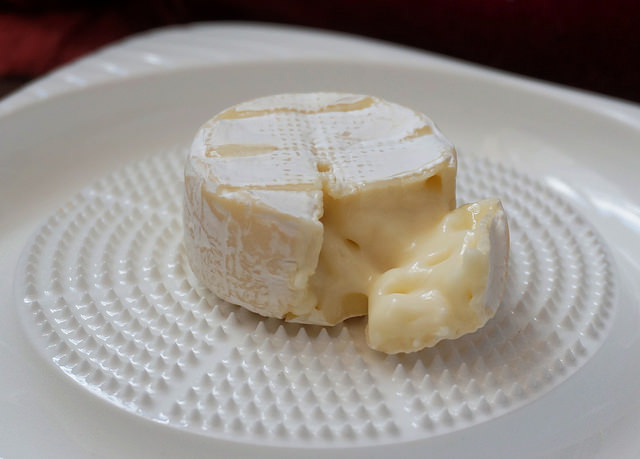
What do tuna tartare and beef capaccio have in common with a really good wedge of imported Camembert? Well, besides their deliciousness, they all start with the raw form of their main ingredient: fish, meat, and milk.
Although, given that the U.S. Food & Drug Administration requires that any raw milk cheese sold in the United States be aged for 60 days (with further importing restrictions for certain types of “soft” cheeses like brie), the actual rawness is up for debate.
“In the U.S., we don’t even have the benefit of knowing what a raw milk brie tastes like,” says Amy Gomez, regional specialty coordinator for Whole Foods’ Mid-Atlantic region. Gomez oversees the region’s cheese program, which at any given time offers between 20-30 raw milk cheeses.
“It’s disallowing a lot of really great European cheese,” adds Mike Bowers, owner of Bowers Fancy Dairy Products in Eastern Market, which carries a wide assortment of raw milk and pasteurized cheeses.
In fact, much to do with raw milk or raw milk products is still up for debate. The health benefits—and the risks—are contested more hotly than the minimum 161 degrees Fahrenheit to which milk is heated during pasteurization. “There’s a whole plethora of people talking about it,” Bowers says of the debate.
A quick rundown on the basics: “Raw” in this context refers to unpasteurized. The FDA warns that unpasteurized milk can carry harmful bacteria, which are responsible for food borne illnesses and other ailments. Pregnant women, children, and those with otherwise weakened immune symptoms are considered especially at risk from such bacteria.
In fact, the purpose of the pasteurization process, in which milk is heated to a high temperature, is to kill microorganisms that can cause illness. But that can be a double-edged sword, as “pasteurizing gets rid of the bad and the good bacteria,” Gomez says.
Raw dairy defenders swear by the health benefits of milk in its purest, least processed form—and stand by consumers’ right to have access to it. Advocates say that pasteurization depletes valuable enzymes and nutrients that can aid in curbing allergies, asthma, and other health problems. Moreover, they say that getting milk from healthy animals in sanitary conditions can mitigate many of the bacteria risks.
And the flavor associated with both raw milk and raw milk cheese is generally considered more unique. “Pasteurized milk has body but not really a flavor,” says Karine Bouis-Towe of Rocky Ridge Club, a D.C.-based private buying club that organizes purchases of fresh milk products, butter, cheeses, pastured meats, wild caught fish, and other Maryland and Pennsylvania farm offerings.
“It depends on the cow’s diet,” Bouis-Towe says. For example, cows that have been dining on fresh spring grass can have an “oniony” taste to their milk.
And raw milk cheeses tend to be earthier in taste, ripen better, with some of that “pungentness”that people like, Bowers says.
The live cultures often found in raw milk cheeses deepen the flavor, making for a “more well-rounded flavor profile, more complex,” Gomez adds.
Just as complex as the flavor, however, might be sorting out some of the restrictions and varying state regulations surrounding raw milk products. If you’re interested in trying a bit of unadulterated dairy in your diet and you live in the District, it’s not super easy. The legal landscape makes it somewhat challenging—but it’s slowly getting easier to navigate.
While raw milk cheese sales are legal in every state under the 60-day aging rule, raw milk retail sales for human consumption are legal only in 10 states, and Maryland, D.C. and Virginia aren’t among them, according to Farm-to-Consumer Legal Defense Fund President Pete Kennedy. Maryland recently relaxed its restrictions of raw milk sales for pet consumption, making it legal for that purpose, he adds.
Virginia is one of the few states in which consumers can get raw milk through a “herdshare.” With a herdshare, you pay a one-time fee, making you the proud partial owner of a dairy cow and usually netting you at least a gallon or so of milk per week. And Virginia lawmakers might soon introduce a bill to legalize raw milk sales in the state, Kennedy says.
Consuming raw milk is fine in every state—but obtaining it presents a problem. “It’s not like a drug where possession and distribution are illegal— it’s just distribution,” Kennedy says.
Kennedy points out that federal law prohibits transport of raw milk in interstate commerce, but that the FDA has said in recent years that it is not enforcing the ban against individual consumers. “Right now, residents [of D.C.] can obtain raw milk from Pennsylvania,” where raw milk sales are legal, Kennedy said.
That’s where Bouis-Towe comes in. She moved to Capitol Hill in 2001 and at that time, there wasn’t a lot of access to things like grassfed beef and raw milk. Back then, she was involved in one of the area’s initial buying clubs, Grass Fed on the Hill, which works “like a temporary grocery store once a week,” she says.
Buying clubs function like middlemen, or in this case, middlewomen, by locating farms willing to participate, taking orders, and arranging a location for delivery. To join, you email one of the clubs, Rocky Ridge (RockyRidgeClubDC@yahoo.com) or Grass Fed on the Hill (grassfedonthehill@gmail.com), providing your name and the reason you’re interested in joining.
It hasn’t been seamless. In 2012, a high profile FDA enforcement action against Rainbow Acres, the Pennsylvania farm that was supplying raw milk for D.C. buying club members, forced sales to cease. “We regrouped,” Bouis-Towe says, adding that the buying club tightened some of its membership practices, a measure aimed at protecting the farmers that work with them, and “food justice” advocacy efforts have ramped since then. “Right now it’s pretty calm,” Bouis-Towe says.