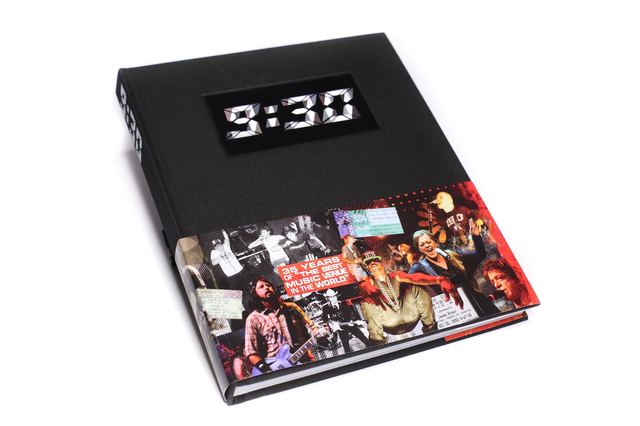
The 9:30 Club is celebrating its 35th birthday—and its 20th year on V Street—with a stunning book that chronicles a storied history. Taken from the club’s slogan, the title conveys the sensory experience of being transfixed by a show at the D.C. landmark.
The pages of 9:30: A Time And A Place are a testament to that legendary status, and are obviously a trove for anyone who loves the venue. But rich with photos, interviews, short essays by musicians and journalists, article clippings, ticket stubs, flyers, memos, and other archived documents, 9:30 would fascinate any Washingtonian.
It’s a visual trip. Opening up 9:30 feels like you’re sifting through the 9:30 Club’s attic, with a design that emanates energy and fun bits and pieces to read throughout.
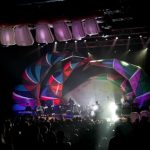
All accounts point to this week’s World’s Fair exhibition being similarly enchanting. The club will be transformed into a multimedia funhouse that serves as interactive tour of the its past and present (tickets are free but limited).
Author/curator/self-proclaimed “nerd for D.C. ’80s history” Roger Gastman compiled the 9:30 book, and spoke with DCist about its conception and design process.
Gastman had a special interest in this particular project: He grew up right outside D.C. in Bethesda, Md., graduating from Bethesda-Chevy Chase High School in 1996. He started going to the 9:30 Club in middle school to see punk and hard rock bands.
While the 9:30 Club was D.C.’s hotspot for those genres at the time, it was a gathering place for many different scenes, Gastman said. The club has always been all-ages, enforcing the notion that music is for everyone. Playing there soon became a status symbol for bands, and the “place [for them] to be in D.C.”
To “capture the history of the club, and the acts and people who made it what it is,” Gastman and a team of researchers interviewed hundreds of people.
The book explores the first years of the club when it was owned by Dody DiSanto and Jon Bowers and located in the Atlantic Building at 930 F Street NW (now home to a J.Crew and Anthropologie). The space held 199 people and had quirky features like a 106-foot long hallway, poles that obstructed views of the stage, and a unique smell determined to be “a combination of nicotine, beer, sweat, and rat piss.” Each relic of the old club is commemorated affectionately in 9:30.
Early performers included the likes of Billy Idol, Social Distortion, Nirvana, Cyndi Lauper, David Bowie, and R.E.M. (who, we learn in the book, won the right to keep their name after out-performing another band called R.E.M. at the 9:30 Club).
The venue also introduced and inspired new bands before they made it big. Dave Grohl was a teenager in Virginia in the ’80s and a frequent 9:30 Club attendee. “I honestly think that the difference between Los Angeles and Washington, D.C. is that the Washington, D.C. community—I don’t think anyone felt like the world was listening. It felt like this was ours, and that was enough,” Grohl said in 9:30.
In 1986, 9:30 was bought by I.M.P. concert producers Seth Hurwitz and Richard Heinecke. Under mounting pressure from the new Black Cat venue that held 600 people, the 9:30 Club moved to what is now its 1,200-person capacity location on V Street in 1995.
The book describes the new club’s attributes, such as an extra hospitable backstage and a retractable stage that gives a packed-crowd feeling for both big and small shows. And to mark the new era, the 9:30 logo underwent its first and only makeover: the right slant of the digits was shifted left (“in a new direction”). The Smashing Pumpkins christened the venue with a two-night performance.
Gastman learned a lot while working on 9:30, but “the biggest surprise in doing the research for this sprawling history you now hold in your hands,” he wrote in the book’s introductory note, “was how 9:30 has had to deal with countless hurdles and risks along the way. And they made it here by sticking to their guns, backing their staff, and outworking anybody who opposed them.”
It took a little over a year to complete 9:30, and while it helped that Gastman often knew the people in the photos he uncovered, and “who to talk with to get the right story quickly,” he told DCist that the book’s creators weeded through a ton of material to create a narrative that made sense.
“I really like digging through people’s stuff,” Gastman explained, “go dig up old flyers, old photos, and you never know what you’ll find when you do it, for the project or for your own curiosity.” And with everything they found, “it could have been a thousand-page book just on the F Street venue,” Gastman added.
The 256 pages of 9:30 do the 9:30 Club justice and show how much the venue has meant to those in and around it. Personally, Gastman hopes readers come away from the book knowing that “the 9:30 Club has continued to respect its city, foster talent, and bring back the classics. It’s reached beyond D.C.”
9:30: A Time And A Place is on sale for $39.95 starting January 5th at the five-day 9:30 World’s Fair anniversary exhibition. It can also be ordered online.