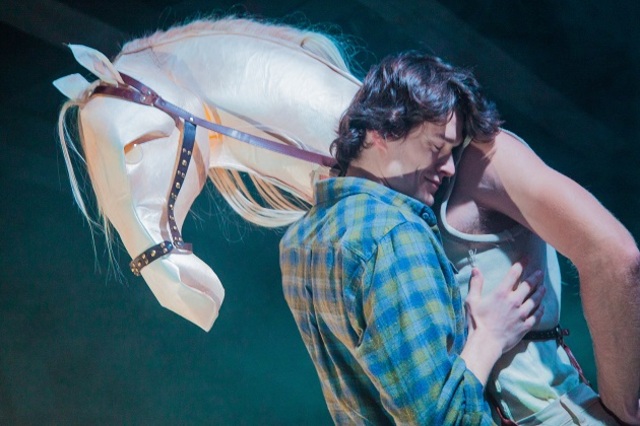
 Ross Destiche and Ryan Tumulty. Photo: DJ Corey Photography
By DCist Contributor Mark Lieberman
For casual theatergoers, the name Equus might be synonymous with Harry Potter. Daniel Radcliffe famously stepped away from his persona as the living embodiment of The Boy Who Lived in 2007 to star in a West End production of Peter Shaffer’s 1973 play alongside his movie co-star Richard Griffiths, who played Vernon Dursley in the series. The production later migrated to Broadway, where it sparked a nationwide controversy over Radcliffe’s decision to graduate to the adult school of acting, complete with full nudity and eccentric explorations of equine obsession.
But setting aside associations with a child star with unexpected ambitions, Equus proves a captivating exploration of psychiatry and psychology. A spare production at the Constellation Theatre casts Radcliffe-lookalike Ross Destiche in the starring role as Alan Strang, a 17 year-old boy confined to psychiatric care after blinding six horses in one night in an apparent fit of rage.
The story follows Alan’s turmoil through the eyes of Dr. Martin Dysart, played with dexterity and compassion by Michael Kramer. Dysart has demons of his own, and working with Strang helps clarify them, even as the pair retreat deeper into Strang’s mind to untangle the unusual shapes into which it’s twisted. By the end, the question is not what’s wrong with Alan, but what it means for something to be wrong, and whether any wrong can or should be made right.
The Constellation production, directed by Amber McGinnis Jackson, approaches the story with nearly universal minimalism. The set is bare, aside from a bench and a few wall adornments. Ensemble members wearing horse masks high above their own visible faces clip-clop around the stage in upright posture. Aside from some light stage mist and an insistent chirping noise to signal scene transitions, special effects are kept to a minimum.
But the staging is deceptively simple, hiding its sophistication in small details. At times, several locations and timelines appear onstage simultaneously—Dysart narrates one of his encounters with Alan to a friend on one part of the stage, and the encounter itself plays out a few feet away. The actors occasionally occupy two different planes simultaneously, commenting on the action they’re describing as they also participate in it. That the story is consistently clear despite these tricky narrative high-wire acts is a testament to the sturdiness and precision of the direction.
The performers realize the show’s carefully orchestrated vision with charisma and grace. Kramer is onstage for nearly all of the show’s two-and-a-half-hour runtime, but he never seems to break a sweat or deplete his energy, equal parts compassionate and weary, ambitious and deflated. Apart from his uncanny resemblance to the onscreen Boy Who Lived, Destiche renders Alan’s inner and outer turmoil with gravitas and handles the potentially treacherous nude scene without visible discomfort. The supporting cast is full of gems, including a wrenching turn from Laureen E. Smith as Alan’s mother Dora, and agreeably droll gruffness from Michael Tolyado as her husband Frank.
Any defects in the play’s effect can be traced back to weaknesses in the ambitious script. Emily Kester does fine work with the underwritten role of Alan’s brief girlfriend Jill Mason, but the character pales next to the three-dimensional figures at the show’s center. Shaffer’s decision to tell the story through Dysart’s eyes has the effect of sidelining the ostensible main character for the first half of the play, as the doctor tells the audience what to think about him without an opportunity for viewers to decide for themselves first. The play’s sexual allusions and climactic nude scene occasionally seem at odds with the studious tone, even as they add an extra layer of intrigue and provocation.
But Constellation’s Equus captures the essence of its source material, presenting a story that contemplates the nature of faith, investigates the purpose of therapy and asserts the importance of empathy. It even manages to sneak a few laughs in, thanks to self-aware dialogue and wry delivery, beginning with a “horsepower” pun so obvious it inspires both a groan and a giggle.
To observers on the outside looking in, Alan is crazy, untethered from the reality that everyone else has constructed for themselves and believe to be paramount. To the characters who seek to understand him, and to the audience, Alan is a young man shaped by his upbringing and struck by unique passions. The same dichotomy seems to exist in the perception of Equus. To outside observers, the play sounds strange, avant-garde, risque. But it’s far more sensitive, thoughtful and thematically rich than it appears. Just as Dysart has to stop himself from judgment based on appearance, so too does the viewer.
Equus runs through February 14 at Constellation Theatre Company. Tickets, $20-45, are available online.