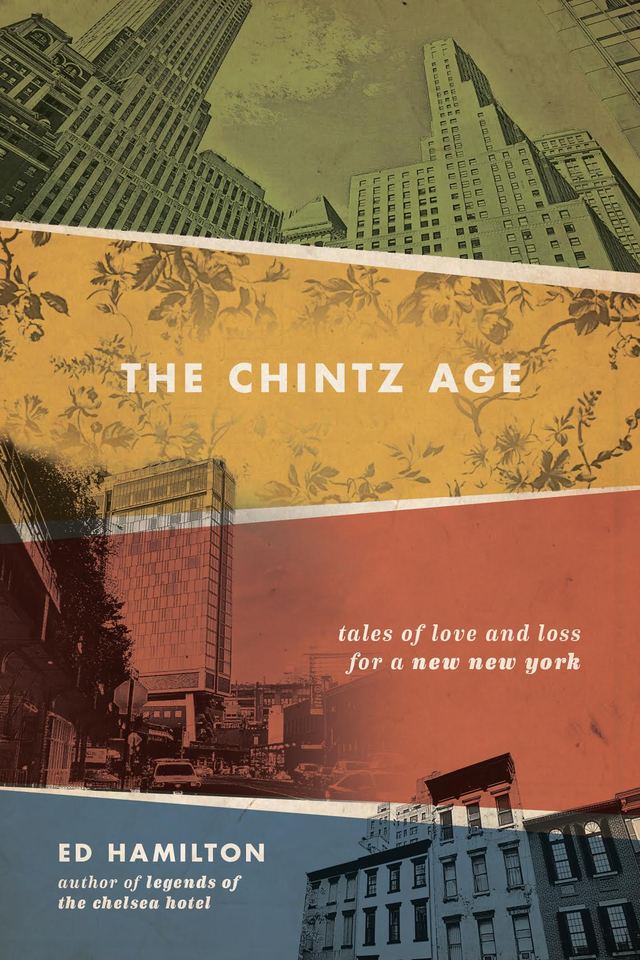
 Nostalgia isn’t what it used to be, and neither are the American cities once vibrant with art and artists. On Thursday, Ed Hamilton will read from his new book, The Chintz Age: Tales of Love and Loss for a New New York (Cervena Barva, $18) at 7 p.m. at Upshur Street Books. Through seven stories and a novella about characters in New York City, The Chintz Age explores how gentrification and capitalism affect city dwellers.
The title is supposed to be a bit cryptic, the author told DCist. Chintz is both an old-timey fabric and synonym for cheap, so it asks readers to consider where our society is headed. “Cars and toasters are made out of plastic now,” Hamilton says, and we “have planned obsolescence in many consumer products. Beautiful buildings are demolished so that cookie-cutter glass-and-steel towers can be thrown up as cheaply as possible.”
It was one of those beautiful old buildings that inspired The Chintz Age: Hamilton’s home. For 20 years, Hamilton has lived in New York’s Chelsea Hotel, which was taken over by developers in 2007. At least 70 residents were evicted, 125-year old moldings and fixtures were torn out, and original rooms (where people like Thomas Wolfe, Arthur Miller, and Bob Dylan worked) were gutted. Hamilton describes it as “an unprecedented act of vandalism, even in a city in which the same thing is happening in hundreds of buildings in all five boroughs.”
But the human toll is even worse, he says. “Working people, including people in the arts, are being forced out as the city is remade solely for short-term profit, and with absolutely no thought for the long-term consequences for society.”
Each story in The Chintz Age addresses different consequences of this “bizarre experiment in social engineering.” Instead of focusing on one character’s voice per story, Hamilton shares multiple, alternating perspectives, giving the stories a well-rounded feel. The characters, deep and empathetic, are struggling to stay relevant while feeling nostalgic for yesteryear. But some are able to turn the changing times into opportunities for personal growth and self-awareness.
That doesn’t excuse the developers, though, who think they are creating a “glittering new city on the ruins of the old,” in Hamilton’s opinion. But he says “it’s not an all-or-nothing proposition: the city can be safer without being turned into a shopping mall or a police state.”
D.C. is in a similar predicament. Hamilton lived here in the 80s and early 90s. “There was a lot of talk then about ‘The Plan’ [of] moving African Americans out of the city so the upper middle class and rich white people could move in,” he recalls. At the time, he thought the talk was a bit paranoid (though he recognized his role in the process as “a writer and bookstore worker living in a brownstone on C Street NE in an otherwise mostly black neighborhood”).
From his vantage point now, Hamilton argues that D.C., like New York, has “entered a new phase of developer-funded and state-sponsored gentrification” that moves much faster than traditional market forces. He partly attributes this to an increase in LLC corporations that make real-estate “a vehicle for speculation, asset concealment, and money laundering” for investors.
Hamilton calls for government regulation of these entities, and sees some progress being made in certain states. Alternatively, another housing bust might cause some of them to go bankrupt, he says, possibly making room for artists and writers to move back.
Hamilton grew up in Louisville, Ky. and his fiction and non-fiction works have appeared in numerous publications. His first book was Legends of the Chelsea Hotel: Living with the Artists and Outlaws of New York’s Rebel Mecca (2007). He lives with his wife in New York City.
The event is free and open to the public.