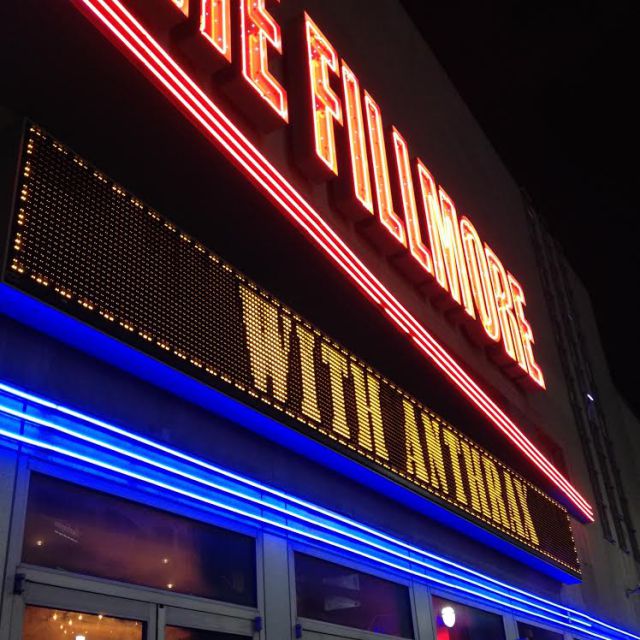
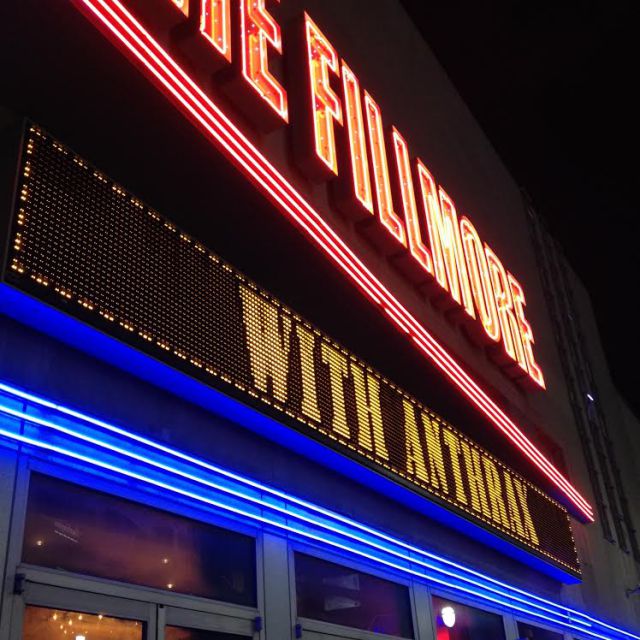
 The Fillmore Silver Spring’s marquis showing a performance by Anthrax earlier this month (Photo by Ethan McLeod)
On a chilly Sunday evening in January, the inside of The Fillmore Silver Spring is a musky flurry of crowd surfers, flying drinks, and bearded men shoving one another. Thrash metal legends Anthrax are playing to a sellout crowd before headliner Lamb of God, preceded by openers Power Trip and Deafheaven. The band is midway through their second song, their 1987 hit “Caught in a Mosh,” when a pit emerges in the middle of the room.
Frontman Joey Belladonna points in the direction of the circle. “Metal is alive, motherfuckers!” he shrieked at the end of the song.
The downtown Silver Spring venue has indeed helped to keep the metal experience alive
for D.C.-area hardcore fans since it opened in 2012. The square-shaped venue’s two-floor music hall fits up to 2,000 people combined, an ideal fit for shows where standing spectators and moshers share the space.
Metalheads are a specific breed of fan. Many come for, rather than despite, the aggressive crowds. “There’s an aura to it that just kind of pulls you in, makes you feel at home,” said Brian Johnson, 23, from Montgomery Village, Md. “It might even just be the smell of body odor, liquor, and pure testosterone.”
Management at The Fillmore are prepared for the rowdiness. “I love watching a metal crowd get into it,” said Todd Miller, vice president of talent and booking for entertainment company Live Nation, which operates The Fillmore. “People just lose their inhibitions. You can help them get away from whatever hassles they have in their lives, if even just for a couple of hours.”
The Fillmore hosts a variety of live music, including pop, hip-hop, and country, among others. However, many metal fans from the District and the Maryland and Virginia suburbs have come to depend on the venue to bring high-profile metal artists to town, particularly since last year’s closing of Empire, formerly known as Jaxx, in Springfield, VA, at the time the area’s sole metal-specialized venue.
“Any metal shows that come here, we come,” said Jerry Barrett, 45, sitting with his wife, Debbie, at the basement bar in The Fillmore at a November show featuring metalcore bands Falling in Reverse and Attila. Barrett, a professional bassist who toured nationally in 2015 with metal group Corrosion of Conformity Blind, brought his daughters from Herndon for the show.
“We wish there was more [live metal], but we live in the area we live in,” said Debbie over pounding double-bass and muted guitars from overhead. “Everyone goes to Baltimore. They do New York, Philly.“
“D.C. gets skipped by a lot of bands,” added Jerry. The area’s fanbase and local acts make up “more of an underground scene,” he says.
Miller, who has booked artists at venues in various regions, agrees that the District has a smaller hardcore appeal than other nearby cities like Baltimore and Philadelphia. “When I think across the country, D.C. doesn’t jump out to me as a metal place, necessarily,” he said.
One bright spot for D.C. metalheads seeking to catch high-intensity shows is The Pinch in Columbia Heights. The gastropub features numerous live local and touring hardcore bands each month at its “D.C. Metal Meltdown” events, among others.
Bigger venues such as the U Street neighborhood’s 9:30 Club and the Black Cat occasionally host well-known touring metal and punk groups, but generally feature a broad mix of electronic, rock, hip-hop, or indie artists.
Metal, a darker, oftentimes (though not always) musically technical subgenre of rock, has been a relatively minor chapter in D.C. local music history. Still, the District was home to a well-known hardcore punk scene for a number of years.
During an earlier punk wave in the late 1970s and early 1980s, bands such as Bad Brains and Minor Threat, along with other artists, helped drive the local hardcore movement, recalls Dante Ferrando, owner of the Black Cat on 14th Street. The sound diversified as a result of Revolution Summer and the rise of Fugazi and a multitude of other bands that came out of the Dischord Records label. According to Ferrando, this led to an indie rock scene in the early ’90s that shifted away from some of the earlier movement’s heavier sound.
Today, various factors, including ticket sales and production costs, make it difficult for clubs like the Black Cat to regularly showcase hardcore or metal bands. The 9:30 Club declined to be interviewed, stating that its staff did not have much to add to this topic.
Even with bigger names at The Fillmore, it’s not always a guarantee that shows will sell enough tickets, said Miller of Live Nation. “You have to have a pretty good sense that a lot of people are going to come,” he says. “It’s kind of rough if we only sell 300 tickets. It’s financially bad, it’s a bad experience for the artists and honestly it feels kind of lame for some of the fans.”
Logistically, well-known hardcore or metal artists seldom play in both Baltimore and the D.C. area because their markets are too close for most fans to pay to see them in both cities. “You don’t want larger acts to play both markets in a row because it’s going to cut the crowd in half,” Ferrando said.
And both Miller and Fernando argue that Baltimore’s comparatively stronger blue-collar vibe makes the city a more attractive metal and hardcore market.
Even 20 years ago, this demographic difference affected the development of both cities’ fanbases for heavier genres such as noise rock, Ferrando said. “For some reason, those bands always did better in Baltimore.”
And so it would be difficult to open a thriving metal-specialized venue today. “In D.C., you’re not going to be able to do a large or mid-sized metal club if it just does metal and have it survive,” said Ferrando.
With an existing void for such a venue, The Fillmore remains a bright spot for D.C.-area hardcore fans. “This place just seems to keep rolling,” said Barrett back at the club’s basement bar in November.