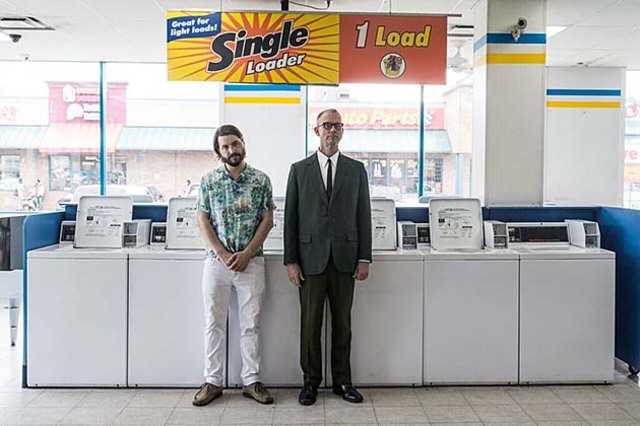
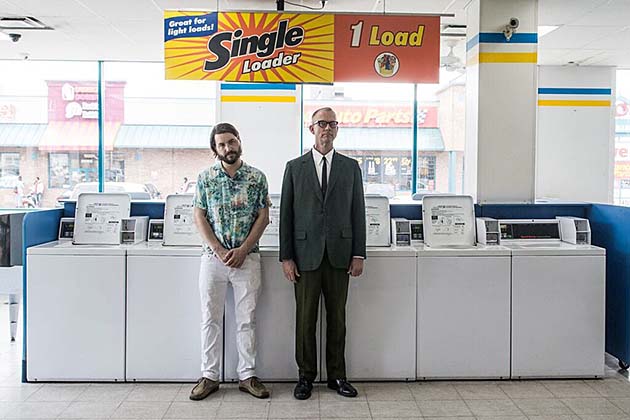
 Drew Daniel and Martin Schmidt (Josh Sisk)
Drew Daniel and Martin Schmidt have been making music for more than 20 years as Matmos, named for a lake of slime in the movie Barbarella. Originally from San Francisco, the duo relocated to Baltimore in 2007. Matmos makes electronic music from unusual sources, but none may be more unusual or more ordinary than their latest album. Last week I spoke to Matmos about the new album Ultimate Care II, whose sounds are completely sourced from the band’s washing machine.
I called just as they were in middle of what Drew called “a double unboxing.” Martin clarified, “We’re unboxing a piping hot pizza and our new album at exactly the same time. It’s real serendipity. I just spilled the download code onto some greasy pepperoni.” It was apt timing, as laundry is kind of a perennial boxing and reboxing.
DCist: You’ve used sounds of hair clippings and cosmetic surgery in your music. Is there anything you’d refuse to make music out of for aesthetic, or moral reasons?
Drew: We had a friend who was working in a mental hospital and he had some surreptitious recordings of schizophrenics, and he shared those with us and they’re amazing. But we felt it was ethically—to me that’s over the line.
Martin: On the other hand there was some amazing suffering going on there. Psychedelic, colorful…
Drew:…Beautiful, poetic! I mean, I love that art brut tradition but it does have some ethical problems.
DCist: The sound of laundry is so ordinary. Did it only just occur to you last year to make a record out of it, or is it something you’ve thought about before?
Martin: That may be the best way I’ve heard that question asked. In a way it sort of reveals my actual motivation to me. The washing machine is in the basement near our recording studio. And I think it was literally like, “Oh! Look, that’s awfully convenient!”
Drew: One of the trials of life when you’re a touring musician is how do you do your laundry. It becomes this onerous obstacle because you just don’t have an extra couple of hours in your day.
Martin: I wear a suit you know so I’m trying to be the opposite of Wretched Rock Boy. I try to be as clean and put together as possible, much more so than I am in my daily life at home.
Drew: So we’ve been thinking about laundry but not laundry qua music. And yet when Martin first proposed it as a possibility he had a kind of gleam in his eye. I wasn’t sure. At first I thought, “oh you’re kidding.” Then when it resurfaced it was clear you really wanted to do this.
Martin: And I’m kidding!
Drew: I think he never stopped kidding. It became apparent really quickly that there were a lot of musical possibilities. As soon as I started looping and layering and working with it, maybe because we’ve all spent hours listening to these patterns, it’s a song we already know.
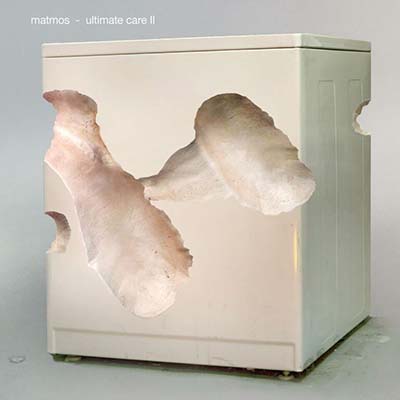 Martin: It certainly has struck a chord with people, like weird people who would not be interested in our music otherwise have responded. People Magazine wrote a thing about us.
Drew: Time magazine, Howard Stern. All these people that would not give a shit about Matmos in any other situation. I think it’s because everybody gets what laundry is and it’s not a laborious concept. When you say an album was made with a washing machine, you know what that is. I’m proud of Martin. We take turns being in charge of the record and this is more his baby than mine. I’m kind of jealous—I wish I’d thought of that. I guess I get to be in the band with him. That’s nice!
DCist: Really the laundry angle was what intrigued me. Did you experiment with different cycles, different fabrics?
Martin: Honestly the timbral difference between socks and sheets is very minimal. The difference between full and empty is big and we definitely did that. All over the record we use the sound of the machine stopping and then a very close mike on all of the little bubbles on the surface of the water popping.
Drew: It’s like a hissing or a crash cymbal.
Martin: It’s a very good replacement for a crash cymbal. That sound does not occur when it has laundry in it. That’s an empty sound.
Drew: We did some things that are beyond normal use. But we didn’t put weird objects in the washing machine
Martin: I didn’t want to wreck the washing machine. I wanted to make the whole thing out of the real washing machine. The thing that occurred to me to do what wouldn’t have hurt it was to fill it with ping pong balls or marbles.
Drew: But then you’d have the sound of marbles or ping pong balls, and that wouldn’t be true to the concept. That would have been a concession—it would have been saying, “Well, this washing machine was not enough.” To me the point of the record was to give everything to the washing machine—the washing machine gets to decide what the source is always. We even had a debate as to whether the discharge sink counts or not. I felt like it does. Martin says, “Well now, technically that’s a different thing.”
DCist: I can see both your points.
Drew: This is going to turn into couple’s therapy.
DCist: I appreciate your integrity in viewing the washing machine as a musician in a sense. But you still processed the sounds. Where do you draw the line with that?
Martin: It’s in a vague place where we still want it to sound like a washing machine a lot of the time. You could start with a washing machine and, with processing these days, you could make a record where there wasn’t a single goddam sound that sounds like a washing machine even though it was all sourced from a washing machine.
Drew: You could make fake polka music or fake heavy metal music out of the same batch of samples depending on how you processed it and what kind of form you wanted to give it. But what we wanted to do was to have rhythms and patterns that seemed to reference the normal operation of the machine but that would grow and crystallize into a song and then collapse back into the machine. So it’s kind of like somebody’s doing their laundry and they’re spacing out. It’s like seeing faces in the fire.
DCist: Is your washing machine talking to you?
Drew: Maybe. It’s especially in the way that the rinse cycles and the spin cycles seem to have an arc in them, and as the weight shifts and the water level drops, you have the sense of a continuous pattern that keeps evolving and keeps changing. I find it really fascinating that’ there’s so much funkiness to this machine. The machine is much funkier than we are. That’s one of the weird ironies about electronic music. It’s about stiffness or looseness and what’s the difference between Kraftwerk and Afrika Bambaatta. Where you feel that a rigid pattern actually has some kind of flex in it. What I like about the washing machine is that it’s both mechanical and liquid. Its volatile but it’s very much a programmed device.
DCist: That is kind of fascinating
Drew: Yeah! We’re going to try to close the loop here by taking our washing machine on stage. I really hope it works! We’ll see. God willing we’ll be rocking that washing machine right up there.
Ultimate Care II will be released by Thrill Jockey on February 19. Record release party will be February 20 at Floristree, 405 W Franklin St, Baltimore, MD
Watch “Ultimate Care II (Excerpt Three)”