 By DCist contributor Mark Lieberman
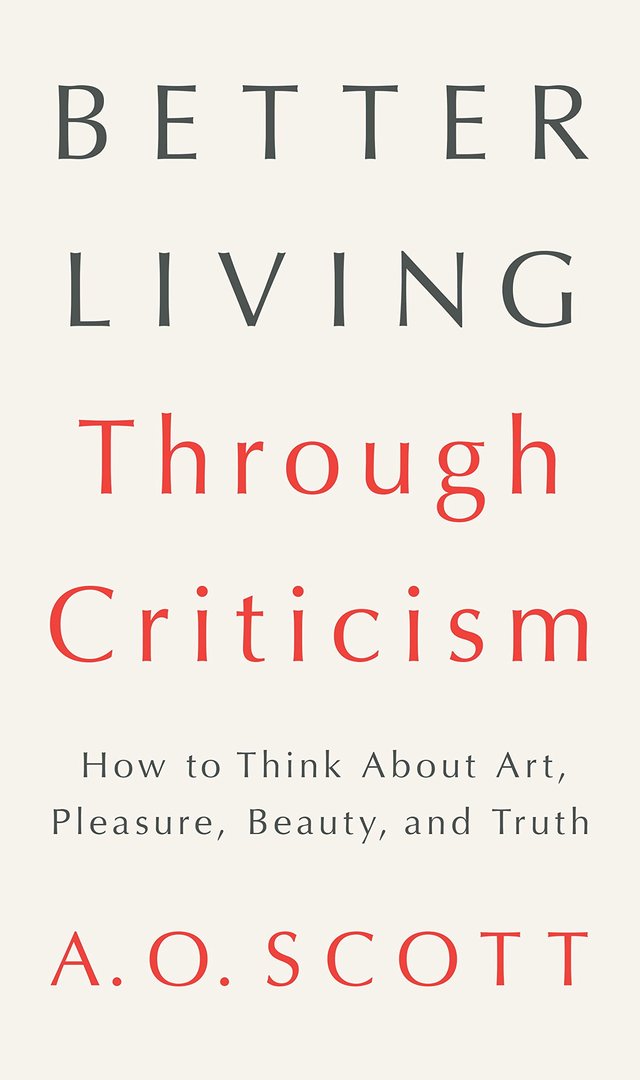
A.O. Scott’s new book Better Living Through Criticism: How to Think About Art, Pleasure, Beauty and Truth (Penguin, $28) begins with Disney’s superhero extravaganza The Avengers and ends with Disney-Pixar’s animated food-fest Ratatouille.
The reflections on the popular Mouse House movies bookend Scott’s rich, wide-ranging interrogation of criticism—what it is, who practices it, whether it’s worthwhile, and why it’s endured. The chief film critic for the New York Times will discuss the book at Politics & Prose on Thursday at 7 p.m.
Better Living Through Criticism assembles a vast range of cultural figures to assess criticism itself, in a manner that’s equal parts examination, defense, and critique. While putting his own profession under the microscope, Scott incorporates his experiences and skepticism about his weekly assignments at the Times, acknowledging his own biases. The book is likely to prompt existential musings in readers who have ever considered themselves to be critics, as well as those who dismiss critics as superfluous.
Before Scott dives into his analysis of criticism, he opens the book with a dialogue between himself and … himself, reimagined as a skeptic struggling to understand why this book exists and what Scott hopes to accomplish by writing it. These dialogues welcome the reader into the book’s discussion, which favors argument and evidence over concrete answers. They also help ground Scott’s increasingly dense literary analysis, flecked with detours into history and sociology, into the present day.
The first dialogue credits the idea for the book to none other than Samuel L. Jackson. The actor unleashed a memorable Twitter tirade against Scott on the weekend of The Avengers‘ release right after Scott panned the film in his Times review. Jackson, who makes a cameo in the movie, called for Scott’s firing and questioned the purpose of film criticism, which Jackson said only punctures audience enthusiasm.
As Scott recounts it, his first reaction was to bristle at Jackson with indignation. But the more he pondered the incident, which had begun to catch attention from film blogs, the more he realized it could inspire a teachable moment. From there, Scott gathered all of the theories he had amassed about criticism over his two decades practicing it, and set to work on research.
It’s clear that Scott did his homework in Better Living Through Criticism. Everyone from 18th century scholar Samuel Johnson to legendary New Yorker film critic pioneer Pauline Kael pops up. Scott spends the first half of the book struggling to define the purpose of criticism and the second speculating on its future, with one chapter about ideal best practices for the medium and another declaring it its own art form that must exist in tandem with the works it covers. Follow-up dialogues, like the one that opens the book, appear again to mark the book’s midway point and its reflective conclusion.
Anyone who’s ever read an A.O. Scott movie review will be delighted to find that his wry, vivid intellectualism and sturdy prose are also present in book form. The self-deprecating faux dialogues let Scott indulge in his penchant for humor, while nearly every chapter ends on a thoughtful and concise closing statement.
It’s an exceedingly strange task to review a book that so explicitly discusses and questions the value of reviewing things, whether they’re meticulously crafted works of art or scraped-together late-night meals. Perhaps Scott will address this conundrum, and the many others the book inspires, at Politics & Prose this Thursday. Until then, the author has pulled off a neat trick, having written a book that challenges the very practices discussed within its pages.
The event is free and open to the public.