 Rachel Sadon
 Photo by John J Young
The District has made a concerted effort to clean up the Anacostia, but it just isn’t safe enough yet to be eating certain fish swimming within the city boundaries—ditto for the waters of Potomac River. Specifically, the D.C. Department of Energy and Environment warns against eating American eel, carp, and striped bass (otherwise known as rockfish or striper) caught in District waters.
In its 2016 Fish Consumption Advisory, the agency also gave guidance on how frequently it is safe to eat other fish species caught in local waterways, including sunfish, blue catfish, northern snakehead, white perch, largemouth bass, brown bullhead catfish, and channel catfish.
Despite previous dire warnings, a number of people still consume fish from the two rivers for a variety of reasons—poverty and lack of awareness about the dangers, among others. DDOE explains:
“PCBs or polychlorinated biphenyls are man-made organic compounds that can build-up and last for long periods (approximately 8 to 15 years from time of exposure) in fatty tissue and in the environment. They were most often used in electrical equipment in the 1950’s – 1970’s. PCBs are no longer produced, but are still present in the environment.
Long-term exposure to PCBs may increase the risk of cancer. Some studies in humans have also suggested that PCB exposure may cause adverse developmental effects in children and developing fetuses. Infants and children are particularly sensitive to the effects of PCBs since their nervous systems are still developing. PCBs also build up in women’s bodies and are often passed on in the mother’s milk.”
Since 1980, when D.C. first began monitoring containment levels, there has been improvement in certain species, and correspondingly, the city has lifted some of its warnings. At one point, the department advised against eating catfish entirely, but they now say it is safe in limited amounts. And since the first advisory was issued more than 20 years ago, the amount of locally caught sunfish and largemouth bass that is considered safe to consume has doubled.
“The decrease in our resident fish species’ chemical contaminant concentrations is encouraging,” said DOEE Director Tommy Wells. “But, there is still more work to be done and we must continue our ongoing efforts to improve the health of our waterways.”
For those who do eat fish from the Potomac and Anacostia rivers, the city advises that cooks trim away fat and broil or grill the fish to allow remaining fat to drip off.
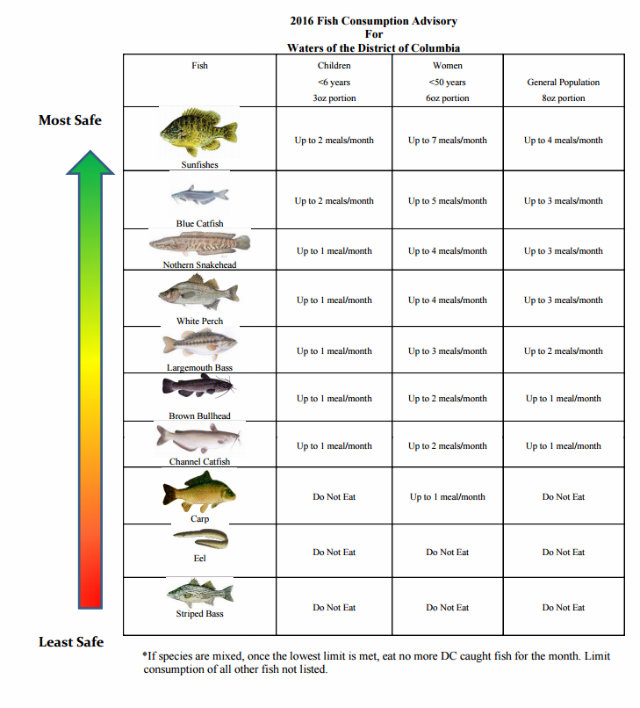 Courtesy of DDOE