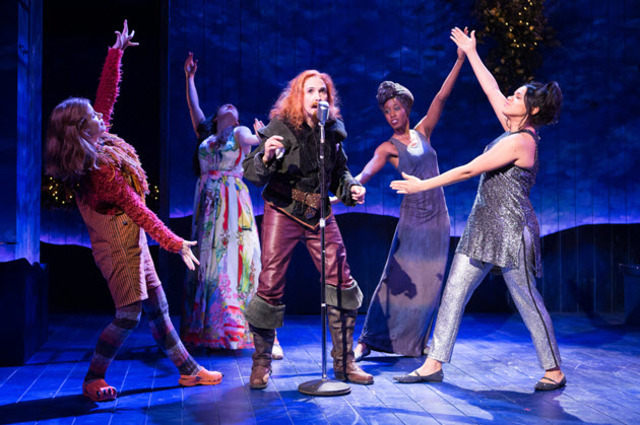
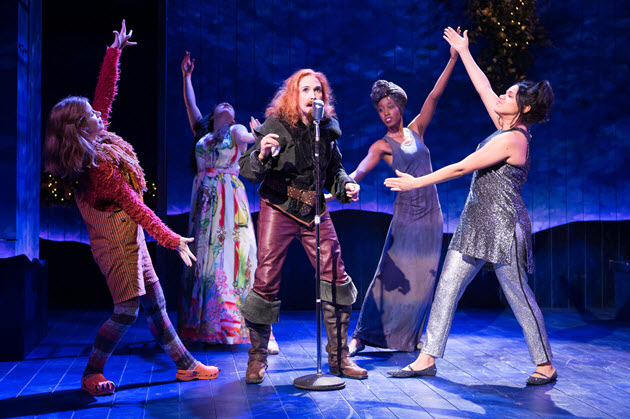
 Holly Twyford as Bottom the Weaver as Pyramus, supported by the Rude Mechanicals (Megan Graves, Dani Stoller, Monique Robinson, Justina Adorno). Photo: Teresa Wood
Intermission at Folger Theatre’s winsome, whip-smart A Midsummer Night’s Dream comes when you’d least expect it: The house lights rise after the plot has been resolved, the handsome young couples properly paired up, all fairy mischief (intentional or otherwise) resolved. The fifth and final act is all that remains to be seen, a (heretofore unrelated) subplot about clumsy craftsmen planning a play—the only action not yet resolved.
It’s a testament to how thoroughly entertaining this production is that four acts without a break to stand and stretch fly by like no time at all. The most action-packed of Shakespeare’s plays—and the script for Midsummer is by no measure a contender for that title—can get bogged down by, say, a single actor failing to find a way to make Shakespeare’s almost foreign-sounding English understandable to a modern audience. Director Aaron Posner uses almost every tool in his bag of tricks to make this play not just zip along, but crackle with energy and wit.
Among those tricks is a cast stacked with some favorite co-collaborators: Eric Hissom as a playful Oberon; Posner’s wife, Erin Weaver, as a taut and unusually tragic Puck; Adam Wesley Brown (from last season’s previous Posner/Folger show, Rosencrantz and Guildenstern are Dead) as a Lysander who is so sweetly loveable that its hard to fault him even when he’s (unwittingly) breaking his true love’s heart. Posner also employs his penchant for prestidigitation, as most of the fairy mischief is realized with stage magic and sleight of hand.
If Posner is known for anything, it is his uncanny ability to write and create acclaimed, loving remixes of older works (two from Chekhov, and another one, District Merchants, from Shakespeare, set to premiere at Folger later this season). He’s just as deft in creating a production with thoroughly contemporary aesthetics and comedy, though, working in the original text. All of Shakespeare’s barbs are still here—an exchange between romantic rivals Hermia (Betsy Mugavero) and Helena (Kim Wong) where they insult each other’s heights, for instance, can draw a laugh in any production—but Posner’s version layers on many, many new laughs.
The “rude mechanicals,” the Athenian actors crafting an awkward proto-Romeo and Juliet play to perform for the noble, in particular feel newly fresh and funny. They are re-imagined as a high school drama team with vivid personalities recognizable to anyone who interacted with school dramatics, including the quiet, mousy kid miscast as a fierce lion (Megan Graves as an almost-silent Snug) and the deep-voiced girl who would really rather be cast as a man (Dani Stoller as a Jersey-twanged Flute). But Bottom, the self-aggrandizing scenery chewer, could not be better realized than as a falsely modest drama teacher who lives and breathes for The Theatre (Holly Twyford, who very nearly steals the show, which is no small feat with such a vibrant cast). When things are at their worst, and Bottom has been transformed into an ass, abandoned by her friends and left alone in the woods, of course she comforts herself with a musical. She sings herself a braying, shaky rendition of “No One is Alone” from Into the Woods.
Such contemporary musical beats pepper the rest of the show (another choice example: hapless Helena enters for the first time mournfully crooning Adele), including a Broadway-style, ensemble song designed to end the play on a high note and fill out the rest of the fifth act or justify the late intermission. It’s the one moment in the play that rings false—especially here, as Puck’s character arc of unrequited love for her master, Oberon, ends tragically unresolved as the rest of the lovers celebrate their (real or fairy-induced) relationships. But of course, sandwiched into this finale is Puck’s famous ending monologue, which asks the audience to pretend they’ve just had a bad dream if they didn’t enjoy the play. The advice isn’t needed; this Midsummer is a sweet dream indeed.
A Midsummer Night’s Dream plays at Folger Theatre through March 13. Tickets, $35-75, are available online