 (Music Box Films)
One of this year’s Oscar nominees for Best Picture is Spotlight, a drama that follows the Boston Globe’s investigation into the sexual crimes committed and perpetuated by members of the Catholic Church. Directed by Tom McCarthy from a script by McCarthy and Josh Singer, Spotlight tackles a painful subject head-on, at the risk of alienating viewers who continue to align themselves with the Church despite its various misdeeds.
Chilean director Pablo Larrain’s The Club picks up where Spotlight left off, focusing not on the people who exposed the Church’s crimes, but on a handful of people who actually committed them. The movie’s 97 minutes are confined to a seaside Chilean town and the beach house occupied by four priests and Mother Monica (Antonia Zegers, outstanding in a role that requires both grit and warmth), the former nun who takes care of them. But the story’s thematic reach is global, thanks to the arrival of a Vatican representative (Marcelo Alonso) tasked with determining whether the men’s imprisonment has been a proper punishment.
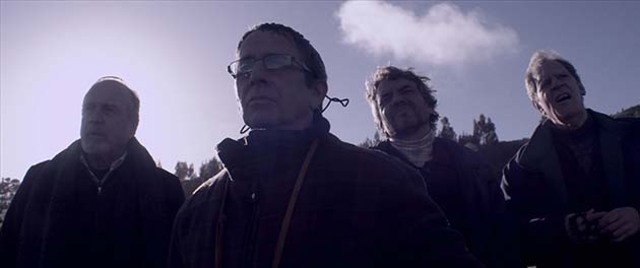
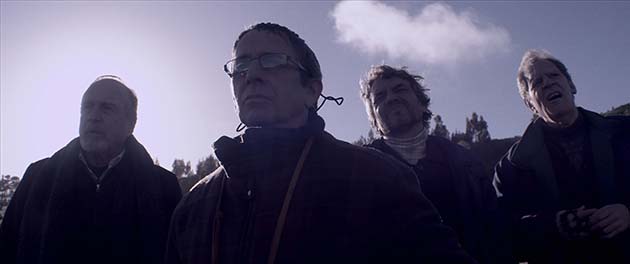
The silent opening minutes paint a deceptively quiet portrait of this sad group of men and their matronly caretaker. They spend much of their time training their sinewy dog Rayo, who competes for cash prizes at a local race — Mother Monica accompanies the dog while the men, banned from entering the town proper, observe with bated breath from a nearby hilltop. The group follows a rigorous schedule of meals, prayer, and song. They lead a quiet, lonely existence.
Despite this soft opening, largely conveyed through a minimal but insistent score, The Club doesn’t pull its punches. Before long, a new priest Father Lazcano (Jose Soza) arrives, seemingly amenable to being absorbed into the house’s routine. But Father Lazcano’s affect appears more troubled than the rest. When a drunken townsperson (Roberto Farias) wanders to the house claiming to be one of Lazcano’s victims, the priest’s anguish reaches an untenable peak. The surprising incident that follows jolts the movie into a new gear that the film never leaves.
What follows is an interrogation, of the characters and of the nature of guilt, shame, sexuality, and truth. The priest’s secrets slowly roll out, as do those of Mother Monica’s, who is hiding a troubled past of her own. None of the characters are redeemed by the end. If anything, they grow more despicable, not less. The question of whether the Church is responsible for making these men, or whether these men made themselves and the Church simply turned the other cheek, remains ambiguous. A thin layer of fog seems to hang over nearly every frame, throwing the characters and settings ever so slightly out of focus even when they address the camera directly.
Though the film largely shies away from visible gore, the dialogue is graphic at times, with vivid descriptions of molestation and other heinous crimes. Larrain, who also wrote the script with Guillermo Calderon and Daniel Villalobos, keeps the story grounded firmly in the present, with glimpses into the past detailed through dialogue only. That choice leaves objective facts up for debate, and calls into question the motivations and mental states of the characters. But the intended mental state of the viewer is clear: disgust, horror, confusion.
As a result, this movie is a tough sit, at times frustratingly so. But it also provides an on-the-ground perspective on issues Spotlight can only hint at. Its frustrating moments hold the audience and the characters alike at a painful, revealing remove. By showing these men interact with a world in which they will never belong, The Club meets a global issue with piercing specificity.
—
The Club
Written by Pablo Larrain, Guillermo Calderon and Daniel Villalobos; directed by Pablo Larrain
With Antonia Zegers, Roberto Farias, Jaime Vadell
In Spanish with English subtitles
Not rated
97 minutes
Opens today at Landmark E Street Cinema