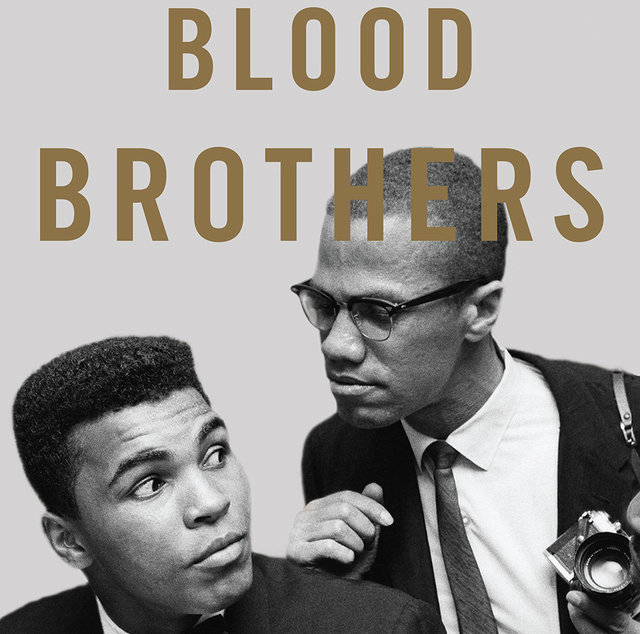
 Muhammad Ali was Cassius Clay before he met Malcolm X. Their friendship ended dramatically after less than two years, but Malcolm X’s recruitment of Ali into Islam would change the course of the two men’s lives and leave a permanent mark on the civil rights movement. History professors Randy Roberts and Johnny Smith tell the whole story in their new book Blood Brothers: The Fatal Friendship Between Muhammad Ali and Malcolm X (Basic Books, $29), and Roberts will be at Kramerbooks to discuss it on Tuesday, February 23 at 6:30 p.m. as part of a partnership with WAMU 88.5.
Blood Brothers uses redacted FBI reports, interview transcripts, and previously unseen documents to tell the gritty truth about what happened, without the “sanded down” images of Ali and Malcolm X that Roberts says we have today. As he told The Economist in an interview, “We’re not saying they’re not great people or didn’t do great things. But they didn’t know which way the wind was going… They were taking chances, making mistakes, and trying to get by with the best evidence they had at the time.”
As for how it all began: Ali, then Clay, expected Malcolm X to recognize him when they met at a Detroit rally in 1962. Clay was 20 years old and becoming famous for his boxing skills, and for what some might call a rather large ego—”the greatest” and “the prettiest fighter” were a couple of ways he referred to himself.
Malcolm X didn’t follow sports. But he was captivated by Clay’s “contagious … likeable, friendly, clean-cut, down-to-earth” quality, and knew the boxer could be useful for the causes he championed as a prominent figure in the Nation of Islam (NOI) religious movement, which has since been labeled as a black supremacist, antisemitic hate group by the Southern Poverty Law Center.
Malcolm became a mentor to the newly converted Ali, and the two men bonded over their similar family experiences and struggles with racism in America. Ali “adopted Malcolm’s rhetoric, mimicked his delivery, and copied his cool,” the authors write, and that, thanks to this, Ali “embraced the world stage, emerging as an international symbol of black pride and black independence. Without Malcolm, Muhammad Ali would have never become the ‘king of the world.'” They kept their friendship private to protect Ali’s career, with Malcolm in the background as Ali’s spiritual, political, and personal adviser.
By 1964, NOI felt increasingly threatened by Malcolm’s influence and criticism of NOI leader Elijah Muhammed (also a mentor to Louis Farrakhan), and Malcolm was soon excommunicated. Even though the activist minister basically knew he had signed his death wish, he converted to the less radical Sunni Islam, then started a new, rival Muslim organization and tried to get Ali to join.
Ali rejected Malcolm, calling him a “hoodlum” and “hypocrite,” which he would come to regret. The next year, NOI members assassinated Malcolm right before his speech to the Organization of Afro-American Unity in Manhattan.
Roberts teaches at Purdue University. He is interested in where politics, sports, and race converge, and Blood Brothers is an ultimate example of that. Roberts’s previous books include Rising Tide: Bear Bryant, Joe Namath, and Dixie’s Last Quarter (2013) and A Team for America: The Army-Navy Game That Rallied a Nation (2011).
The event is free and open to the public.