Rachel Kurzius
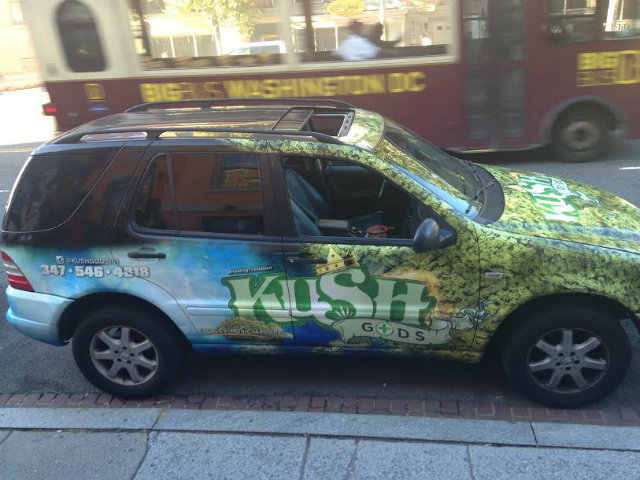 Photo by Rachel Kurzius.
One of the defendants in the Kush Gods marijuana distribution case pled guilty in court today—creating tension with her co-defendant, who wants to negotiate a plea that allows him to continue operating the business.
Assistant U.S. Attorney Richard Barker said in court that now-19 year-old Evonne Lidoff “was not the target of MPD’s investigation” into Kush Gods, though she served as a “go-between” on multiple occasions between undercover officers and business owner Nicholas Cunningham, 30.
Lidoff pled guilty to one misdemeanor charge of distribution of marijuana in a plea deal that involved the government agreeing to drop her second distribution of marijuana charge, not file any enhancements, or oppose probation. Judge Rhonda Reid Winston handed down a suspended sentence of 30 days in jail and six months of probation under the Youth Sentencing Act, meaning the charge could be removed from her record. She also needs to complete 20 hours of community service and pay a $50 fine. Lidoff cannot associate with the Kush Gods business or mobile app, nor can she be involved in distribution of marijuana in any form, regardless of payment.
“You came in here without a record,” Winston told her. “Nothing and nobody is worth your muddying up your record in this way.”
The charge stems from Cunningham and Lidoff’s arrest in December, when D.C. Police seized three luxury cars emblazoned with enlarged images of marijuana buds and the lettering “Kush Gods.” Since the summer, those cars offered marijuana edibles on some of D.C.’s busiest corridors.
 (Courtesy of MPD)
While Initiative 71, which legalized marijuana, does not allow for its sale, Cunningham attempted to skirt the rules by having a donation-based system. He told DCist back in October: “People understand the reality of the situation. Brownies are ten dollars.”
D.C. Police launched an undercover investigation into the business that same month. At the previous status hearing in January, Barker said that the government has 300 pages of written materials and 10 CDs-worth of video that build a case against Cunningham and his Kush Gods business.
As Winston read the government’s outlining of its case against Lidoff, Cunningham was visibly upset. He left the court room after she, her mother, and her lawyer did, saying, “Why did you lie in court?” The U.S. Marshall in court spoke to Cunningham, and he was not allowed to leave the court room again until after Lidoff was gone.
“I feel like her attorney took an easy way out, but I didn’t like the way it turned out at all,” Cunningham says. “She shouldn’t have been charged.”
Through her mother, Lidoff declined to comment.
Barker said in court that the government was “close” to reaching a plea with Cunningham as well.
Cunningham says that they’re “working on a plea deal that would let us stay in business. I kind of got ahead of myself in terms of the law, I admit.” Since launching his mobile app—which features music and apparel—shortly after the bust, he has talked about turning the Kush Gods business into a media empire. At the Capitol CannaShow, he talked about signing a model as well as music artist CyHi The Prynce.
Our new song with @CyhiThePrynce releases this Friday…stay tuned! #KushGods pic.twitter.com/Xn6b3t83be
— Kush Gods (@KushGods101) February 22, 2016
“We hope the lawful operation of Kush Gods will continue,” says Matthew Von Fricken, Cunningham’s lawyer. He would not let Cunningham answer whether he would consider keeping Kush Gods open, but end its distribution of edibles. Von Fricken later clarified in a phone conversation that Cunningham would be open to such an arrangement.
Already, his terms of release require that he cease and desist all distribution of marijuana in the District, irrespective of remuneration, and stop operating the mobile app.
The next status hearing will take place on March 21.