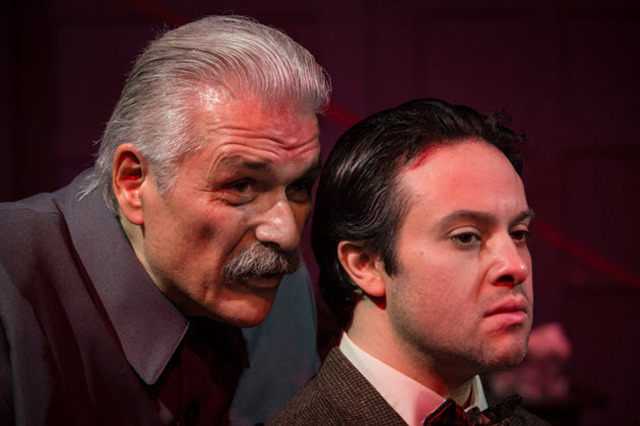
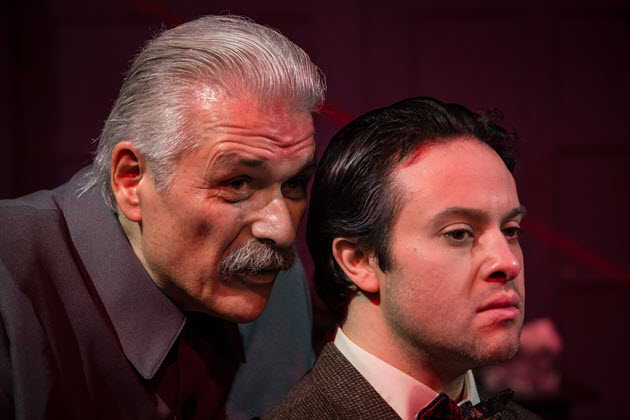
 We all have an angel and a demon on our shoulders; Bulgakov (Paul Reisman) has Joseph Stalin (Joe Duquette). Photo: Tony Hitchcock.
By DCist Contributor Allie Goldstein
When the phone rings on stage in Spooky Action Theater’s Collaborators, an audience member could just as easily answer it—that’s how close the viewers are to the viewed. If an onlooker had in fact reached for the receiver, they would have been no more shocked than novelist Mikhail Bulgakov to find Joseph Stalin, the source of the writer’s persistent nightmares, on the other end of the line. Set in 1938 Moscow in the midst of The Great Terror, the play is an at times heavy-handed examination of the entanglement of art and history, and the many moments when it is not quite clear which is shaping the other.
“Less drama, more life,” Bulgakov (Paul Reisman) tells wife Yelena (MacKenzie Beyer) after learning his kidneys will soon fail, and they proceed to turn on the gramophone and dance away their worry. But the writer’s statement later takes a dark turn against him when his clandestine encounters with Stalin (Joe Duquette) —Bulgakov has been commissioned to craft a rose-colored script of the despot’s early biography for his 60th birthday—become more about the terror ensuing on the streets than about the business of writing a play. But before long it is Stalin himself who sits behind the typewriter while the impotent playwright is given a new, unwanted power: forging Stalin’s initials to approve decisions that affect steel production, food shortages, and other high-stakes government affairs.
This at-first comical role swapping soon becomes ingrained, with Bulgakov and Stalin adopting each other’s lines. In Bulgakov’s case, his somewhat unbelievable parroting of the Kremlin’s justifications for brutal decisions make him puppet and Stalin ventriloquist. However, when Stalin repeats Bulgakov’s advice that “the individuals don’t matter” when sussing out dissenters, it’s a very intentional twisting of his words—as if the kill quota of NKVC Order 004477, a real document that led to the Great Purge, were the writer’s idea.
Collaborators has some rather slapstick moments—a cat-and-mouse chase between Stalin and Bulgakov, a doctor’s fantasizing about a buxom actress —but all of the laughs echo against the backdrop of The Great Terror, a time in which neighbors go missing, “brain guts cleaner” is a plausible profession, and art is worse than censored.
Director Richard Henrich’s interpretation skillfully holds the era’s realities of humor and horror in the same palm, making the blurring of the two seem as obvious as it is jarring. Nimble performances by Matthew Marcus as Stalin’s flamboyant lover in the play-within-a-play, and Robert Bowen Smith as the soul-wrenched writer Grigory, add to the production’s humor and depth, respectively. G. Michael Harris is convincing as the outwardly menacing, inwardly insecure policeman Vladimir.
John Hodge’s script, which won Britain’s Laurence Olivier Award for best new play in 2012, is self-aware in its moments of absurdity, but the far-fetched can be stretched too far: indeed, the playwright’s rapport with Stalin comes a bit too easily to be believable, however affable the dictator comes across in the one-on-one scenes. Still, the play’s intimate setting, performed in the renovated auditorium of the Universalist National Memorial Church, contributes to this sense of getting up-close-and-personal, and seeing more nuance than expected. During a dinner party scene, even the whispered small talk is audible.
Giorgos Tsappas employs a simple set design that transitions easily from Bulgakov’s cramped apartment to his underground meeting spot, while leaving enough space for a few scrappy fight scenes. Sliding doors double as Stalin’s dramatic, smoky entrance and the “cupboard” that bohemian tenant Sergei (Ryan Carlo Dalusung) occupies. Red lines angling across the floor and walls are a subtle reminder that all aspects of life and art are circumscribed by the regime.
Though “distance” cannot be taken too literally, Collaborators is a well-chosen play to reflect Spooky Action Theater’s namesake. “Spooky action at a distance” was Albert Einstein’s phrase for describing the quantum mechanics theory of entanglement, when two particles spookily affect each other from afar. Applied to theater, spooky action is the entanglement of actors and audience; the “play” is ephemeral, existing only in the interaction. But for Hodge’s Stalin, the spooky action that matters is actually the entanglement between dictator and playwright as he uses theater to control minds. Though Stalin’s initialing of documents determines whether people eat or starve, he still covets the seat behind the typewriter as the most powerful of all.
Collaborators from Spooky Action Theater plays at the the Universalist National Memorial Church through March 6. Tickets are available online