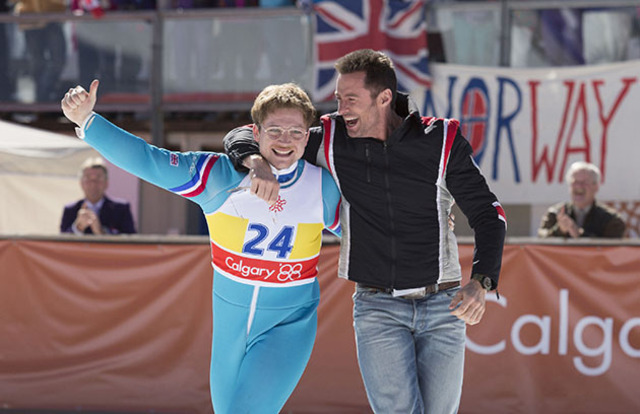
 Taron Egerton and Hugh Jackman (Larry Horricks/Twentieth Century Fox Film Corporation)
Imagine walking into a multiplex circa 1988 where your choices included an action flick, a rom-com, and a heartwarming sports movie about an underdog who beat the odds to triumph over adversity. The movie would have been shot on 35mm film and featured a synth-heavy soundtrack with bombastic synth drums and a training montage set to Hall and Oates.
That sports saga could have been Eddie the Eagle, a brand new crowd-pleaser that might well make you think you’ve gone through a time machine. This dramedy is about the struggle and success of Michael “Eddie” Edwards, who became the unlikely British ski jumper at the 1988 Winter Olympics in Calgary. I’ve seen it all before, but I didn’t mind seeing it again.
The movie opens with an unusual viewpoint from young Eddie (Tom Costello Jr.) circa 1977: it’s the blurred image of a watch. Eddie is holding his breath in the bathtub, and after learning he can hold his breath for a whole 58 seconds, he tells mum and dad (Jo Hartley and Keith Allen) that he’s off to the Olympics.
A montage depicts a pint-sized agony of repetitive defeat as the awkward, graceless Eddie tries and fails at one sport after another. When he becomes a young man (Taron Egerton), Eddie is still a graceless klutz. Egerton’s portrayal of this underdog at first comes off as mannered, all squints, curled lips, and myopia to emphasize his apparent lack of motor coordination skills. Yet he overcomes the obstacles of personal limitations and naysayers, and with the help of washed-up ski-jumper Bronson Peary (Hugh Jackman), Eddie fights to be part of the British ski team at the 1988 Winter Olympics in Calgary.
The script by Sean Macaulay and Simon Kelton makes Eddie more of an underdog than he really was. By 1984, the real Edwards was a good enough downhill skier that he almost made the cut for the Winter Olympics in Sarajevo, and he moved to Lake Placid after that to compete in North American tournaments. None of this is addressed in the movie, and Edwards was in fact taken aback when he learned that “only 10-15 percent“ of the script was truly based on his life.
Poetic license aside, Eddie is a heartwarming semi-fictional character, wrestling the human spirit of resilience and determination from the jaws of failure. Which is ultimately what the movie is about. Eddie’s coach Bronson (an entirely fictional character) was a talented young ski jumper who drank away his gifts despite the pleas of his (apparently fictional) coach Warren Sharp (Christopher Walken), so both Eddie and Bronson have something to prove.
The movie was shot digitally but has the look of 35mm film and the sound of the ‘80s. As much as training montages have become a cliché, setting one to “You Make My Dreams Come True” seems inspired not by irony but by wistful admiration. Think of the movie as 85-90 percent daydream. I laughed and I cried at Eddie the Eagle, and I’m willing to forgive it any number of things, even the inevitable use of a certain Van Halen song at a climactic moment. The movie is a serviceable, enjoyable impersonation of a 1988 crowdpleaser. I just wish it were a little more true to life.
—
Eddie the Eagle
Directed by Dexter Fletcher
Written by Sean Macaulay and Simon Kelton
With Taron Egerton, Hugh Jackman.Christopher Walken
105 minutes
Rated PG-13 for some suggestive material, partial nudity and smoking
Opens today at a multiplex near you.