 Rachel Sadon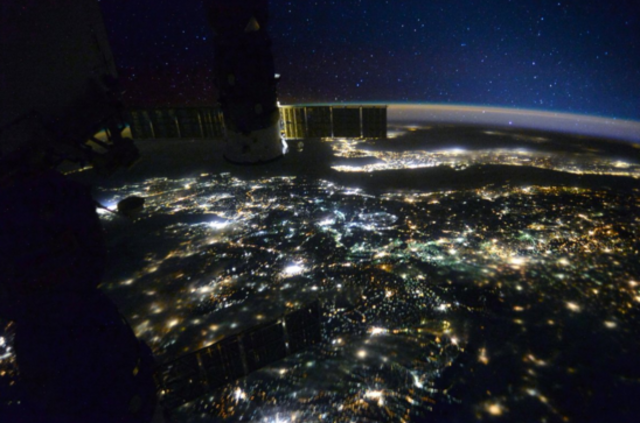
NASA astronaut Scott Kelly is coming home after a very long time away.
Having spent 340 days at the International Space Station, Kelly is coming home with two new records: the longest continuous mission and the most days in space period (combined with three other trips, he’s been in orbit for 540 days) for an American astronaut. The international records are held by Valeri Polyakov, who spent 437 days aboard the Mir space station, and Gennady Padalka, who spent a total of 879 days in space.
He’s shared the journey with Russian cosmonaut Mikhail Kornienko, who is also throttling home in just a few hours. They are due to land in Kahzakstan around 11:30 p.m. and NASA is streaming the journey live.
Here’s the schedule for tonight and tomorrow:
4:15 p.m.: Farewell and hatch closure coverage; hatch closure scheduled at 4:40 p.m.
7:45 p.m.: Undocking coverage; undocking scheduled at 8:05 p.m.
10:15 p.m.: Deorbit burn and landing coverage; deorbit burn scheduled at 10:32 p.m., with landing at 11:25 p.m. (10:25 a.m. on March 2, Kazakhstan time)
Wednesday, March 21:30 a.m.: Video file of hatch closure, undocking and landing activities
11:45 p.m.: Live coverage of Kelly’s Return to Houston (based on current landing and transportation plans). Second Lady of the United States Dr. Jill Biden, Assistant to the President for Science and Technology Dr. John P. Holdren, NASA Administrator Charles Bolden, and Kelly’s identical twin brother and former NASA astronaut Mark Kelly will be in Houston to welcome Kelly home.
Upon his return, scientists will study how such a lengthy time in space affected Kelly. They’ll be able to use his identical twin Mark (also an astronaut and the husband of former Congresswoman Gabrielle Giffords) as a control.
After nearly a year with very limited company, Scott Kelly got really good at social media. “I have taken a lot of pictures because I’ve been up here for a long time,” he said at a recent press conference. “I’ve definitely taken some good ones and some memorable ones.”
#Countdown We’re down to a wakeup. #Earth. I’m coming for you tomorrow! #GoodNight from @space_station! #YearInSpace pic.twitter.com/kLe2755XyG
— Scott Kelly (@StationCDRKelly) March 1, 2016
Day 288. Dream big. #GoodNight from @space_station! #YearInSpace pic.twitter.com/0c6dY32lhz
— Scott Kelly (@StationCDRKelly) January 10, 2016
More #Africa #EarthArt hues. #YearInSpace pic.twitter.com/SythDOBILo
— Scott Kelly (@StationCDRKelly) February 22, 2016
Day 329. One night over #Macedonia. #GoodNight from @space_station! #YearInSpace pic.twitter.com/uJHAXG1maK
— Scott Kelly (@StationCDRKelly) February 20, 2016
The daily morning dose of #aurora to help wake you up. #GoodMorning from @Space_Station! #YearInSpace pic.twitter.com/Ar6ScCbUPo
— Scott Kelly (@StationCDRKelly) October 7, 2015
While the photos helped give us Earth-bound humans a sense of the majesty of space (and our own planet), Kelly said he hopes the mission is remembered for its role in getting us to Mars one day.
“I’d like for the legacy of this flight to be that we can decide to do hard things, and hard things that will take us further away from the Earth,” he said. “I think we’ll learn a lot about longer duration space flight and how that will take us to Mars someday. I’d like to think that this is another of many stepping stones to us landing on Mars sometime in our future.”
And Kelly is willing to do the whole thing all over again. “I could go another hundred days, I could go another year if I had to.”
My last #sunrise from space. 3 of 5. #YearInSpace pic.twitter.com/uRZEFWVFMB
— Scott Kelly (@StationCDRKelly) March 1, 2016